Monday, 24 April 2006

"I woke up and sighed: the world was Marian"


Uta Ranke-Heinemann is a German theologian who is most famous for being the first woman to gain a chair in theology at the University of Essen, and the first to lose it after denying the virgin birth and was excommunicated in 1987. She is most famous in the English-speaking world for her wonderful book Eunuchs for the Kingdom of Heaven.
In an interview last year she talked about her admiration for Ratzinger's intelligence and compared it unfavourably with JPII. "The enormous difference between John Paul II and Ratzinger is intelligence. Ratzinger is more, much more, intelligent. Quite frankly, John Paul II was tedious without end. I couldn’t stand it any more. He was obsessed with Mary. “Mary, Mary, Mary,” he repeated over and over and over. I mean, I feel much for Mary myself, because she lost her son. But John Paul II said Mary was glad to see her son on the cross and that she would have put him there herself because it meant our salvation. I tell you, Ratzinger would not say such a stupid, horrible thing! No, he has much more taste than that. Ratzinger has much more of what the French call esprit de finesse. And John Paul II had none! ... At Munich, Ratzinger did his doctorate with professor Söhngen, and I did mine with professor Schmaus. This was in 1954—at the time of Pius XII’s dogma about Mary being received into heaven. Söhngen quoted Jerome who, around 400, said: “I woke up and sighed: the world was Arian.” (Arius was the great heretic who denied the divinity of Jesus.) And similarly, Söhngen said about Pius XII’s dogma, “I woke up and sighed: the world was Marian.” So, none of us, including Ratzinger, Söhngen’s main doctoral student, were excessive Marians." On the future of the Church she says: "I don’t see any future for a church in which all shepherds are men, and all women are sheep. How could that be a universal church? It’s a mutilated construct!...The church will continue as it always has. Ratzinger will not change 2,000 years of male domination. But perhaps he might make one tiny change for the better. He might permit the use of condoms in AIDS-ravaged Africa. Those women in Africa who are told by their priests that they will go to hell if they use condoms—well, those women are told they're the martyrs of this millennium!"

Sunday, 23 April 2006

Inside Man (2006), dir. Spike Lee


Clive Owen plays Dalton Russell, who explains to us in the opening shot that he has planned the perfect bank robbery. The film then proceeds to show the heist in progress, and the efforts of Det. Keith Frazier (Denzel Washington) to get the hostages being held in the bank out alive and getting the case wrapped up. When the four robbers seal off the bank and begin the robbery they make everyone take off their clothing and get into dark jumpsuits, white masks, and blindfolds; they are dressed just like the robbers. From here on it is very difficult to tell the good guys from the bad guys, and that is a key theme in the film. Russell isn't an evil criminal mastermind, he's got a point to make, and it isn't about holding hostages or hurting them, or about robbing millions of dollars from the bank. There is a funny scene where a little black kid is playing with a Sony PSP and explains to Dalton the object of the game (kill people, put grenades in their mouths, sell crack to them, rape people, the usual thing an 8-year-old should be playing, in sum). Dalton shakes his head and says he'll have to talk to his father about this game. He's disgusted with the violence. Along comes the super powerdressed Madeline White (Jodie Foster, rather gingerly sporting an Hermès Birkin bag), who has been hired by the bank's owner, Arthur Case (Christopher Plummer) to make sure something in a safe deposit box never sees the light of day. It becomes clear that what's in the box interests Dalton too, and he's not willing to part with it just yet. In a bank full of money, the most important thing is an envelope documenting the origin of Case's money, Nazi loot. Can they manage to escape? And do we care?

I think that's my main gripe with the film. We don't care enough about the heist because the motivation is never properly developed. It is undoubtedly worthy, but many questions remain unanswered, and the main one is 'Why does Dalton do it?'. Lee is making us work for it in the film, but in a way we do need certain assurances that are not forthcoming. The film left me oddly dissatisfied. The film is well made, assuredly directed, and the acting is all very solid. There are plenty of nice parallel scenes set up in the film: Frazier can't afford a diamond ring for his girlfriend, the only real piece of evidence left at the scene is a Cartier diamond ring. And with a Spike Lee film you expect some angry political angle. It is there but you have to dig a little for it. It is a very post-9/11 film in this sense. One of the bank clerks who is released is being told to kneel (the cops think he's booby trapped) and when he takes his mask off one of the police officers says 'Oh shit he's a fuckin Arab', meaning 'of course he's wired up to explode'. The man is a Sikh. But the friend of the Nazis Arthur Case is paralleled rather nicely with the shady Birkin-toting Madeline, who blackmails Case to go referee on a purchase deal of property on Fifth Avenue by the nephew of Osama Bin Ladin. The implication is clear: Al-Qaeda are the Nazis of today, and the people we describe as war criminals are the same people who today make money in bed with those who wish to destroy Western civilization; they are perfectly respectable, they are pillars of society, who do lots of worthy and laudable things for people in need. But in fifty years, when the atrocities have been raked over, they will be called war criminals too; and others will have stepped in to take their place. Case says, I saw a chance to make money and I took it; Madeline is just the same. There are many who should be uncomfortable with these sentiments.

Saturday, 22 April 2006

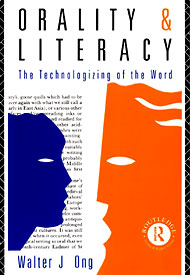
Walter J Ong, Orality and Literacy (Routledge, 1982)


Ong's Orality and Literacy is a classic of its kind. A kind of response to Marshall McLuhan ('The medium is the message' and all that) and an extended discussion of what Orality and Literacy actually means. The book also refers briefly to Derrida et al., but clearly isn't going to go into it. Ong is mainly interested in what he calls primary orality, meaning communities who have no contact with the written word whatsoever. Such communities must surely be hard to find now, and indeed in much of his discussion anything after oral Plato is not quite in this category of orality. Even the so-called primitive society (the kind of stuff Lévi-Strauss ran around looking for), I wonder if they really fit in. Is there really any such thing as primary orality?

His discussion of the changes in literacy and orality in the move between manuscript and print is interesting, though I do wonder a bit about his presentation of manuscript production, and the whole notion that manuscripts were so difficult to read printing really had to be invented. Well, they might look difficult to read by comparison to print, but when there's nothing else, then they are not difficult to read. They just are. Ok, there are cases where scribes copying abbreviations can make mistakes, but that does not mean they found them difficult, it means they are human and make mistakes. Books are often spotted with typos, which doesn't mean that books are hard to read. The restricted access to books in a manuscript culture is a complex phenomenon, and manuscripts cannot be 'blamed' for the fact that they don't look like printed books.

Tuesday, 11 April 2006

A.C. Spearing, Textual Subjectivity (OUP, 2005)


Anyone familiar with Spearing's recent work will, in a way, have seen this book being born. His article on the Man of Law's Tale (NLH 32 [2001], 715-46) in particular will show a fault line of the polemics of the book. Why do we need all these narrators in Chaucer's work? Spearing says that it's a notion that was developed with Kittredge and has stuck fast since; if we have a problem with a tale, we generally attribute it to the narrator. If, on the other hand, we like something in the tale then we attribute it to Chaucer. The proliferation of narrators is unnecessary according to Spearing. In an opening chapter, entitled 'Subjectivity and Textuality' he outlines how he has come to this view, mainly with recourse to Derrida. He uses Derrida's suspicion of Western phonocentrism and priviledging of the spoken word over the written word which has led to our multiplying narrators in the Tales: thus, we trust a narrator more because he is speaking, rather than allowing ourselves to trust the textuality of the poem.
There is an awful lot more I could say about this book. It is a good book, and I recommend it. I do, however, have some problems with it. For all his talk about textuality, his attention in the analysis of the Man of Law's Tale to its curious textual format in both the Hengwrt and Ellesmere manuscripts is too scant. The Tale is glossed in Hg and El, drawing material from Innocent III's De miseria condicionis humane, Ptolemy's Almagest, and Bernard Silvestris' Megacosmos. Robert Enzer Lewis has already demonstrated that these glosses are drawn from Chaucer's manuscript of the De miseria (see PMLA 81 [1966], 485-92 & SP 64 [1967], 1-16). OK. Now go somewhere with that. What's all this talk about textuality and then no talk about the manuscripts? He makes the point that Chaucer's texts are hugely self-conscious, and in a very physical way. This is true. He cites Cooper (Oxford Guide to Chaucer [2nd ed; 1996], p. 126) on the abundance of glosses supporting his claim that the Tale was seriously intended. Ok. Now what? On pp. 12-13 he cites Jeffrey Kittay ("Utterance Unmoored: The Changing Interpretation of the Act of Writing in the European Middle Ages", Language in Society, 17 [1988], 209-30) who highlights the changes in the format of manuscript pages, in particular word division, and biblical glossing where reference is made to numbered passages rather than cited passages (indicating readers flicked back and forth to texts); this is all to talk about a developing textual awareness and increasing sense of textuality. "The implications of this fact for the elements of commentary and self-glossing in medieval poetry are obviously important (see Rouse and Rouse 1982)". And that's it. What? The Statim invenire article is very important, but it's one and only one starting point of a huge point that shouldn't be left hanging like that. Reynolds, Stillinger, Minnis' new stuff (Magister amoris for example), everything Ralph Hanna has written [not cited BTW], and a whole shed load more are just screaming out after this full stop for attention. It is like he has made an excellent point but then has done nothing with it, and indeed the flatness of the subsequent reading of the MLT is a good case in point.

Final word: very stimulating book with some huge gaping holes.

Friday, 7 April 2006

Death & Resurrection: Aspects and Approaches, Lincoln College Oxford


Roll Up Roll Up! Yes, it's that time of year again. The Second Annual Oxford Graduate Medieval Conference will take place next week, Wednesday and Thursday, April 12th and 13th, 2006 on the theme of Death and Resurrection: Aspects and Approaches. The following papers will be delivered:
Christine Maddern (York): Early Medieval Name-Stones as Manuscript Pages; Richard Burian (Glasgow): Wyrd as Death?; Sarah Baccianti (Lausanne): Dead Man Talking, or When Dead Bodies Talk and Move in Grænlendinga saga and Eriks saga rauða; Beth Tovey (Somerville): Sexuality and Dying Bodies in Anglo-Saxon Literature; Alexander Ibarz (Sheffield): Ausiàs March (1400-1459): From Plague to Civil War; Darragh Greene (TCD): 'Let by your sorwful lyf, | For in your sorwe ther lyth no red': From Disorganization and Despair towards Reorganization in the Book of the Duchess; Anna Welch (Melbourne Coll. of Divinity): 'Sister Death': The Influence of St Francis' Attitude Towards Death and Resurrection on the Crucifixion Scene of the Codex Sancti Paschalis; Will Rossiter (Liverpool): Roma/Amor: Petrarchan Necromancy and Necrophilia; Marco Nievergelt (Lincoln): Allegorical Discernment and the Death of the Body: Deguileville's Pèlerinage de la vie humaine; Cecilia Hatt (St Hilda's): Goodbye Vienna: Learning to Die and Measure for Measure; Michael Funk Deckard (Leuven): Fear of Death and the Sublime in John Milton and Edmund Burke.
Professors Vincent Gillespie (LMH) and Eric Stanley (Pembroke) will open and close the conference, and chairs include Paul Strohm (Columbia), Mary Carruthers (Balliol/NYU), and Richard Rowley (Linacre).
And all this just before Easter!

Thursday, 6 April 2006

R. Howard Bloch, Etymologies and Athropologies (U. Chicago Press, 1983)


R. Howard Bloch's Etymologies and Genealogies is an exploration of medieval French literature on the crest of the wave of mainly French theoretical work in the two decades from the Sixties onwards. Derrida, Saussure, Lévi-Strauss, Barthes, de Certeau, are all names that loom large. Bloch takes a central theme and preoccupation in the French Middle Ages, that of lineage, and extends it to an examination of grammar and literature, to ideas of kinship, romance and lyric. And much more.

The book is very interesting and quite a challenging read, and is a good example of a heavy hitting theorist writing about the Middle Ages. I'm not sure whether he's made me rethink anything, but I did take the book seriously as I read it. So that's something. The prose is a little impenetrable at times and might have done with a little clarifying here and there. Anyway, most books of this kind are rubbish (frankly), but I don't think this one is.

Thursday, 30 March 2006

John McGahern


John McGahern passed away in the Mater Hospital in Dublin today.


manibus date lilia plenis

Read this

Wednesday, 22 March 2006

Arthur Miller, Resurrection Blues dir. Altman (The Old Vic, London)


Arthur Miller's penultimate play, Resurrection Blues, is having its European premiere at the Old Vic in London. The stars have been assembled (James Fox, Neve Campbell, Matthew Modine...) and Robert Altman directs. It's a recipe not only for a hit but also for some great theatre. And yet one is left with a curious feeling of having fallen victim to a huge hoax. This play is so awful that I cannot believe that a) Miller (whom I love) wrote it, b) Altman (whom I love) directed it, or c) that any of the actors have ever stood on stage before. The whole thing really is that bad. It's clear that Miller is angry (Corporate America blah blah blah) but the anger has been diffused throughout all the characters so that it becomes a malaise; the humour is so misguided that there are moments in the play when one would think a panto was being performed.
The military dictator/leader of an unnamed South American country has sold the rights to broadcast the execution (a crucifixion) of a revolutionary by an American media corporation. The broadcast's director has scruples about what's being done and try to persuade the dictator not to go through with it. Meanwhile, the dictator's brother has returned from study exile (he was a pharmaceutical mogul) to plead for this revolutionary's case. The people of this country begin to believe this revolutionary is God. So the play is about how people are oppressed, how they believe, how Corporate America doesn't understand such things and only understands money, how people need faith, and lots more.
In a way that's exactly the problem. There are far too many strands in the play for it to gel together. The cast is so lacklustre (I cannot remember one single line from the play) and the direction so flawed that I shall wait some time before I go back to the Old Vic. The whole thing is such a pity.

Saturday, 18 March 2006

Olivia Holmes, Assembling the Lyric Self (U Minnesota Press, 2000)


Olivia Holmes makes a powerful argument that some early French and Italian manuscripts display highly wrought self-conscious impulses to arrange and gather verse into authorial cycles, an impulse we more often associate with much later traditions, such as Dante's Vita Nova and more famously Petrarch's Rerum vulgarium fragmenta. In this she is largely successful, and makes for a very enjoyable read (I particularly enjoyed the chapter on Nicolò de' Rossi).

My criticism should not really detract from what has been achieved in the book. The novelty of Holmes' approach is that the texts under discussion do not come from critical editions but from manuscripts, which has the effect of creating a peculiar alterityabout some familiar texts. This is much to be praised. She discusses some rather well-known manuscripts, such as Modena, Biblioteca Estense e Universitaria α. R. 4. 4., and Chigiano L. VIII. 305, to name but two. The reason for a paucity of descriptive accounts of the manuscript's construction and planning is that these MSS have been described elsewhere, and indeed exist in facsimile (such as Chig. L. V. 176, Boccaccio's autograph no less). However, I feel that since she relies so heavily on the particularity of these examples, the best way to reinforce her observations is by making her reader very very aware of its physical format. We need to know things like collation, ink, parchment, scripts: has the manuscript been put together over a period of time or does it look like it was produced in one coherent block? What evidence is there of ownership? How many scribes worked on it? Do they look professional? How formal is the manuscript? What does its format suggest about the book's use? In sum, it is not enough just to cite from manuscripts, but you've got to give a voice to the physical manuscript itself to really appreciate all that manuscripts have to offer.

Tuesday, 14 March 2006

Sunday, 12 March 2006

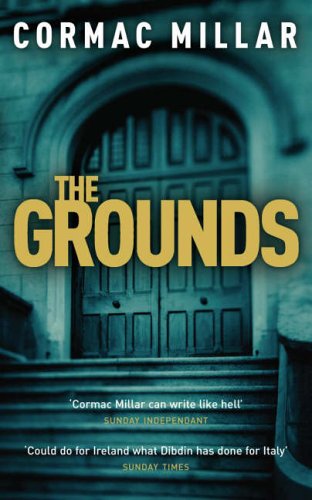
Cormac Millar, The Grounds (Penguin, 2006)


First of all, I feel it is only fair to say that I know Cormac Millar. He teaches Italian, as Cormac Ó Cuilleanáin, at Trinity College Dublin, where, for his sins, he taught me. He is a man of uncommon erudition, of intellectual humanism, and wicked generous wit. I say this because these are attributes that glitter and coruscate throughout The Grounds, his second novel. Millar has certainly raised his game from the first - very enjoyable - novel, An Irish Solution (Penguin, 2005), and the prose has levelled off at a cruising altitude that is both satisfying and challenging. The book just sparkles, it really does; this short review can not do justice to this complex and exciting work.

Séamus Joyce returns to his alma mater, King's College Dublin, to report back to an American university consortium on its suitability for investment. The academics, for a host of different reasons, all look on Joyce with suspicion and alarm. Things get sticky when the college president is found murdered and it looks like he himself is being framed for the delitto. What does it have to do with the painful and seemingly pointless changes being proposed for the venerable institution? And what has happened to a senior historian, whose research assistant's body was found washed up? Can all these deaths be related? But how? We meet a host of academic types who all expend vast energy sniping at each other in a wildy enjoyable manner. There is a property developer who has virtually bought the campus and is busily building apartments everywhere, and there is Séamus's ex-girlfriend, now a junior academic at King's, who is behaving oddly and doesn't have a permanent job! All is not as it appears, even at second glance, at King's College.

Cormac Millar's mother was the distinguished Irish writer Eilís Dillon, and the mise-en-scène of The Grounds is drawn from her 1956 novel Death in the Quadrangle (Faber). As such we are dealing with no ordinary crime novel, but rather a complex, intertextual and extratextual, literary work. This dimension only adds to the internal literary complexity of the book. And of course while the author assures us in a note at the end of the novel that this is not a roman à clef, one cannot resist wondering just how resonant it is with current business plans to keep Trinity College floating with its head just above water. Humanism does not fit well into business plans, it doesn't have a heading of its own, it cannot be poked and prodded, and it cannot be patented. It just won't do.

Sit back and enjoy this funny and clever novel from a powerful new voice in Irish crime fiction. You won't regret it.

Saturday, 11 March 2006

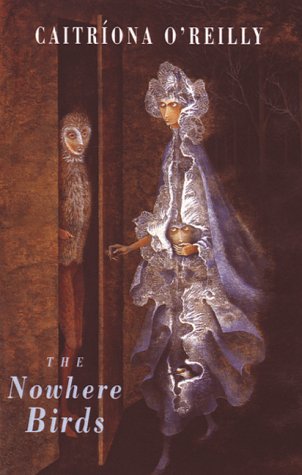
Caitríona O'Reilly, The Nowhere Birds (Bloodaxe, 2001)


The Nowhere Birds is O'Reilly's début collection of poetry and is very impressive. Since I have a small pint glass of daffodils on my desk right now, I'm going to reproduce her poem from this collection called 'Daffodils', which I think will give you a sense of these sensual, and unsettling, poems:


They bring this hint of something startled in them -
the dreadful earliness of their petals
against dead earth, the extremity of their faces
suggesting a violent start -
dumb skulls opening, overnight, to vehemence.
Their lives are quicker than vision,
their voices evade us. And as
water tightens its surface in vases
and sharpens its glass, slicing their sticks
in half, these funnels clatter on their bent necks,
like bells for the already dead.

Tuesday, 7 March 2006

Stupidity


Good films don't get watched. I suppose it is just that simple. But apparently the Oscars are to be considered a flop this year, with one of the lowest ratings in 20 years. Sigh. The films, pundits say, were too highbrow, and nobody had seen them.

Too highbrow. Sigh. Why is everybody so stupid? Or rather, why are most people so stupid? I am disgusted and nauseated by this.

Sunday, 5 March 2006

Astell on Job, reviewed by Lerer


It is a commonplace that academics are embittered jealous failed creative types who eventually succumb to drink or some other such self-destructive behaviour, and who rarely have anything positive to say about fellow academics. Reading reviews can often give one a glimpse of these tendencies, side swipes here and there, footnotes that are less composed to convey information but are meant as a glove used to smack one on the face.
But it was with joy that I read Seth Lerer's review of Ann Astell's book Job, Boethius, and Epic Truth (Cornell UP, 1994) published in Speculum 70 (1995), 869-871. The review opens: 'This is a book of literary criticism; but it is, as well, a testament of faith.' He goes on to look at Astell's treatment of the medieval reception of Boethius' Consolation of Philosophy, pointing out the very stimulating aspects of the study; pointing out too, its deficiencies, where it elides certain problems of textual transmission. He ends the review with an extraordinary, generous, and magnanimous recommendation that could only be produced by a mind capable of breadth, embrace, and art:
'In spite of these criticism, or perhaps because of them, this is a book that I have come to admire with each rereading. It is a rarity in academic criticism: a study of great learning and great belief, whose arguments are voiced without the slightest tinge of pedantry or condescension. It illustrates a way of reading literature as a spiritual humanist; and if its deep faith in a higher truth seems out of step with current institutional uncertainty, then at the very least it should refresh the reader with the courage of its critical convictions.'

Thursday, 2 March 2006

World Book Day 2006


Today is World Book Day. Go out and buy someone your favourite book.

It makes a difference.

Wednesday, 1 March 2006

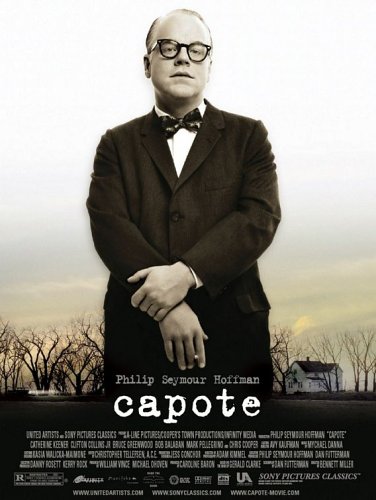
Capote, dir. Bennett Miller (2005)


Capote is the story of the circumstances of Truman Capote's writing of In Cold Blood. Capote reads a short column in the New York Timesof the mysterious killing of a family in Kansas and becomes fascinated. He goes with his friend and research assistant, Harper Lee, to the town of Halcomb and and is profoundly moved by the experience. He follows the trial and befriends the killers, especially one, Perry Smith. The book Capote wants to write is a new kind of book, a fictional work based on true events, the non-fiction novel.

The killers' resistance of the death penalty and Truman Capote's desire to finish the book are represented in the film as opposing each other, and the tension that arises from that is very interesting. He wants to help them, finding them a lawyer for appeals etc, but he wants to write the end of his book. This end that he desires must result in their execution, and when it does happen it shocks him deeply. His self-obsession is clear at the beginning of the film, but the book grows into a destructive obsession that almost transcends his own enormous ego. He confronts questions of honesty and truth, and how the process of creating must incorporate these. It's a challenging film, in many ways.

While the direction is not always as artistically assured as it could be, Phillip Seymour Hoffman gives nothing short of a masterclass in acting in this film. He is just extraordinary. You are utterly convinced and moved by his remarkable performance and for it alone this film is a must see.

Sunday, 26 February 2006

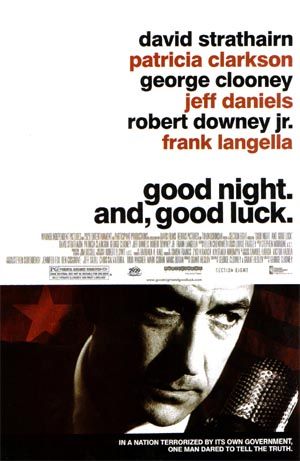
Good Night, and Good Luck, dir. George Clooney (2005)


Good Night, and Good Luck is the story of the confrontation between CBS News anchor man Edward R. Morrow (David Strathairn) and Sen. Joseph McCarthy. These witch hunts are well known; those familiar with Arthur Miller's work will know how this period affected him and his work: The Crucible, for example.
The film does not show anyone being dragged off and thrown in jail. Instead, it depicts a group of journalists at CBS trying to come to terms Sen. McCarthy's one man crusade against Communism seen in every corner of independent thought throughout the United States. In the face of the seemingly monolithic power of government Edward R. Morrow decides to broadcast a series of in-depth examinations of the kind of mock-trials McCarthy was engaged in and questions their legitimacy and legality. I wouldn't describe is as a hatchet job on the junior member from Wisconsin, but some will.
It's a powerful and timely film. It's wonderfully acted - Strathairn is tense and righteous throughout in equal measure, and the direction is sure and satisfying. Robert Downey Jr. seems to be staying on the straight and narrow and showing that he can act. Clooney is curiously set back in the film, he doesn't overpower the screen with his presence and allows the others their space.
If, as one critic put it, one feels preached to, it is because this is a film with a message. So get it. The Left will love it, the Right will hate it. The usual idiotic debates will rage, trying to strangle appreciation and independence, art and beauty. Perhaps there is no hope for us. I left the cinema sad and worried. I enjoyed it immensly, but couldn't help feeling plus ça change plus c'est la meme chose. The danger is most certainly within. Not without.

Saturday, 25 February 2006

OED for All!


This is a bit of an anorak thing to get excited about I know but it's from today's Guardian:

"Oxford University Press has signed a breathrough deal with public libraries across England. Library users will get free access to online resources including the Oxford Dictionary of National Biography, the Oxford English Dictionary, Grove Music and Grove Art. The agreement was brokered with the Museums, Libraries and Archives Council, which hailed the benefits for all sides. Indeed, anyone will be able to get full, free access to the databases at home using their library card number."

I love the OED.

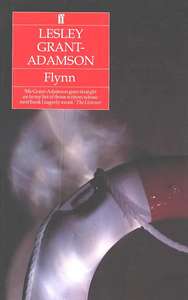
Lesley Grant-Adamson, Flynn (Faber, 1991)


Lesley Grant-Adamson is a well-known British crime writer and Flynn is her seventh novel; she has clocked up fifteen so far - the latest being Undertow. In Flynn she introduces a new character, a detective called Laura Flynn. The book runs two stories in parallel, an initially innocuous case of corporate ownership and the case of her father who walked out when she was four. It is actually very good, quite subtle. She doesn't go for any flashy effects, and most of what happens is very believable, at first seems even banal, until you realize you are actually biting your nails. The writing is very solid and Flynn is a nice character, well balanced between competence and chaos, a detective who gets rather modest jobs that just pay the bills. When yet another seemingly modest job comes along you feel that she's enjoying the increasing danger but at the same time that she's not at all sure that she can keep things in control. All of this is set against the backdrop of the Irish in London, with more than a tinge of the failure so many of them encountered. There's much that is poignant and intelligent in this book. I enjoyed it a lot and will read more.

Sunday, 19 February 2006

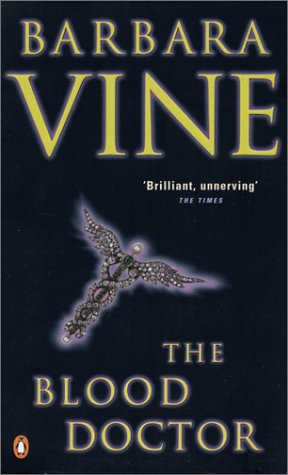
Barbara Vine, The Blood Doctor (Penguin, 2003)


This is quite simply an awful book. It needed a scalpel-wielding editor to be ruthless, for a start. It is a good 200 pages too long. And the excessive length is indicative of the lazy meandering writing. It's not that the idea isn't a good one. It isn't bad. Though it isn't great. No. It's the bad writing. Why is crime fiction often written so badly, especially when plots take lots of thinking and sometimes even a bit of cleverness?
And why bother writing novels of the same genre under a pseudonym? Barbara Vine is the pseudonym of Ruth Rendell, but Ruth Rendell is a crime writer, and Barbara Vine is a...crime writer. I can understand, say, if someone is a poet and a novelist: those two don't seem to mix that comfortably (think of David Harsent, for example). But why write crime novels under two names?

LinkWithin

Related Posts Plugin for WordPress, Blogger...