Monday, 28 March 2011

The End of Poetry, Now

After such powerful lectures by Belinda McKeon and Anne Carson on Thursday it was with high expectations that the DLR Poetry Now Festival proceeded for the rest of the weekend. The audience was not disappointed.

The first day of readings opened strongly with Joseph Woods, Luis García Montero, and Paul Farley, introduced by Eiléan Ni Chuilleanáin. Woods read from is forthcoming collection with Dedalus Press, who have published his previous two, Sailing to Hokkaido (2001) and Bearings (2005) in a single volume entitled Cargo (2010). Montero read in Spanish with translations read by Martin Veiga. Paul Farley gave a strong and highly enjoyable reading, mainly from his last two collections, The Tramp in Flames and The Ice Age. The second reading of Friday was introduced by Philip Coleman, and had Heather McHugh and Michael Longley read. Very different poets and very different readings. McHugh got up and grabbed the crowd by the...eh, throat. With a kind of sharp and unpredictable humour, it was terrifying to watch and exhilarating to experience. She commented, joked, challenged, discussing as she went along, at one point stopping to question her choice of a particular word. The last poem she read was entitled ‘What He Thought’, a wonderful exploration of the glib, the easy, the lesson of difficulty. It closes with the image of Giordano Bruno, face covered in an iron mask to prevent him inciting the crowd: ‘poetry is what | he thought, but did not say’. Longley read mainly from his new collection A Hundred Doors (Cape, 2011), with a gorgeous, almost unbearable nuance. Particularly powerful was his poem ‘Citation’, a ‘found poem’, made from his father’s citation for the Military Cross. Longley read with the softness of one putting petals back on a flower, with syllables that were so delicate you needed a pair of tweezers to separate them. He is an artist working with gold leaf, brushing it on with his breath.

Saturday’s readings had Dave Lordan, Fiona Sampson and Jaan Kaplinski. Lordan read a kind of performance poem, with enormous energy, while Sampson’s reading was a good deal more muted, more intricate, more poised. And Kaplinski opened his reading with a poem he said he had not yet written, which comprised a minute of silence. There followed the evening reading, by Sinéad Morrissey and Gerald Stern, beautifully introduced by Aengus Woods. Morrissey read from her latest collection Through a Square Window with a quietness and firmness that made you sit up straight and sometimes lean forward, catching details in a breeze. Stern asked that the lights be raised over the audience in the (normally darkened) Pavilion Theatre so he could see them, read to them. This speaks volumes, volumes of poems. He was a ball of pure energy and read with an extraordinary sense of engagement and wit. This sense of fun is anchored by a tremendous sense of the important, the essential, the utterly compelling.

Sunday’s afternoon reading was with Nuala Ní Dhomhnaill and Don Paterson. These are two poets who listen to waters that run deep under ‘official’ English. Ní Dhomhnaill writes in Irish and has often talked about the experience of writing in a language that is spoken with fluency by a small proportion of the population but claimed to be spoken (for all sorts of social and political reasons) by a considerably higher number.1 I greatly enjoyed the reading but she has a school-mistress quality that made me a little nervous and she read like she was speaking to a group of intelligent but lazy students who could get this if they really tried. I felt as if I had not done my homework. Paterson read from his latest collection Rain as well as new, unpublished work.2 He has a remarkable sense of ease with his own discomfort, all the more remarkable because it in no way mitigates that discomfort for the listener/reader. I believe Paterson to be a great poet.

A theme of silence ran like an undercurrent throughout this year’s festival, inadvertently perhaps, inasmuch as these things ever are, pointing up the end of the festival. From Carson’s lecture on untranslatability and the silences of translation, to Longley’s remarks about the silent white spaces on the page (and cf. the epigraph by Barbara Guest, The future writ in white space, in his A Hundred Doors), to Aengus Woods’ meditation on Adorno and the (too) oft-quoted remark about poetry being impossible after Auschwitz and Gerald Stern’s response that only poetry is possible after Auschwitz, not to mention (!) Kaplinski’s silent poem one minute long.

It was a chance to meet old friends and make new ones. Catching up with the poet and illustrator PJ Nolan for example, was a great pleasure, as was meeting the poet Leanne O’Sullivan. I was greatly glad to meet Nikolai Popov, an academic and translator (as well as the husband of Heather McHugh), a man with an aristocratic intelligence and the vague and exquisite sadness of an exile. Meeting him was what I think it would be like to meet Dante.

Belinda McKeon closed proceedings by thanking those who’d contributed to making this year’s Poetry Now Festival the great success that it was and struck an emotional note as she expressed her regret that the festival is to be dismantled. Heaney, too, expressed grave concern at this decision when he accepted the Irish Times Poetry Now Prize for Human Chain. When Longley began his reading, he lamented the decision to ‘tinker with the Festival in any way’. It was a remark warmly received by the audience. This is a bad decision and being taken for bad reasons. The financial crisis has created a state of exception in which all manner of decisions are allowed to be taken under one guise but with motivations that are not at all related, quite unequal to the consequences. Dun Laoghaire has suffered a terrible loss and the end of the Festival left me with a sense of having witnessed something pass from us, without being able to properly articulate it nor indeed resist it.

Belinda McKeon let poetry have the last word, and read a wise and warning poem:

‘Had I not been awake’

Had I not been awake I would have missed it,
A wind that rose and whirled until the roof
Pattered with quick leaves off the sycamores

And got me up, the whole of me a-patter,
Alive and ticking like an electric fence:
Had I not been awake I would have missed it,

It came and went so unexpectedly
And almost it seemed dangerously,
Returning like an animal to the house,

A courier blast that there and then
Lapsed ordinary. But not ever
After. And not now.

from Seamus Heaney, Human Chain (Faber, 2010), p. 3


1. See her essay ‘Why I Choose to Write in Irish, the Corpse That Sits Up and Talks Back’, first published in The New York Times Book Review, 8 Jan 1995, pp. 27-28, repr. in Representing Ireland: Gender, Class, Nationality, ed. Susan Shaw Sailer (University Press of Florida, 1997), pp. 45-56.

2. On which I’d had occasion to write about.

Friday, 25 March 2011

(A) Night with Anne Carson


Photograph by Einar Falur Ingólfsson

Anne Carson’s Nox (New York: New Directions Books, 2010) is very hard to talk about because it is a lot of things. And it has quite a bit of thingness to it. Written after the death of her brother, it is an extended exploration of Catullus’s Poem 101, itself written after the death of his brother. Because the elegy is stunning, I reproduce it here:
Multas per gentes et multa per aequora uectus
--aduenio has miseras, frater, ad inferias,
ut te postremo donarem munere mortis
--et mutam nequiquam alloquerer cinerem.
quandoquidem fortuna mihi tete abstulit ipsum,
--heu miser indigne frater adempte mihi,
nunc tamen interea haec, prisco quae more parentum
--tradita sunt tristi munere ad inferias,
accipe fraterno multum manantia fletu,
--atque in perpetuum, frater, aue atque uale.
Produced on a single long sheet of paper, folded like an accordion and stored in a box, it is not a book but feels like it is at a point somewhere between a papyrus roll and a codex. A meeting of Greek and Latin, the old and the new. Anne Carson is a distinguished classicist and this powerfully liminal bookness can not be accidental. She seems to be exploring the very nature of how we read in its most physical dimension. When one reads it, it is almost easier to handle the pages while leaving it inside the box, like one is rummaging through Carson’s most personal effects. A box of memories, a box of memory, even.1 It is a livre d’artiste, with the word artiste including poet: at once a book-object, art-book, a book-poem, a page. When open, the left hand side has a ‘dictionary’ entry for each word of Catullus 101, while the right hand page will have pieces of paper glued on, family photos, scraps of letters written by her brother Michael, pieces of her own mind. The sections are numbered 1—10, subdivided 1.1, 1.2 and so on. I place the word dictionary in scare quotes there because even these entries, which look ‘official’, are in fact her own, highly nuanced understanding and definition of the word: it, too, becomes another mode of expression. It is encylopaedic, like a poetic Isidore of Seville: Truth from Words.2 Thus, the poem unfolds along parallel lines, etymology, translation on one side, recuperation, recreation, history (his-story) on the other, both constantly intersecting, nourishing each other. The book is almost impossible to “cite” in the tradition sense: it must be experienced.

Nox opens by thinking about history, its closeness to elegy. History comes from the Greek ‘to ask’ (ἱστωρεῖν): ‘One who asks about things - about their dimensions, weight, location, moods, names, holiness, smell - is an historian’. The word ‘autopsy’ is used by historians to mean eyewitnessing. “To withhold this authorization is also powerful. Herodotus carefully does not allege to have seen a phoenix, which comes only once every five hundred years... Herodotus likes to introduce such information with a word like λέγεται: ‘it is said,’ as one might use on dit or dicitur” (1.2). This leads to Carson repeating what she had heard about her brother’s dog and his reaction to Michael’s death, calming down once he put his paws on the coffin. Putting together the tiny scraps of information Michael revealed about himself, his few letters home, his few telephone conversations, Carson proceeds on this recuperation, meditation, creating both a history and an elegy. All the while, each word of Catullus 101 slowly works on the reader, with an insistent slowness that becomes inescapable. In section 7.1 Carson says that Catullus 101 has always exerted a powerful force on her:

Nothing in English can capture the passionate, slow surface of a Roman elegy. No one (even in Latin) can approximate Catullan diction, which at its most sorrowful has an air of deep festivity, like one of those trees that turns all its leaves over, silver, in the wind. I have never arrived at the translation I would have liked to do of poem 101. But over the years of working at it, I came to think of translating as a room, not exactly an unknown room, where one gropes for the light switch. I guess it never ends. A brother never ends. I prowl him. He does not end.

Photo: Hannah Whittaker/New York Magazine

That image of the tree showing its silvery leaves in the wind is a festivity that is revealed to us, that to which we have access. Carson has used the image of the tree to capture the difference between Greek and English: “There’s something about Greek that seems to go deeper into words than any modern language,” she has said. “You’re down in the roots of where words work, whereas in English we’re at the top of the tree, in the branches, bouncing around.” This is not an either/or, it is a both. Without one, there is not the other. Feeling around for the roots makes us understand what we are doing when we are bouncing around in those branches.3


Another important dimension to this book is that it is a facsimile: from the Latin fac make (imperative of facere) and simile like (neuter of similis), make like. On the back of the box Carson writes: ‘When my brother died I made an epitaph for him in the form of a book. This is a replica of it, as close as we could get.’ This is like the original but not the original: that is, it is untranslatable, like Catullus 101. Replica is a suggestive word to use: replicatio means a folding or rolling back again (of a book, for example), while in English it also means a reply, or a reproduction. In a sense, this is a replicatio, a rolling back of the original, and it is a reply to her brother, a reply with an address that he never left. That poignant ‘as close as we could get’ does not just refer to the accuracy of the facsimile, but to the closeness it brings them, brother and sister. In a famous essay, Walter Benjamin talked about the age of mechanical reproduction taking something away from the ‘aura’ of the work of art. The reproduction points relentlessly to its original, and to that which it is not: ‘The presence of the original is the prerequisite to the concept of authenticity... The whole sphere of authenticity is outside technical–and, of course, not only technical–reproducibility’.4 In a very wonderful analysis of this idea of authenticity and reproducibility, Michael Camille looked at the way in which facsimiles of the Très Riches Heures are packaged and sought to examine how, in fact, the facsimile emphasized the aura of authenticity by pointing up its rarity. The facsimile became the only means of accessing the manuscript, something Camille noted was the effect of the publicity material released by Faksimilé-Verlag Luzern: ‘After the facsimile has been produced the original will be locked away forever!’5 When one opens out the page(s) of Nox, it becomes apparent that the back side of the page is white. In the language of manuscripts, its recto is blank, while we read its verso. In a wonderful interview with Parul Seghal in the Irish Times Carson says that “Because the backs of the pages are blank, you can make your own book there. We did this with a class of eight-year-olds. They loved it.” We are invited to make our own reply. In many ways, that is what makes Nox so powerful, the way it invites, the way the reader participates and experiences, and shares. As Seghal says: “Nox trains the reader how to read it”.

Benjamin also says in his essay on mechanical reproduction: ‘Even the most perfect reproduction of a work of art is lacking in one element: its presence in time and space’ (p. 214). But in talking about the technical challenges for the book, Carson has spoken of how her friend and collaborator Robert Currie thought about the book: “I like to walk around ideas, but I’m not intrinsically spatial as a thinker. I make a page, which is a flat event. Currie has a way of observing any page and knowing how it would be in space. He added spatiality to these pages.” The possibilities afforded the kind of quality reproduction that can now be made and the nature of the very design of Nox extend even to Benjamin’s sense of the production lacking ‘time and space’. In other words, Nox is an event in 3D, an encounter occuring in time and space.

The Dun Laoghaire Rathdown Poetry Now Festival festival opened in heady style with a lecture by Belinda McKeon earlier in the day entitled “The Eye of the Poem” in which she discussed the idea of attention and attentiveness, the poem as object of attention, the reader as object of the poem’s intention. With generous and penetrating reference to all of the poets reading this year, she explored the notion of how attention concretizes both that which is in the poem and the reader encountering the poem. The lecture will be available as a podcast and will repay attention.

Anne Carson delivered the opening address at this year's DLR Poetry Now Festival: The Untranslatable (In All of Us).6 It was with great excitement and not a little trepidation that I made my way to hear it. Speaking while images were projected onto a screen, it was two lectures, one in images and one in words. She talked about silence and cliché, and what happens when we arrive at the untranslatable. She discussed the plant Odysseus is given by Hermes to resist the power of Circe: μῶλυ (Od. 10. 305), a word that belongs to the gods. She then reflected on the trials of Joan of Arc, described as fraught with translation issues: thousands of words passed between her and the lawyers, all being translated back and forth between her French and the Latin of the lawyers. But Joan’s response to a question on the nature of the voices she heard resisted translation, it was a language of the gods: “The light comes in the name of the voice”. With great ease, Carson then moved on to talking about Bacon and his “Brutality of Facts”, examining the surface of the work, its painted, violent reality and the continual drive to eradicate narrative, his attempts to “destroy clarity with clarity”. She set up a dichotomy between cliché and catastrophe, one the opposite of the other. The cliché is the question, it allows us not to think, or to think the already thought; the catastrophe is the answer.7 She then looked at translating the colour purple from the Greek word κάλχη, referring to the purplefish, but which leads to the verb καλχαινειν, to make dark and troublous (like a stormy sea), to ponder deeply (LSJ). When Hölderlin came to Sophokles’ Antigone: “You are obviously grown dark in mind over some piece of news” (Soph. Antig. 20: τί δ᾽ ἔστι; δηλοῖς γάρ τι καλχαίνουσ᾽ ἔπος) he translated it with: “Du seheinst ein rotes Wort zu färben”, You seem to colour a red word, you dye your words red. This “deadly literalism” as Carson calls it leads her to think about his madness and the madness that is in translation, as well as the silence that falls within the word. But if cliché and catastrophe seem to offer two ways (only), one of naming, one of chaos, translation offers a third place to be, between naming and namelessness. She ended with Paul Celan’s poem in praise of Hölderlin (‘Tübingen, January’) and his neologism Pallaksch, which sometimes meant yes, and sometimes meant no. Perhaps a word from the gods, meaning yes and meaning no. A good one for a translator to tackle, a middle way between cliché and catastrophe.

It was a stunning, sensitive and graceful offering, received gratefully by an audience in rapture.

McKeon’s meditations on attentiveness and the power of poetry to keep us in its aim, as well as Carson’s consideration of translatability, καλχαινειν, cliché and catastrophe took on a very sharp focus as the audience realized that the DLR Poetry Now Festival will no longer exist in its current format. It is to be incorporated into another literary festival (‘Mountains to Sea Book Festival’), in a much reduced scale. I greatly regret this loss of an individual identity for the Poetry Festival, especially considering how long it has taken to establish and build up. Financial pressure is certainly part of it, but other pressures of audience and accessibility have undoubtedly played their part, all with concerns of metrics and measurability, impact and the perceived elitism of poetry. It all makes me fear that we are all now much too close to a kind of cliché and catastrophe that have nothing to do with poetry.


Notes:

1 See the remarks by Jess Row (here) on memory, the ars memorativa, esp. via the Rhetorica ad Herennium. The box in which Nox comes is not just like that archivists use for precious and delicate books or manuscripts, it might also be the room Carson likens to translation itself.

2 To paraphrase the title of John Henderson, The Medieval World of Isidore Seville: Truth from Words (Cambridge: Cambridge University Press, 2007).

3 And cf. “Words bounce. Words, if you let them, will do what they want to do and what they have to do.” Carson, Autobiography of Red, p. 3.

4 See Walter Benjamin, 'The Work of Art in the Age of Mechanical Reproduction' in Illuminations, ed. with an introduction by Hannah Arendt, trans. Harry Zohn (London: Jonathan Cape, 1970), pp. 211-244, with citation from p. 214.

5 See Michael Camille, 'The Très Riches Heures: An Illuminated Manuscript in the Age of Mechanical Reproduction’, Critical Inquiry, 17 (1990), 72-107, at p. 72. For further fascinating work on facsimiles, see Sandra Hindman and Nina Rowe (eds), Manuscript Illumination in The Modern Age: Recovery and Reconstruction (Evanston, Il: Mary and Leigh Block Museum of Art, Northwestern University, 2001).

For reviews of Nox see that of Meghan O'Rourke in The New Yorker; Andrew Motion in The Guardian; Sam Anderson in New York Magazine; Ben Ratliff in The New York Times; Michael Dirda in The Washington Post; Peter Stothard in the TLS; Tom Payne in The Telegraph; Jess Row in The New Republic

Not strictly speaking a review, but excerpts from a reading, an interpretation can be seen here:


and here


6 There is a transcription(?) of another slightly modified version of the lecture here.

7 Cf. καταστροφή, an overturning, sudden turn, conclusion (LSJ)


Tuesday, 22 March 2011

Another timepiece from the McGonigles


I've had occasion before to blog about the McGonigle brothers and their extraordinary watches. Well, the brothers have developed another watch, entitled "Tuscar". It is gorgeous, and features a new in-house calibre movement. Read the specs here. Read the Press Release here.

Friday, 18 March 2011

Listen Again


Listen to Melvyn Bragg's In Our Time with Miri Rubin, Ian Wei and Peter Denley talk about the Medieval University.

From the website:
In the 11th and 12th centuries a new type of institution started to appear in the major cities of Europe. The first universities were those of Bologna and Paris; within a hundred years similar educational organisations were springing up all over the continent. The first universities based their studies on the liberal arts curriculum, a mix of seven separate disciplines derived from the educational theories of Ancient Greece.

The universities provided training for those intending to embark on careers in the Church, the law and education. They provided a new focus for intellectual life in Europe, and exerted a significant influence on society around them. And the university model proved so robust that many of these institutions and their medieval innovations still exist today.

Wednesday, 16 March 2011

Irishmen writing in Italian


On March 29th, a letter in the collection of Roy Davids will come on sale at Bonhams, London, written by James Joyce to Carlo Linati, an Italian writer and translator. In the two-page letter, written in Italian, Joyce asks Linati to translate some of his work, explaining the trouble he was having with the censors: He wrote: “For the publication of Dubliners I had to struggle for ten years. The whole first edition of 1,000 copies was burnt at Dublin by fraud; some say it was the doing of priests, some of enemies, others of the then Viceroy or his consort, Lady Aberdeen. Altogether it is a mystery.” A transcription of the Italian has not been published [a translation has appeared in The Letters of James Joyce, ed. Stuart Gilbert (1966)] but hopefully when this letter makes its way to a new owner, it will see the light of day.

Thursday, 17 February 2011

Still Alive


Agnolo Bronzino, 'Portrait of Bartolomeo Panciatichi',
tempera on wood, 104 x 84 cm; Florence, Uffizi Gallery.

I am still alive. I feel I should say this since it has been an unforgivably long time since I last posted. Things have been busy in the land of Miglior Acque, book buying has been proceeding with gusto, and the work is proceeding at a rate that I can only describe as flat out. So, that's that. Books. I have recently been lucky enough to acquire Storia della letteratura italiana, gen. ed. Enrico Malato (Rome: Salerno Editrice, 1995-2002), which was originally published in 14 volumes. It was then reissued with Il Sole-24 Ore in 24 volumes. The pagination is the same and so is the text, so one can reliably cite them and use them. They are really excellent, though some of the medieval chapters have been republished in revised monograph format. This is the case for (the excellent) Lucia Battaglia Ricci, 'Giovanni Boccaccio', which came out in Vol. 2, Il Trecento [1995], pp. 727-877, but which was republished in a revised 2000 monograph. In any case, I'm delighted to have it and am often using it. There have been some good books come up at Bennett & Kerr lately too, such as Ricci's 1965 Monarchia, which I'm glad to have, though I have my eye on Prue Shaw's new edition for the Edizione nazionale. I was particularly happy to get Giuseppe Mazzotta, The World at Play in Boccaccio's Decameron (Princeton: Princeton University Press, 1986), and Dante, Poet of the Desert: History and Allegory in the Divine Comedy (Princeton: Princeton University Press, 1979). I also recently got my hands on a lovely uncut copy of Giovanni Boccaccio, Il Decamerone, ed. by Giuseppe Petronio, Nuova raccolta di classici italiani annotati, 3, 2 vols (Torino: G. Einaudi, 1950). This is an edition not that easy to find here and it was very reasonably priced and I needed it. Petronio has also produced a couple of other important essays on the Decameron such as Il Decamerone. Saggio critico (Bari: Laterza, 1935); and a couple of articles reprinted in I miei Decameron (Roma: Editori Riuniti, 1989).

The Cambridge University Press booksale this January was where I spend a few hours at the beginning of term and I picked up a few bargains that I was delighted with: they sell the hardbacks for £7 and the paperbacks for £3. Particularly pleasing were: Piero Boitani, English Medieval Narrative in the Thirteenth and Fourteenth Centuries, trans. Joan Krakover Hall (1982); Susan Woodford, Looking at Pictures (1983); Jeryldene M. Wood (ed), The Cambridge Companion to Piero della Francesca (2002); Jeremy Tambling, Dante and Difference: Writing in the Commedia (1988); Peter Humfrey (ed), Venice and the Veneto, Artistic Centers of the Italian Renaissance (2007); Fiona Somerset, Clerical Discourse and Lay Audience in Late Medieval England (1998); Jessica Rosenfeld, Ethics and Enjoyment in Late Medieval Poetry: Love after Aristotle (2011). A pretty good haul, all things considered. I was also quite delighted to pick up Nicolai Rubinstein (ed), Florentine Studies: Politics and Society in Renaissance Florence (London: Faber, 1968) in G. David & Sons a couple of weeks back. A lovely, elegant thing really.

In January I had a very brief but very enjoyable visit to Florence to visit some colleagues, to work in the library, and to see the wonderful Bronzino exhibition at Palazzo Strozzi. I was kindly hosted by William E. Coleman and Edvige Agostinelli, who are in the final stages of a very exciting project editing Boccaccio's Teseida - they are preparing an edition for the Chaucer Library, which will be a text they believe is closest to what Chaucer had access; an 'old spelling' edition with SISMEL; and a digital facsimile of the autograph, BML, MS Acq. e Doni, 325. They've been working hard on the autograph and have a whole host of new readings to offer. It is important work and will be very exciting to work on.

At the BNCF, I was able to look at a manuscript, Magliab. II, II, 8, which I'm writing about right now: it is the oldest extant witness to the Decameron and has been the subject of some very exciting work by Marco Cursi: see esp. his Il Decameron: Scritture, scriventi, lettori. Storia di un testo (Roma: Viella, 2007), but see too 'Per la più antica fortuna del Decameron: mano e tempi del «Frammento Magliabechiano» II, II, 8 (cc. 20r-37v)', Scrittura e civiltà, 22 (1998), 265-293. I'm picking up some crumbs left behind.

The Bronzino exhibition was a revelation. Verily. A magnificent achievement for all concerned, with a beautiful, serious, scholarly catalogue (Carlo Falciani and Antonio Natali (eds), Bronzino: Painter and Poet at the Court of the Medici [Florence: Mandragora, 2010]). The great portraits were on display, especially 'Eleonora of Toledo with her son Giovanni', and I stood and marvelled at her dress: you can see the threads, and to be honest, it looks like it has been woven rather than painted. And I was intrigued by the two Panciatichi portraits. The famous portrait of Lucrezia is the subject of a wonderful essay in the catalogue by Elizabeth Cropper, which argues that the religious views of the couple offer ways to interpret some parts of the painting, such as her chain and its device reading amour dure sans fin. I got to wondering about his portrait. The background is just so odd, perspective that does not quite make sense, buildings that cannot be identified, possibly recognizable Florentine (Michelangelesque). And at the same time, completely...bonkers. Perhaps, if there are dimensions to the Lucrezia portrait that were executed with discretion because of a whiff of unorthodox Lutheranism, there might be new ways to interpret this portrait too? I'm not exactly suggestion that it merits some sort of Dan Brown wild symbology goose chase, but maybe the background is begging a question that has not yet been asked. Why is it so elaborately impossible?

Sunday, 14 November 2010

A PhD in the Humanities


and then, just to turn that smirk into a tear, watch this (thanks to Karl Steel over at ITM):


Sunday, 31 October 2010

Boccaccio, by Boccaccio


Of Boccaccio's autograph manuscripts, it is arguably that of the Decameron that has attracted the most attention in recent years. Now in the Staatsbibliothek - Preussischer Kulturbesitz, in Berlin, under the shelfmark "MS Hamilton 90", this fascinating manuscript, produced in the 1370s, clearly shows an author concerned with the 'packaging' of his great masterpiece. This is all the more interesting because the late Boccaccio is often thought of as more interested in the production of Latin works, as repudiating the earlier, youthful and foolish vernacular work. The manuscript certainly disturbs any neat division anyone might wish to draw between these two Boccaccios.

While there had been some talk earlier in the twentieth century of this being an important manuscript, but it was not until the publication in 1962 of Vittore Branca and Pier Giorgio Ricci, Un autografo del Decameron (Codice hamiltoniano 90), (Padova: C. E. D. A. M., 1962), that its true importance was realized. Branca and Ricci identified it as an autograph and the former set about producing a critical text based on it. This was subsequently published as Decameron: edizione critica secondo l'autografo hamiltoniano (Firenze: L'Accademia della Crusca, 1976), and appeared simultaneously as volume 4 of Tutte le opere di Giovanni Boccaccio, gen. ed. Vittore Branca, Classici Mondadori 10 vols (Milano: A. Mondadori, 1964-1998). The 600th anniversary of the death of Boccaccio fell in 1975 and was the impetus for a good deal of publications on the author and his work. So, in 1974, there appeared, under the auspices of Charles S. Singleton, Decameron: Edizione diplomatico-interpretativa dell'autografo Hamilton 90 (Baltimore: Johns Hopkins University Press). This contains a very important description of the manuscript by Armando Petrucci, 'Il MS. Berlinese Hamiltoniano 90. Note codicologiche e paleografiche' (pp. 647-661); as for the rest of the volume, it really never recovered from the scathing review by Branca in Studi sul Boccaccio 8 (1974), 321-329.

In 1975 Branca produced a beautiful facsimile of the manuscript: Decameron: facsimile dell'autografo conservato nel Codice Hamilton 90 della Staatsbibliothek Preussischer Kulturbesitz di Berlino, Manus summorum: autografi dei capolavori nella civilità universale riprodotti in facsimile (Firenze: Alinari). Well, dear reader, while perusing on Ebay what did I find only a rather reasonably priced copy of the said facsimile and before I could say Buy It Now, it was winding it way from sunny Italy to the dark and wintry North. I am so delighted to have this. It is invaluable to be able to check each passage from the printed text against how it appears in the autograph, keeping an eye on how the punctuation and capitalization are marked out. This has been rather wonderfully discussed by Lucia Battaglia Ricci in her Boccaccio (Rome: Salerno, 2000; = 'Giovanni Boccaccio', in Storia della letteratura italiana, ed. by Enrico Malato, 12 vols [Roma: Salerno Editrice, 1995], Vol. 2: Il Trecento [1995], pp. 727-877), where she suggests that Boccaccio distinguishes between narrative layers that are not always easily reproduced in modern printed editions. She makes some very important points too about the look and feel of the manuscript: it is a rather serious book that looks for all the world like a university text.


The beautiful and witty catchphrases are also a constant source of fascination for me. There are thirteen catchwords in the manuscript though there were others since the final three quires are missing. The one illustrated above occurs on f. 71v and represents Pietro di Vinciolo, at Dec v 10 37; his text reads 'che poco'. Branca saw in these an illustrative programme reflecting the work's thematic concerns. So, the figures represent the triumph over Fortune, Love, and Wit (fortuna, amore, and ingegno), four portraits for each. Six of the ten male figures are merchants, which he saw as indicating the social class in which many of the stories are set and perhaps indicating too the presence of this class amongst the work's earliest readers and copyists. (While not dissenting [too much] from Branca, I have a somewhat different take on these catchwords, outlined in greater detail in the third chapter of my forthcoming Chaucer and Italian Textuality [Oxford: Clarendon Press]).

The facsimile was set and printed in the famous Stamperia Valdonega, in Verona, in 325 copies; mine is numbered 188. The photographs were taken by Alinari; the paper produced by the Cartiera Ventura di Cernobbio; it was bound by the Legatoria Torriai di Cologno Monzense, and comes boxed in brown cloth and card. It is a thing of sober beauty. And a great addition to the library.

Friday, 22 October 2010

Hell's Half Acre, Lazarides Gallery London, October 12-17, 2010

Dante: no other medieval author continues to exert such an extraordinary force on the modern imagination. Those who've read his Comedìa never recover; those who've never read him still feel like they know the Inferno, and because it has become such a cultural norm, they probably do know it. At Cambridge, Prof. Robin Kirkpatrick has been undertaking a massive critical and creative engagement with Dante over the past couple of years in a project entitled Performance, as well as a conference at CRASSH entitled Pain in Performance and 'Moving Beauty'. This year, on October 30th, Performance 2010 will further explore Dante and other texts in a series of performances, music, dance, art and drawings.

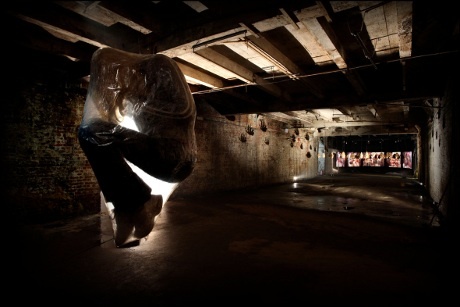
Recently, the Lazarides Gallery in London held an exhibition (suggestively) entitled Hell's Half Acre in which sixteen artists produced work evoking Dante's Inferno in The Old Vic Tunnels, under Waterloo Station. The setting is an important aspect of this exhibition. You enter and descend into a dark series of cavernous spaces in which artworks are lit by spotlights, passing a projection of a barking dog on the way. Curiously, this not on the list of works exhibited: perhaps no-one wanted to own up to such creature. Your eyes take some time to become accustomed to the low light - I nearly fell over in my first five minutes, adding to my disorientation and considerably heightening the effect! Steve Lazarides is a name often associated with Banksy though he represents over thirty contemporary artists and his vision in putting together this exhibition in this particular space is remarkable. This short review will no do justice to the richness of the exhibition.

The Old Vic Tunnels comprise five long, wide, intersecting tunnels accommodating an exhibition of installations, paintings, sculpture and film. This has allowed works to be displayed with fairly generous space, and installations have room to breathe. It also allows the darkness of the space between works plenty of room to exert itself on the viewer's imagination. The engagement with Dante is not always apparent. A plan of hell is provided in which the names of various artists are found in certain circles, sometimes indicating a whole circle, or merely sitting beside certain sins. There is obviously a good deal of humour involved here and surely a smile was raised when deciding where to put which artist: akin to taking the Inferno quiz. It implies structure, that the exhibition is mapped against the moral design of the Comedy; and while it was enjoyable to think about the interpretative possibilities that became available, I'm not sure that it has been so mapped quite so seriously.


These are images of pain and suffering, of bodies being punctured. There are Boogie's Needles, and Paul Insect's Object Desire, a sphere of syringes with needles pointing out. Threatening, forbidding. Compelling and maybe beautiful too. There is the affecting piece by Jonathan Yeo, For What We are About to Receive, an installation of several panes of glass that need to be viewed from a specific angle to re-compose two kneeling supplicant figures. Here perspective and position are essential. To see the whole image you need to stand in one very specific spot. The act of viewing is rendered performative: it makes the art. But in another real sense, the art makes you. It forces you to stand in front of it, directly, head on. You are being controlled by it. There are often moments in the Comedy when we feel like that.


Bodies too are central to the explorations of Mark Jenkins in a sculptural installation entitled Chrysalis 1-5. These hanging bodies wrapped in clingfilm are quietly waiting, in the foetal position, for something. They are in a limbo-like stasis. Or, given that a chrysalis will become a perfected creature, perhaps there is more of a purgatorial state of becoming about these bodies. There is nothing of expiation in their hanging, it does not feel like a punishment or a purging. It points to a natural state on one hand; on the other it is deeply unsettling that their human form is so developed. They unsettle but they do not disgust. One is compelled by them, compelled to look at them, to try and see their faces (which are not visible). One wants to know who they are and why they are there. One waits for dialogue. Like them.


Readers of the Comedìa in the 1320s must have recognized figures from Florence, perhaps people they knew personally. Branca Doria could have read Inferno 33.136-138 and raised an eyebrow to have found himself there. So too, the present is more than enough for some of these artists contemplating Dante. A wonderful installation by Vhils entitled Bernie Made Off shows a painting of Bernard Madoff on a wall which has suffered serious damage. It is only when one looks more closely that it seems as if the damage, bullet holes, are in fact creating the image. It is an elegant and at the same time angry piece. Viewers have no trouble locating him somewhere in Hell. Quite far down actually. Even his name should have given something away: he becomes almost like the devils in Malebolge with their violent, cruelly parodic names, Malebranche, Malacoda, Scarmiglione, Alichino, Calcabina, Cagnazzo, Libicocco, Draghignazzo, Ciriatto, Graffiacane, Farfarello, Rubicante. Similarly, a piece by George Osodi, Niger Delta Series comprises photographs of the Niger Delta in front of a sand and oil installation. The stagnant, polluted water is surely reminiscent of the Inferno (cf. 'L'acqua era buia assai più che persa'; 'The waters here were darker, far, than perse', Inf 7. 103, trans. Kirkpatrick [Penguin, 2006], p. 63). Perhaps not subtle, but then again, not much about the destruction there is subtle. Again, one has no trouble imagining those responsible somewhere in Hell.

Hell was not the only part of the poem explored. A beautiful piece by Tokujin Yoshioka entitled Stellar had a white sphere hanging from the ceiling, made up of pieces of opaque crystal. A smoke machine filled the room (which was closed off with heavy drapes) with white smoke. I do not have a photo of this piece, but I doubt a photo would really convey the effect. Viewers walked under the sphere, rapt in attention, as we were enveloped. You could really only see people's faces, all moving in an ethereal and quite sublime appreciation of this strangely lit object overhead. It was paradisal and I found it a profoundly moving piece of work. Beautiful. Humane. And joyful.

Thursday, 14 October 2010

Bolt from the Blue

via the BBC website:

This is the moment a lightning bolt appears to strike the Statue of Liberty in New York. New York photographer Jay Fine had spent the night braving the storm in Battery Park City, Manhattan, in a bid to get the perfect picture. Jay spent nearly two hours poised with his camera and took more than 80 shots before striking lucky with this particular bolt of lightning at 8.45pm on 22 September. He said he had been waiting 40 years to get the picture.

To capture the shots Jay used a Nikon D300s with 60mm f/2.8 lens on the following settings: Aperture: F/10, Shutterspeed: 5 seconds, ISO: 200.

Saturday, 18 September 2010

Faddan More Psalter

Some time ago I blogged about the discovery of the Faddan More Psalter in Co. Tipperary in 2006. Conservation work has been carried out on the Psalter which has allowed for some startling discoveries (see here for more). These are discussed with some experts in a wonderful documentary on RTE called 'Treasure from a Bog' (produced by John Murray and written and directed by the great Alan Gilsenan). This documentary goes through the huge technical challenge that the Psalter presented in stabilizing its condition and retrieving as much as possible for study. About 15% of the book survives, and one single page survives almost intact. This offers valuable clues as to the construction of the book and how the parchment was prepared, pricking, ruling, and the like. However, one of the most exciting, and puzzling, discoveries relates not to the book itself but rather to its leather cover. Very few of these have survived so this was already an extraordinary discovery. Analysis revealed that the inside of the cover was lined with a material not found at all in 8th/9th century Ireland: papyrus. This is such an unexpected discovery that its importance and significance cannot be overestimated, but quite what it means is anybody's guess! Does it connect the early Irish church with the Middle East? If so, what does that mean? Exciting stuff. The Faddan More Psalter and its cover are expected to go on display in the Summer of 2011. You can be sure of an update.

Wednesday, 1 September 2010

CJ Sansom, Heartstone (London: Mantle/Macmillan, 2010)


It is the summer of 1545 and the king prepares for war with France. Master Matthew Shardlake, the lawyer who has been keeping his head down and trying not to attract the attention of those many grasping and ruthless courtiers who seem to congregate around Henry and his queens, receives a letter from Queen Catherine Parr. He cannot refuse her request to investigate what has led to the suicide of the son of one of the queen's old servants. It is a hopeless case. He and his opposite number, the very disagreeable Master Dyrick, are charged with travelling to Hampshire to take depositions. While there Shardlake decides to make inquiries about a woman he has been visiting in Bedlam and the circumstances that lead to her madness. Thus Shardlake finds himself weaving in and out of two slowly unfolding, terrible, stories. Things come to a head when he must confront enemies old and new on board the Mary Rose.

Sansom is in great form in this marvellous novel. He has a wonderful sense for atmosphere, especially in the Herician court. His vulnerable hunchback lawyer is a figure always on the outside, wanting to be accepted but at the same time resisting being involved since it only leads to danger. The religious upheaval is another wonderful context: everyone is under suspicion and suspects each other. An old cleric, a little too nostalgic for the 'old ways', in a discussion about faith with Shardlake mentions that he doesn't like mysteries, that he needs to solve them. This is true in many ways: Shardlake looks first for the human hand behind the unexplained. The novel is long but not, I think, overlong. It also skillfully sets up the next installment, with a brief but memorable meeting with the young daughter of Anne Boleyn, the Lady Elizabeth. She will, inevitably, play some part in the next novel. In fact, I think she'd have rather enjoyed reading this novel and when you read you'll know why.

Wednesday, 4 August 2010

Hallelujah for Leonard Cohen

The Hebrew word הַלְּלוּיָ means Praise the Lord (or more properly Praise Yahweh, being praise הַלְּלוּ and יָ the first two letters of the Tetragrammaton), an injunction to the congregation to join in praise. During Leonard Cohen's wonderful performance of his incomperable 'Hallelujah' at Lissadell House in Sligo, he innovated upon his own song by mentioning Yeats' County. In the first half of the concert he mentioned having learned one of Yeats' poems mentioning Lissadell House over fifty years ago and could not have imagined singing in its gardens. That poem has been much mentioned in recent reviews of these two concerts. It opens Yeats' 1933 collection The Winding Stair and Other Poems and is printed below in full, alongside the master himself singing.

In Memory of Eva Gore-Booth and Con Markiewicz

The light of evening, Lissadell,
Great windows open to the south,
Two girls in silk kimonos, both
Beautiful, one a gazelle.
But a raving autumn shears
Blossom from the summer's wreath;
The older is condemned to death,
Pardoned, drags out lonely years
Conspiring among the ignorant.
I know not what the younger dreams —
Some vague Utopia — and she seems,
When withered old and skeleton-gaunt,
An image of such politics.
Many a time I think to seek
One or the other out and speak
Of that old Georgian mansion, mix
Pictures of the mind, recall
That table and the talk of youth,
Two girls in silk kimonos, both
Beautiful, one a gazelle.

Dear shadows, now you know it all,
All the folly of a fight
With a common wrong or right.
The innocent and the beautiful.
Have no enemy but time;
Arise and bid me strike a match
And strike another till time catch;
Should the conflagration climb,
Run till all the sages know.
We the great gazebo built,
They convicted us of guilt;
Bid me strike a match and blow.

(October 1927)


Monday, 26 July 2010

Very limited edition


In the 1996 film Tiré à part, dir. Bernard Rapp, with Terence Stamp (speaking French quite beautifully) there is a scene in the study of one of the characters, Nicholas Fabry. It is a scene in which he is looking for something and so pulls all the books off the shelves, but the study itself is quite marvellous (and I've had occasion to refer to it before). Well, I've pulled a quick screen shot from a preview clip. It's a mess but you get the idea.

Wonderful study.

Sunday, 25 July 2010

A Beautiful Friendship


This is a picture featured in the The Observer Magazine, 25.07.10, p. 33 (Travel, 'Casablanca write large'), which shows the library of Dar Khalifa, the Caliph's House, in Casablanca, restored by its owner Tahir Shah.

Isn't it just beautiful?

Friday, 23 July 2010

Books in Bologna - and elsewhere


My trip to Italy for the NCS Congress in Siena has also resulted in the happy acquisition of a small but select number of books for my delectation and pleasure. This was a combination of picking up books I already knew were in certain shops and picking up some other things unexpectedly. In the former category was Giuseppe Corsi's anthology Rimatori del Trecento (UTET, 1969), an excellent selection of poetry with a hugely detailed critical apparatus. I'd been using the library copy and was using it enough to justify owning it. When I went to Libreria Belli in Bologna to pick it up I happened quite by happy accident upon the Romano and Tenenti edition of Alberti's I libri della famiglia, first published by Einaudi in their NUE series in 1969. This edition has, however, been revised by Francesco Furlan, in 1994, with a text that takes account of new manuscript evidence. It was not cheap but then again, this hardly ever appears second hand (and it is now out of print, like so many other volumes in this series). I'm very happy to own this fascinating work and will be using it more often, both for teaching and research.

I was also kindly gifted some books which I'm delighted to have. Piero Boitani's Letteratura europea e Medioevo volgare (Il Mulino, 2007); Prima lezione di letteratura (Laterza, 2007); and Sulle orme di Ulisse, rev & exp edn (Il Mulino, 2007 [1998]). Taken together these represent a significant part of the research interests of this fine medieval scholar and will be a mine of future reading and study.

At the NCS bookstand, there was a representative of Einaudi and, taking advantage of a conference discount, I decided to procure a copy of Chiara Frugoni, L'affare migliore di Enrico: Giotto e la cappella Scrovegni (Einaudi, 2008), and Maria Luisa Meneghetti, Il pubblico dei trovatori: la ricezione della poesia cortese fino al XIV secolo (Einaudi, 1992). This last I'd been long on the lookout for and was delighted to pick up, but the former got me very excited. It is a very substantial tome by a very famous historian. Then, while in Bologna, I was then able to pick up a copy of Giuseppe Basile (ed), Giotto: gli affreschi della Cappella degli Scrovegni a Padova (Skira, 2002), at Mel Bookstore. I read one alongside the other.

Frugoni's book is very interesting and very good. It is often much more the work of a historian than art historian, in the sense that her readings of the paintings are often somewhat straightforward. They are certainly always very plugged in to the source texts, and the volume includes an edition and translation of Enrico Scrovegni's will which will prove invaluable to contextualizing his much discussed motivations in building and commissioning the frescoes. But there was often room for a bit more verve in her interpretations. She is prompt in her disagreement with the work of other scholars (such as Laura Jacobus, Andrew Ladis, Anne Derbes and Mark Sandona) though does not explain the nature of these disagreements. For example, she takes issue with Jacobus's thesis of multiple entrances to the chapel, something Jacobus elaborates upon quite a bit in her exploration of different scenes being 'choreographed' for different audiences. I'd like to know why Frugoni disagrees. For all that, this is an engaging and informed study of the Scrovegni chapel and is well worth reading.

Tuesday, 20 July 2010

NCS Siena 2010

That's it for another NCS Congress. It has been an exhausting five days but they have been of great vitality and interest and immensely enjoyable. Quite apart from the wonderful setting (and the new building in which the conference itself took place was gratefully equipped with air-conditioning), the meeting this time was in great form. I met lots of people, made new friends and caught up with old friends. We were fed and watered with care and attention. The conference dinner, at the Tenuta di Monaciano was one of the best I've ever had, in an exquisite setting. The company was delightful.

At the end of the Congress several scholars who are not Chaucerians gave a perspective on their own experiences attending: it was interesting to hear this, especially as three were from modern language departments. I wouldn't have minded a few Chaucerians talking about their own conference highlights, but this did not happen at this forum. It was the end of the conference and everyone was tired, perhaps talked out. I humbly offer some of my own initial thoughts. While there were Chaucer and Italy threads at the conference, I did think that Chaucer and Italy was not quite as well represented as it could have been, in terms of sessions and how they were scheduled and put together. For example, there was a session called 'The French of Italy', lovely. Why not the vernaculars of Italy? Looking at Tuscan dialects, Genoese, Milanese? (Joseph Grossi gave a paper in my own session on L'Anonimo Genovese, complete with very successful readings in dialect!). This was a missed opportunity, I felt. And I recognize that the opportunity is now passed, and there not much point in complaining now.

There was too the egregious absence of the man of grete auctoritee, the one who has done so much for Chaucer and Italy, who did not have that far to travel. That needs explaining.

There were some rather excellent papers. These included those in the session 'Image Trouble, 1380-1538: The Secular Image': Alastair Minnis, 'Image Trouble in Vernacular Commentary: The Glossing of Evrart de Conty and Francesco da Barberino', Kathryn Starkey, 'An Iconography of the Secular in Der Welscher Gast', and Barbara Newman, 'René of Anjou and the Heart's Two Quests'. I really enjoyed the papers in the 'Italian Encounters' session, Nick Havely, 'An English Reader of Dante in Papal Avignon' [sic Adam Easton], William Robins, 'Did Chaucer Meet Sercambi', and Carolyn Collette, 'Richard de Bury, Petrarch, and Avignon'. Robins argued that Chaucer might well have visited Lucca (and therefore possibly come into contact with Sercambi, and that the exchange might not have been all one way). He did so by outlining the travel itineraries possible in late fourteenth-century Italy while also recognizing the speculative nature of his paper. It was, for all that, a fascinating paper. There were some other good sessions on MSS, Michael Hanly on Jacopo Rapondi of Lucca, for example. And a good session on humanism and the House of Fame. There were some excellent papers in a session on the French of Italy (especially a beautifully detailed and linguistically sensitive paper by Charmaine Lee), and it was an important opportunity to think about just how linguistically complex the scene is for Chaucer in Italy. Other highlights included Glenn Burger's paper on performative reading and manuscript studies, and Martha Rust on paper and parchment and the Middle English verse love epistle, a beautiful piece of work. The plenaries were powerful, chief among them Aranye Fradenburg's. Moving, compelling, enjoyable. And it was great to see Griselda stepping out in style with Richard Firth Green.

But the highlight of the conference, and certainly among the conference's most important papers, was one that was never mentioned again. This is most curious considering how much time we spent talking about manuscripts, theorizing about manuscripts, salivating over manuscript illuminations. Estelle Stubbs gave a paper on the morning of the first day in which she identified the famous 'Scribe D' as John Marchant. The importance of this scribe in copying work by Chaucer has always been recognized, but his identification now allows us to place this copying in a much more specific context (and Stubbs threw the Guildhall into relief in this respect). It was a groundbreaking piece of work, compellingly and elegantly presented, and should have been the talk of the conference.

It was an enormously successful conference.

Friday, 4 June 2010

Eiléan Ní Chuilleanáin wins Griffin Prize


The Irish poet Eiléan Ní Chuilleanáin has won the prestigious Griffin Prize for her wonderful collection The Sun-Fish (Gallery Press, 2009). The judges' citation reads as follows:
“This beguiling poet opens many doors onto multiple worlds. From the outset, with the startling imagery of ‘The Witch in the Wardrobe’ – a ‘fluent pantry’, where ‘the silk scarves came flying at her face like a car wash’ – we are in a shifting realm, both real and otherworldly. The effect of her impressionistic style is like watching a photograph as it develops. The Sun-fish contains approaches to family and political history, thwarted pilgrimages in which Ní Chuilleanáin poses many questions – not always directly – and often chooses to leave the questions themselves unresolved, allowing them to resonate meaningfully past the actual poem’s end. She is a truly imaginative poet, whose imagination is authoritative and transformative. She leads us into altered or emptied landscapes, such as that in ‘The Polio Epidemic,’ when children were kept indoors, but the poet escapes on a bicycle ‘I sliced through miles of air/free as a plague angel descending/On places buses went …’ Each poem is a world complete, and often they move between worlds, as in the beautiful ‘A Bridge between Two Counties.’ These are potent poems, with dense, captivating sound and a certain magic that proves not only to be believable but necessary, in fact, to our understanding of the world around us.”
One of my favourite poems from this collection is entitled 'The Cure', and I think that it embodies so many of the qualities that I admire in Ní Chuilleanáin's work, the quietness of it, the tender observation that is never patronizing and the great sense of strangeness. There's also a very delicate kind of 'Irish' feel to it that I have trouble explaining: it is a tone that seems to characterize but at the same time to disappear before your very eyes.

The Cure

They've kept the servant sitting up;
It's late again,
Their fire burning so high they've opened a door,
And from her room

She hears them settling the great questions:
How treat a case
Of green-sickness or, again, one of unrequited love?
The fire burns down,

They close the door. She was writing to her mother,
Resumes: Don't think
Of consulting that fraudulent woman. Her sister, who
Died, had the gift.

... I understand, it must be hard for her,
So long, no news,
But surely, secretly it comforts her heart
That the child thrives.

The voices boom again, the door is wide,
She hears the bell,
Appears with her candlestick, ready to guide
A guest to bed,

Then back to her letter. The lady of this house
Keeps to her room.
The master sighs as he locks the heavy street door.
There is no cure.

(from Eiléan Ní Chuilleanáin, The Sun-fish (Gallery Press, 2009). Poetry Book Society Recommendation; Winner of the Griffin Prize, 2010.

Wednesday, 2 June 2010

This is how they all (should) do it!

On Sunday, I'm off to Glyndebourne to see Così fan tutte, dir. Nicholas Hytner, with Barbara Senator (Dorabella), Sally Matthews (Fiordiligi), Allan Clayton (Ferrando), Robert Gleadow (Guglielmo), Anna Maria Panzarella (Despina) and Pietro Spagnoli (Don Alfonso).

Needless to say, I'm very excited about this.

For a little taster, listen to this:


'Soave sia il vento' from Mozart's Così fan tutte from Glyndebourne on Vimeo.

LinkWithin

Related Posts Plugin for WordPress, Blogger...