Here is a short video I did last month with Nancy Vickers on Pg. 10, which was a lot of fun to do. It’s part of a whole series sponsored by the Dante Society of America (and Alison Cornish is really the prime mover). Enjoy!
Friday, 28 May 2021
‘Picture This: Pg. 10’, with Nancy Vickers


Saturday, 23 May 2020
Boccaccio's Plague
 |
| London, British Library, MS Harl. 5383, f. 7r |
In the last post we looked at the way that the Decameron’s multiple narrative frames gave Boccaccio an enormous amount of authorial freedom, allowing him to move in and out of frames in a manner almost imperciptible to the reader.
In this short post I’d like to think further about one aspect of the metaliterary quality of the Decameron. In the Introduction to Day I the narrator assures readers that he has witnessed with his own eyes the terrible events that he is describing:
Vittore Branca published a short chapter, ‘Un modello medievale per l’Introduzione’ in Boccaccio medievale ([1946] 1996, pp. 381-387) in which he identified Boccaccio’s use of Paul the Deacon’s History of the Longobards, and in particular the description of the sixth-century plague in the time of Narses (II 4). So Boccaccio’s eye-witness account becomes also a piece of prose with a Latin source. It would be an error to think that this lessens the authority of Boccaccio’s account. Rather, it layers his personal experience with a further, historical, resonance. Dante defines an auctoritas as one worthy of faith, ‘degno di fede’ (Convivio IV vi 5), and here Boccaccio presents both Paul the Deacon and his Decameron as degni di fede.
Branca notes in the essay cited above, and in the notes to edition of the Decameron, that Boccaccio makes repeated use of Paul the Deacon throughout his other work. And we now know that Boccaccio actually copied this work out in his own hand. The manuscript has been divided up, and is currently: Firenze, Biblioteca Riccardiana 627 and 2795, and British Library, MS Harley 5383. Teresa De Robertis’s entry, nr. 62, in Boccaccio autore e copista (pp. 343-346), gives a full and utterly fascinating account of the reconstruction of the manuscript, due to the work of Emanuele Casamassima (and Salomone Morpurgo before him), Teresa De Robertis, and Laura Pani, all across several decades.
In the London fragment, only identified by Pani in 2012, we find the relevant section describing the plague (History of the Longobards, II 4). In the margins Boccaccio has written a note:
There is much to say here about Boccaccio’s obsession with books, with copying texts, and with how he writes things in the margins. In the present context I want to say one thing in particular. In reading an historical account of a plague by an Eighth-century auctor, Boccaccio has been struck by similarity, the similarity between events of the past and the present. Not only that, but in observing the sheer scale of the plague, he draws another connection between Florence and the rest of the world. Florence, that is, can be thought of as a microcosm, a distillation of all that happens in the world. The Decameron, then, can be thought of as a kind of declaration ‘urbi et orbi’, ‘to the city and to the world’.
_________________________________
References:
Giovanni Boccaccio, Decameron, ed. by Vittore Branca (Torino: Einaudi, 1992); The Decameron, trans. G. H. McWilliam, Penguin Classics, 2nd edn (London: Penguin, 1995).
Vittore Branca, Boccaccio medievale e nuovi studi sul Decameron, Saggi Sansoni (Firenze: Sansoni, 1996).
Emanuele Casamassima, in Mostra di manoscritti, documenti e edizioni. VI Centenario della Morte di Giovanni Boccaccio, Firenze - Biblioteca Medicea Laurenziana, 22 maggio-31 agosto 1975, 2 vols (Certaldo: A cura del Comitato promotore, 1975), I, pp. 133-134, nr. 107.
Teresa De Robertis, ‘Restauro di un autografo di Boccaccio (con una nota su Pasquale Romano)’, Studi sul Boccaccio, XXIX (2001), 215-227.
Laura Pani, ‘«Propriis manibus ipse transcripsit». Il manoscritto London, British Library, Harley 5383’, Scrineum Rivista, 9 (2012), 305-325.
Teresa De Robertis, Carla Maria Monti, Marco Petoletti, Giuliano Tanturli, and Stefano Zamponi (eds), Boccaccio autore e copista (Firenze: Mandragora, 2013).
In this short post I’d like to think further about one aspect of the metaliterary quality of the Decameron. In the Introduction to Day I the narrator assures readers that he has witnessed with his own eyes the terrible events that he is describing:
Maravigliosa cosa è a udire quello che io debbo dire: il che, se dagli occhi di molti e da’ miei non fosse stato veduto, appena che io ardissi di crederlo, non che di scriverlo, quantunque da fededegna udito l’avessi. (Dec. I Intro, 16)
(‘It is a remarkable story that I have to relate. And were it not for the fact that I am one of many people who saw it with their own eyes, I would scarcely dare to believe it, let alone commit it to paper, even though I had heard it from a person whose word I could trust.’ trans. McWilliam)
Vittore Branca published a short chapter, ‘Un modello medievale per l’Introduzione’ in Boccaccio medievale ([1946] 1996, pp. 381-387) in which he identified Boccaccio’s use of Paul the Deacon’s History of the Longobards, and in particular the description of the sixth-century plague in the time of Narses (II 4). So Boccaccio’s eye-witness account becomes also a piece of prose with a Latin source. It would be an error to think that this lessens the authority of Boccaccio’s account. Rather, it layers his personal experience with a further, historical, resonance. Dante defines an auctoritas as one worthy of faith, ‘degno di fede’ (Convivio IV vi 5), and here Boccaccio presents both Paul the Deacon and his Decameron as degni di fede.
Branca notes in the essay cited above, and in the notes to edition of the Decameron, that Boccaccio makes repeated use of Paul the Deacon throughout his other work. And we now know that Boccaccio actually copied this work out in his own hand. The manuscript has been divided up, and is currently: Firenze, Biblioteca Riccardiana 627 and 2795, and British Library, MS Harley 5383. Teresa De Robertis’s entry, nr. 62, in Boccaccio autore e copista (pp. 343-346), gives a full and utterly fascinating account of the reconstruction of the manuscript, due to the work of Emanuele Casamassima (and Salomone Morpurgo before him), Teresa De Robertis, and Laura Pani, all across several decades.
In the London fragment, only identified by Pani in 2012, we find the relevant section describing the plague (History of the Longobards, II 4). In the margins Boccaccio has written a note:
Anno Domini MCCCXLVIII simillima pestis Forentie et quasi per universum orbem
There is much to say here about Boccaccio’s obsession with books, with copying texts, and with how he writes things in the margins. In the present context I want to say one thing in particular. In reading an historical account of a plague by an Eighth-century auctor, Boccaccio has been struck by similarity, the similarity between events of the past and the present. Not only that, but in observing the sheer scale of the plague, he draws another connection between Florence and the rest of the world. Florence, that is, can be thought of as a microcosm, a distillation of all that happens in the world. The Decameron, then, can be thought of as a kind of declaration ‘urbi et orbi’, ‘to the city and to the world’.
_________________________________
References:
Giovanni Boccaccio, Decameron, ed. by Vittore Branca (Torino: Einaudi, 1992); The Decameron, trans. G. H. McWilliam, Penguin Classics, 2nd edn (London: Penguin, 1995).
Vittore Branca, Boccaccio medievale e nuovi studi sul Decameron, Saggi Sansoni (Firenze: Sansoni, 1996).
Emanuele Casamassima, in Mostra di manoscritti, documenti e edizioni. VI Centenario della Morte di Giovanni Boccaccio, Firenze - Biblioteca Medicea Laurenziana, 22 maggio-31 agosto 1975, 2 vols (Certaldo: A cura del Comitato promotore, 1975), I, pp. 133-134, nr. 107.
Teresa De Robertis, ‘Restauro di un autografo di Boccaccio (con una nota su Pasquale Romano)’, Studi sul Boccaccio, XXIX (2001), 215-227.
Laura Pani, ‘«Propriis manibus ipse transcripsit». Il manoscritto London, British Library, Harley 5383’, Scrineum Rivista, 9 (2012), 305-325.
Teresa De Robertis, Carla Maria Monti, Marco Petoletti, Giuliano Tanturli, and Stefano Zamponi (eds), Boccaccio autore e copista (Firenze: Mandragora, 2013).
The Decameron and COVID-19
 |
| Paris, Bibliothèque nationale, MS Ital. 63, f. 9v |
The rapid and alarming spread of COVID-19 around the world, and the consequent lockdowns imposed in one country after another, have led to a good deal of commentary on how people have dealt with outbreaks of contagious diseases in the past. Perhaps it was inevitable that the fourteenth-century example of the Black Death would be raised, but it was less expected that copies of the Decameron would sell out on amazon.com. Indeed, it is becoming increasingly common to talk of the Decameron and COVID-19 - see here and here and here.
The Decameron of course is a text that emerges out of lockdown conditions. The ‘story’ of the story-collection is that ten young Florentines, seven women and three men, gather in the church of Santa Maria Novella during the plague of 1348, and agree to flee the city together and repair to a country villa, safely away from the noxious air of Florence. When they arrive at this villa they decide to tell each other stories to pass the time. One member of the brigata (‘group’) is nominated monarch for the day, and this person chooses the order in which the stories will be told (each person tells one story per day), and selects the theme for the following day’s stories. Each day closes with a ballata sung amidst decorous dancing and merry-making. So the Decameron is a ‘framed’ narrative, deploying a literary technique of mise en abyme: first the author presents his book in a ‘Proem’, which in turn frames the ‘Introduction’ to the First Day, introducing the story of the brigata, members which in turn tell their individual stories. The frame has the effect of keeping the stories at a certain distance from the author, and allows for the author to offer further commentary on the stories. This happens, for example, in the ‘Introduction’ to the Fourth Day.
Let’s return to the beginning of the Decameron, since the technique of framing necessitates the reader to pass over several thresholds, namely, the Proem and the Introduction, and consequently to draw connections between them.
In the ‘Proem’ the author explains how he came to write the work. As a young man, such was the immoderate intensity of love that he experienced, that he frequently benefited from the sympathy of friends. Wishing to be grateful, the author proposes to offer these stories for the benefit of those who are currently in distress. Lovesick women suffer in particular because, unlike men who can go out hunting with their male friends for distraction, they must remain indoors to protect their honour. Women, that is, are subjected to a continuous lockdown because of their gender, and, under such conditions, are prone to noia, an anxious mental state that is not equivalent to what that word means in present-day Italian, ‘boredom’, but rather something much more akin to what we would call depression. Thus
‘in soccorso e rifugio di quelle che amano, per ciò che all’altre è assai l’ago e ’l fuso e l’arcolaio, intendo di raccontare cento novelle, o favole o parabole o istorie che dire le vogliamo’ (Dec. Proemio 13)
(‘I intend to provide succour and diversion for the ladies, but only for those who are in love, since the others can make do with their needles, their reels and their spindles. I shall narrate a hundred stories or fables or parables or histories or whatever you choose to call them’, trans. McWilliam).A couple of things are very striking about this: the Decameron is directed at a restricted audience, those women who are suffering; and the kinds of stories that will be included cover a very wide range of genres. Indeed, the paratactic phrasing ‘novelle, o favole o parabole o istorie’ flattens out the distinction between them, perhaps suggesting that the genre of the stories in the Decameron won’t be easy to define with traditional terms.
The ‘fictional’ story of the frame then begins, set during the real plague of 1348. We know that Boccaccio was in Florence when the plague broke out (March-April, 1348), and his father had an official role in the city as one of the ‘Otto di Abbondanza’, whose duties included food rationing and public hygiene (Branca, Boccaccio: profilo biografico [1977], p. 78 n. 41). We would probably call such a role now a ‘front line service’. He appears to have been appointed to this role between June 1347 and August 1348, when he succumbed to the contagion. Boccaccio also lost his stepmother, and a host of friends and acquaintances.
 |
| Paris, Bibliothèque nationale, MS Ital. 63, f. 6r – the ‘triumph’ of Death |
The first half of the Introduction (§§1-48) is given over to a description of the plague in Florence. It details the first signs of the disease, the symptoms, the immediate response of the citizens of Florence, one is to ignore the problem, the other is to completely isolate, and others still chose a middle path between the too. It made little difference to the outcome, and those who showed symptoms were inevitably dead within three days. The social consequences of this destruction are then outlined, with people left in neglect through fear of becoming sick, the obsequies of the dead being too short, and many unscrupulous types taking advantage of people’s fear with quack remedies. What would have once been considered utterly inappropriate in terms of modesty has become normal. And the narrator then closes this account by observing that even those in the countryside, in less densely populated areas, fared no better.
This is the context in which seven young ladies find themselves in Santa Maria Novella, and begin to wonder if getting out of the city might not be a good idea. They are joined by three handsome young men, who at first think their invitation to join them in the countryside is a joke, and thus the second half of the Introduction Day I continues.
It should be already clear that a parallel is being drawn between two different kinds of illness: lovesickness, and the plague. A remedy for one, amusing distraction and keeping oneself entertained, is also a remedy for the other. The multiple frames of the Decameron allow for these several perspectives to be in play at the same time.
So the many stories that are now in circulation on ‘heartbreak’ in lockdown, where those who have just broken up are stuck at home and cannot move on, might take some solace in the Decameron and in the knowledge that it is a book written more or less just for them.
So the many stories that are now in circulation on ‘heartbreak’ in lockdown, where those who have just broken up are stuck at home and cannot move on, might take some solace in the Decameron and in the knowledge that it is a book written more or less just for them.
Tuesday, 19 March 2019
Kathryn McKinley, Chaucer’s House of Fame and Its Boccaccian Intertexts
Kathryn McKinley, Chaucer’s
House of Fame and Its Boccaccian
Intertexts: Image, Vision, and the Vernacular (Toronto: Pontifical
Institute of Mediaeval Studies, 2016), xvi + 228 pp. ISBN 978-0-88844-206-2.
€85/$85.

In this enjoyable volume Kathryn McKinley seeks to examine
the House of Fame and its sources,
arguing in particular that a greater prominence be given to Boccaccio’s Amorosa visione (AV). This early dream-vision is written in terza rima, under the
influence of Dante, and divided into a modest ‘half-Comedy’ of fifty ‘cantos’,
kissing the steps of the great poem but not emulating it. Chaucerians, she
rightly points out, have been quick to dismiss the AV as having offered the English poet no more than a passing detail
here and there. McKinley re-examines the AV
and suggests that its rich and insistent recourse to ekphrasis, its flawed and unauthoritative guide-figure, and its
complex representation of Fame, all provided Chaucer with an opportunity to
reflect upon those key concerns of the House
of Fame: poetics, literary self-representation, and the aleatory nature of
one’s literary future. One of the core polemics of the book is that in the AV Boccaccio was resisting Dante,
offering an alternative to the sublime, divine poem, in something more earthly
and human. Boccaccio, then, in such a reading, become a very important point of
reference for a Chaucer coming under the influence of Italian poetics. It is
through Boccaccio that Chaucer’s poetry is not burned up like Semele in response
to the genius of Dante.
After a detailed summary of the AV in Chapter One, ‘Boccaccio’s Narrative Arts: Text, Ekphrasis,
Image’, and some brief remarks on the manuscript tradition and its second
redaction written late in Boccaccio’s life, McKinley looks at some of the wider
visual contexts in which to consider the poem, especially large-scale fresco
cycles that were in demand in Italy in the fourteenth century. This serves to
focus attention on Boccaccio’s acute interest in the visual, in ekphrasis, in
the life of artists, discernible in the AV,
the Teseida, and the Decameron.
The rest of the book might be described as a close-reading
of the House of Fame, with its Books
1 and 2 being analyzed in chapters 2 and 3, and the long final book of the poem
given over to two chapters, 4 and 5. The generous space for such a reading
makes for an unhurried journey through the poem, and the opportunity to become
acquainted or reacquainted with Chaucer’s extroardinary dream-vision is one to
be relished. McKinley pays especial attention to parallels, analogues, and
lexical echoes in the AV, with a
series of tables setting out comparative passages for the reader’s convenience.
Boccaccio’s technique of synthesizing his sources is highlighted. For example,
in his treatment of Dido in AV cantos
28-29, Boccaccio combines lines from both the Heroides and the Aeneid,
joining Ovid and Virgil together; McKinley suggests that this may have ‘helped
shape Chaucer choice to feature alternating Virgilian and Ovidian depictions of
the heroine in House of Fame, Book 1’
(p. 86). The eagle in HF Book 2
provokes a series of reflections on wing imagery in Boethius, Dante and
Boccaccio, focussing especially on a passage opening Book 6 of the De casibus in which the narrator
explains he does not have the wings to bring him sufficiently high to access
arcane knowledge nor does he have the language to describe such elevated
material. The passage echoes Dante’s warning in De vulgari eloquentia (II iv
11) about matching style and subject-matter, and tempering one’s ambitions so
as not to be like the ‘star-seaking eagle’ (astripetam
aquilam). This trope of declaring oneself not entirely up to the task is echoed
in Chaucer’s worrying about his verse being ‘lyght and lewed’, metrically
failing ‘in a sillable’ (1096-1098), and ‘embodied’ in the figure of the
talkative, comic eagle; the only ‘gravitas’ Geffrey can boast of is literal
rather than stylistic, as the eagle complains about how the effort required to
carry his (over) weighty body. The final chapter reflects upon the figure of
Fame and how Boccaccio represents Wordly Glory in the AV, proposing that the densely packed gallery in canto 6 provided
Chaucer with a source for his own list of petitioners before the goddess.
Many of the parallels and echoes between the AV and the HF are based around catalogues of names and are not quite as
clear-cut as to constitute a firm source; naturally, these echoes sound a bit
different every time one revisits them. That said: McKinley’s assertion that
Chaucer’s reference to ‘cruel Achilles’ (HF
1463) is close Boccaccio’s line del teban
mal, d’Achille ’l vigor raro (AV canto
5, line 36), which is only found in the hypothesized second redaction, does not
sound close, especially given that in Purgatory
21, where Dante calls Statius a ‘Tholosaun’, we find the name Achilles given the
prominence of rhyme position (line 92), a prominence it has in HF. The kind of reworking Chaucer does
with Boccaccio is often not conducive to definitive statements about sources.
While the Decameron seems an obvious
analogue for the Canterbury Tales,
there are no very clear verbal echoes to suggest Chaucer worked from it
directly. And when he clearly was
reading Boccaccio, and translating the Filostrato
line-by-line in Troilus and Criseyde,
he attributed the work to someone else, almost seeming to refuse to name Boccaccio.
A few typos do creep in but none is misleading. One curious
moment of inattention in the book (p. 120) leads McKinley to suggest that
Vatican City, Biblioteca Apostolica Vaticana, MS Chig. L. V. 176 (a celebrated
manuscript in the hand of Boccaccio, compiling a number of works by Dante and
Petrarch) was in fact sent to Petrarch “some time…after 1351”, citing Martin
Eisner’s 2013 monograph. The construction of this manuscript is very complex,
and it is certainly in some sort of ideological dialogue with Petrarch, but it
was never sent to him.
Kathryn McKinley in this book ensures that work on Boccaccio
remains crucial to understanding what Italy meant to Chaucer.
[A shorter version of this review appeared in Medium Ævum LXXXVIII.1 (2019), pp. 167-168]
Tuesday, 19 February 2019

Tuesday, 27 March 2018
I'm not dead
I could offer any number of excuses, and they’d all be good ones. Research, teaching, marking, administration, living, sleeping. But I miss this blog, and I shall endeavour to reprise fairly regular posts.
Thursday, 19 May 2016
Nicola Gardini, Lacuna. Saggio sul non detto (Torino: Einaudi, 2014)

In this remarkable book, Nicola Gardini takes the theme of the unsaid, that which is omitted, avoided, skirted around, or suppressed. The opening sentence strikes a note that is maintained throughout the rest of the book: ‘Io sono innamorato della parola «lacuna»’; this passion drives what follows, with a rigorous attention accorded the very texture of the word. Gardini moves deftly deftly through a wide range of languages and literatures, and is careful to give both a micro and macro level of analysis, according to each moment of the argument.
It is an essay in the proper sense of the word (in the sense, that is, used by Montaigne, and in the sense used too infrequently now), a trying out of something, an attempt at exploring something. An essay should be risky. It should be uncertain. It should not be too sure of where it is going. And Gardini marshals all of these resources magnificently in this book. The sections are given strange titles, such as ‘Textus’, ‘La mente scultrice’, ‘Reliquie’, and ‘Il segreto di Octave’, and this estrangement is another important value in his prose. Some sections are very short, a couple of pages in length, and others range over fifteen or twenty pages. The result is a kind of pace that keeps you on your toes, but never leaves you at sea.
It is an essay in the proper sense of the word (in the sense, that is, used by Montaigne, and in the sense used too infrequently now), a trying out of something, an attempt at exploring something. An essay should be risky. It should be uncertain. It should not be too sure of where it is going. And Gardini marshals all of these resources magnificently in this book. The sections are given strange titles, such as ‘Textus’, ‘La mente scultrice’, ‘Reliquie’, and ‘Il segreto di Octave’, and this estrangement is another important value in his prose. Some sections are very short, a couple of pages in length, and others range over fifteen or twenty pages. The result is a kind of pace that keeps you on your toes, but never leaves you at sea.
One of the book’s primary assertions is the importance of recognizing that which is unsaid, omitted, left out, and seeing how the partial points to completeness. As he says, on p. 5: ‘Occorre, in un certo senso, che diventiamo anche noi invisibili per riconoscere l’invisibile. Non c’è omissione testuale che non rimandi a una pienezza extratestuale; a questa sta al testo come l’ombra al corpo’. Thus the imperfect becomes replete with power and with potential.
The pages that follow then range over a dazzling array of authors, from the Ancient Greeks to the contemporary, weaving in and out with ease and conviction. The few passages on Dante are well worth chasing, but the attention to the detective story I found particularly enjoyable, a chapter (‘C’est du Sherlock Holmes’, pp. 145-167) that brings together Arthur Conan Doyle, Proust, Leopardi, Simenon, and Seneca.
The pages that follow then range over a dazzling array of authors, from the Ancient Greeks to the contemporary, weaving in and out with ease and conviction. The few passages on Dante are well worth chasing, but the attention to the detective story I found particularly enjoyable, a chapter (‘C’est du Sherlock Holmes’, pp. 145-167) that brings together Arthur Conan Doyle, Proust, Leopardi, Simenon, and Seneca.
The final chapter begins ‘A malincuore arrivo a chiudere questo libro’, and by then it is undoubtedly a sadness shared by the reader. Perhaps because of the unusual form of the essay, this final section, ‘Conclusioni’ discusses the composition of the book, explaining what he had set out to do, what changed when he began, and how he found himself rewriting the entire work. This final section is a kind of (anti)manifesto ‘On Method’, in which he shows how the intricacies of argument and experimentation are not easily planned in advance. Gardini leaves his readers with a cri de cœur, asserting forcefully that in this navigating of the said and the unsaid, literature is a paradigm of life, and its value is fundamental. ‘Le lacune della letteratura ci preparano, appunto, ad affrontare la nostra fine’: The lacunas of literature prepare us exactly to face our own end.
This is a great book.
This is a great book.
Wednesday, 3 February 2016
Sunday, 30 August 2015

Friday, 20 February 2015
And also...
 |
| Cornerstone Books - 27 New St., Plymouth |
Also: how has it taken me so long to get back to blogging? I’m not entirely sure. I’ve been busy, and then I got out of the habit. I’ve missed it though, and would like to get back to bookish madness. You’ll have noticed that in the Books I’d Like to Own category on the sidebar, Enciclopedia virgiliana no longer appears. I wonder why? I know. Because now I have my own copy! I’ll blog about that, I hope. Soon. I also want to blog a review of Prue Shaw’s new book on Dante, as well as post a few more reviews.
Robey and Hainsworth, Dante: A Very Short Introduction (OUP, 2015)

The lastest offering in OUP’s highly successful series ‘A Very Short Introduction’ is dedicated to Dante, perhaps one of the most widely recognized names of all of medieval literature. Rather appropriately it appears with another volume released the same week, Love: A Very Short Introduction. Perhaps they could be read as companion volumes, for love is one of the central themes in the Comedy, a term of constant engagement in Dante’s writing life. It is surprising that it has taken until now for Dante to appear in the VSI catalogue, which represents a kind of canon of authors, of ideas, of urgent and important questions. But a most welcome addition it is. The authors, David Robey and Peter Hainsworth, are two Italianists, medievalists, and Dantisti well known in the United Kingdom and beyond. Robey, for example, has devoted considerable energies to the computer analysis of poetry, and is the author of a fascinating monograph with OUP entitled Sound and Structure in the Divine Comedy (2000). Hainsworth was a Fellow and Tutor in Italian at Lady Margaret Hall for many years, and will probably be best known to readers for his book on Petrarch: Petrarch the Poet: An Introduction to the Rerum vulgarium fragmenta (Routledge, 1988, and now reissued in the ‘Routledge Revivals’ series). He has a very finely-tuned ear, and is, in many ways, a scholar of the old school, whose rigorous attention to the text, to the word, as a reader and as a translator, renders him urgently modern.
To write any of the Short Introductions must be a daunting task, but to write one on Dante seems to me particularly terrifying. The format requires clarity and compression, in equal measure (much like Dante, actually). The volume unfolds in an introduction and then six chapters: Autobiography; Truth; Writing; Humanity; Politics; and God. The book, then, sets Dante into a context, and emphasizes the importance of Dante as a character in his own work; ‘Writing’ is a lovely treatment of what Dante wrote, and in the case of the Comedy, how he wrote. ‘Humanity’ draws attention to the human, the fact that the whole Comedy is teeming with humans, and how frequently the poem explores, engages with, and is nourished by, the humanity of those figures. This leads on to human interactions, humans exercising power together, in ‘Politics’, a chapter that also draws attention to Dante’s own activities as a politician. Read the final chapter, ‘God’. Several ‘Boxes’ also illustrate particular aspects, such as ‘Dante’s hendecasyllable’ as well as three more giving the moral systems of each cantica. Nine illustrations also accompany the text, drawn from various sources, from the medieval (MS Holk. misc. 48), to the Renaissance (Botticelli’s illustration to Par 30), to the modern: Benigni reciting Dante in Piazza Santa Croce, with a statue of Dante dramatically towering over him, like the Giants in Inf 31.

The ‘Very Short Introductions’ are now, in a way, a genre unto themselves, with their own momentum, their own rationale, their own audience. As such, this is an excellent ‘Short Introduction’ to Dante, with a wealth of finely observed detail, coupled with judiciously executed broad brush-strokes. As an invitation to read more Dante, and read him more carefully, more deeply, I think it will succeed.
Wednesday, 8 January 2014
Thursday, 26 December 2013
The Bodies of Italian Lyric

In 2011, under the direction of Lino Leonardi, the first part of a big project on the early vernacular Italian lyric was published as LirIO Corpus della lirica italiana delle origini su CD-ROM. 1. Dagli inizi al 1337 (Firenze: Edizioni del Galluzzo per la Fondazione Ezio Franchescini), in a series called Archivio Romanzo (as number 20), and Lirica europea (as number 4). It has the ISBN: 978-88-8450-415-9, and is on sale for €250. A short review will appear in the medieval studies journal Medium Ævum, but I thought it would be opportune to present the database in greater detail and discuss it in a slightly broader context. [The second part has just appeared, ‘Dagli inizi al 1400’, a cura di Lino Leonardi e di Alessio Decaria, Pär Larson, Giuseppe Marrani, Paolo Squillacioti, Archivio Romanzo, 25, ISBN: 978-88-8450-503-3. This includes everything that was in Part 1, and extends the inquiry to the year 1400. Can this means that a user must now buy a second part, which includes what s/he already has, to get from 1337 to 1400, and at a cost of €400? Surely this cannot be the case? — UPDATE: I have been informed that for those who have bought the first CD, SISMEL will reduce the cost of Vol. 2 by the cost of the first CD, meaning that for them, the second CD will cost €150]
Firstly, what is it? It is a database of the entire corpus of lyric poetry up to the year 1337, which the editors have considered is, with the death of Bindo Bonichi, the end of the ‘Dolce stil novo’. A work in prose, namely Dante’s Vita nova is included, given its influence. The idea is that it provides an extremely powerful tool for text searching, based on the best available editions. Indeed, as Leonardi says in the Preface:
L’obiettivo era — ed è — proporre di quella stagione fondativa una repertoriazione sistematica, opportuna e necessaria dopo le grandi edizioni portate a termine alla fine del secolo scorso, dal corpus duecentesco di Avalle alle rime di Dante di De Robertis. Una repertoriazione che consenta di mettere pienamente a frutto gli acquisti di tanti scavi in profondità, e di costituire nuovi strumenti e nuove fondamenta per la comprensione di un sistema letterario che è alle origini della cultura poetica europea moderna.
[The aim was, and is, to offer a systematic repertoire of that foundational period, now opportune and necessary after the completion in the last century of the great critical editions, from the thirteenth-century corpus by Avalle to Dante’s lyric poetry by De Robertis. A repertoire that allows us to make the most of what has been gained in many in-depth analyses, forming new tools and establishing new bases for the understanding of a literary system that is at the very origins of modern European poetry.]
 So there’s a sense here that the philological endeavours of the last century have culminated, and indeed made possible, the building of these corpora. In other words, the better the quality of what goes in, the better the quality of what comes out, ‘allowing philologists to answer better the questions they have long been asking’ (in the words of Sheldon Pollock, ‘Future Philology? The Fate of a Soft Science in a Hard World’, Critical Inquiry 35 (2009), 931-961, at p. 949 n45). An important publication preceding the appearance of LirIO is known by the acronym CLPIO, or Concordanze della lingua poetica italiana delle origini, edited by D’Arco Silvio Avalle (numbered 25 in the series ‘Documenti di Filologia’) and published by Ricciardi in 1992. It is a remarkable work, a corpus of Duecento poetry, a beautifully detailed linguistic analysis, much material on scribal practice, an incipitario, and various indices (prepared by Lino Leonardi), all comprising pp. CCLXX + 870, with the ISBN: 88-7817-900-0. It is monumental, and for me offers an interesting contrast, as an ‘end-user’, with using the CD-ROM of LirIO. I should say that I love how CLPIO is set on the page and how it has been finished. [I should also say that I have recently come into possession of my own copy, from the library of a distinguished and late-lamented palaeographer, and I’m already finding using it regularly a thoroughly thrilling experience.]
A feature of editorial activity in Italy over the past two decades (and more) has been the attention to electronic, searchable corpora, and there is no doubt that it is adding greatly to the control the reader and the specialist researcher has over the material, changing the kinds of questions it is now possible to ask, as well as improving the accuracy of the answers we get. Users of TLIO, the Tesoro della lingua italiana delle origini, which is published under the auspices of ‘L’Opera del Vocabolario Italiano’ (OVI), an institute of the ‘Consiglio Nazionale delle Ricerche’ (CNR), and based at the Accademia della Crusca, in Florence, will immediately recognize the enormous value of such material. LirIO can also to be placed into a wider context of a massive editorial effort to digitize and index the corpus of Troubadour poetry. It must also be placed in the context of the series ‘Edizione nazionale I canzonieri della lirica italiana delle Origini’ published with SISMEL, of the utmost importance in the study of the early Italian lyric. In the words of Antonelli and Rea, in a research paper entitled Il lessico delle emozioni nella lirica europea medievale e un nuovo database (available here), it is no exaggeration to state ‘che un uso sistematico dei database ora completati consentirà di riproporre in termini nuovi l’intera storia della lirica romanza, sia dal punto di vista semantico e ideologico che formale, posta anche la ricchezza dei dati che accompagnano le vere e proprie concordanze (schemi metrici, bibliografia, sviluppo cronologico delle singole forme, grafici, ecc.)’. See here for a contribution by Lino Leonardi entitled ‘Varianti, apparato, testo. La prospettiva ipertestuale delle Concordanze della lingua poetica italiana delle origini (CLPIO)’, which also provides valuable contextual material on LirIO.
So it can be stated firmly that those interested in the origins of vernacular Italian literature, and specifically its lyric poetry, now live in an era of what we could term ‘Big Data’. The subject of Big Data in Medieval Studies has received some highly stimulating commentary recently over on Bruce Holsinger’s beautiful blog Burnable Books (with a series of contributions by Martin Foys, Timothy Stinson, Bruce Holsinger, Deborah McGrady, Stephen G. Nichols, Elaine Treharne, and Alexandra Gillespie). The kinds of questions they have posed are pressing and important.
I’m not a techie, so I cannot get into the nitty gritty of back-ends and what runs the database, or XML markup and the like. The software that runs the database is called Gatto (the Italian word for cat). The software is being continually updated, which you can see on the OVI website. It is the software that runs TLIO online, but on the CD-ROM it only runs on a Windows platform. I have to say that this was rather a problem for me, as a Mac user, and I was not going to, and would not, pay the cost of another operating system on my Mac, even if with BootCamp I can run a parallel environment. It means I can only intermittently use it when I have access to a PC. I do not understand why it cannot run on a Mac, but my advice to those responsible would be to address this with the greatest of urgency. There is a larger question of future-proofing this resource. The answer lies, perhaps, in something web-based rather than on CD-ROM, which would make updates and corrections easier, and avoid platform limitations (like TLIO, for example).
The look and feel of the database is quite retro, it almost feels DOS-like, though I’m sure it’s much more up-to-date than that. I’d go as far as to say that the interface is a little forbidding, perhaps even a little severe for my taste. The user has great control over the search terms, what material is searched, and the output format for the search. It is a resource that requires lots of curiosity, but not the curiosity of a browser, but rather that of someone on the hunt for something, something specific. It does not lend itself to leafing through, since there is nothing to look at without doing a search. It is not a book and is not designed to look like one. One can of course read individual poems, but the interface is very spartan and does not encourage reading for pleasure in the way I might take down Poeti del Duecento for a few hours on a Sunday, or the way I browse CLPIO. This is not the fault of anyone, and given the extraordinary power and scope of the resource, my comments sound like cavils.
The value of this resource is clear to anyone who uses it. The kind of sensitivity to the lexicon of the early Italian lyric that is essential for any detailed critical, literary, and philological study is now immeasurably facilitated. All such studies will now be indebted to this resource, and the editors are to be congratulated on a marvellous project.
It is an immensely exciting time to be working in this field.
The look and feel of the database is quite retro, it almost feels DOS-like, though I’m sure it’s much more up-to-date than that. I’d go as far as to say that the interface is a little forbidding, perhaps even a little severe for my taste. The user has great control over the search terms, what material is searched, and the output format for the search. It is a resource that requires lots of curiosity, but not the curiosity of a browser, but rather that of someone on the hunt for something, something specific. It does not lend itself to leafing through, since there is nothing to look at without doing a search. It is not a book and is not designed to look like one. One can of course read individual poems, but the interface is very spartan and does not encourage reading for pleasure in the way I might take down Poeti del Duecento for a few hours on a Sunday, or the way I browse CLPIO. This is not the fault of anyone, and given the extraordinary power and scope of the resource, my comments sound like cavils.
The value of this resource is clear to anyone who uses it. The kind of sensitivity to the lexicon of the early Italian lyric that is essential for any detailed critical, literary, and philological study is now immeasurably facilitated. All such studies will now be indebted to this resource, and the editors are to be congratulated on a marvellous project.
It is an immensely exciting time to be working in this field.
Wednesday, 19 June 2013
Dreams and books

Readers may have noticed that another item has been removed from the sidebar section listing the ‘Books I Dream of Owning’. That is Foster and Boyde’s Dante’s Lyric Poetry (Clarendon Press, 1967). I’d been slightly despairing of finding it, and had encountered some friends and colleagues who had their own copies, found for a song here and there, or given as gifts by retiring colleagues and the like (you know who you are). I’d received a note about a copy in an Italian bookshop, no dustjacket, with some pencil marks, for a whopping €800. Yes, you read that right, eight-hundred euro. That rather put me off, and had me worried about other sellers getting ideas.
Fortunately, a very reasonable bookseller in Montana (imagine) put his copy up for a what we’ll call a normal price, recognizing that it had no dustjacket, that there was a small water stain, etc. By no means a mint copy. However, in very good nick. I’m so happy to have this. The power and lucid brilliance of the commentary is wondrous, and as a translation it really has not dated. I’m always puzzled that OUP have never reprinted it.
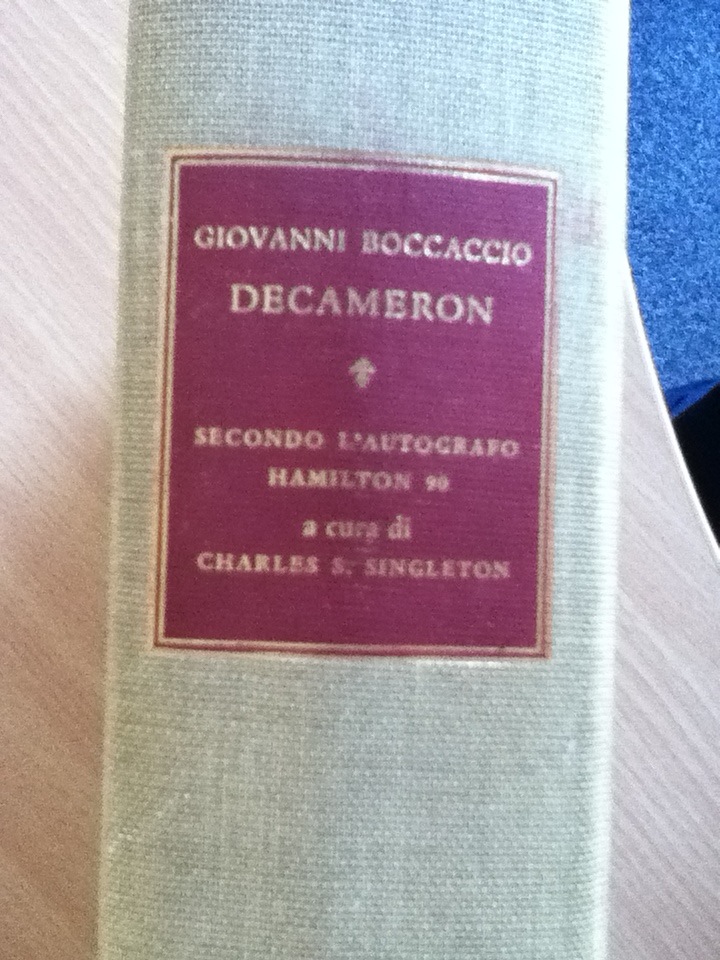
The other addition to the crazy man library is the ‘edizione diplomatico-interpretativa’ of MS Hamilton 90 (Boccaccio’s autograph of the Decameron), edited by Charles S. Singleton and published by Johns Hopkins University Press in 1974. It’s quite an interesting volume and I’d been on the lookout for it for a while, and you do indeed see copies appearing, and sometimes not for crazy prices. But when I saw this one online for £2.50, I thought: this is a kind of craziness I can really get behind. In lovely condition, ex-library, usual stamps (as they say), but a good deal more than adequate as a study copy. I have already cited it in a footnote, so it has now earned its keep on the shelf. I think I’d rather like to have Singleton’s 1955 Laterza edition of the Decameron, and, again, you do see copies around, but I’ve been put off by them being ever so slightly pricy, and of course the enormous, exaggerated postage costs from Italy.
Now, back to (my) Boccaccio.
Tuesday, 11 June 2013
Boccaccio Baby!

It is possible that some of you may not have heard that, throughout this very year, the anniversary of the birth of Giovanni Boccaccio is being celebrated in Bacchanalian excess all over Europe. An enormous number of conferences have been organized, the proceedings of which will emerge over the next couple of years and will keep us going for some good while to come. It’s all very exciting, to be perfectly honest. I have saddled up a couple of times myself, giving a paper in Bologna in November of last year, on the Mannelli glosses to the Decameron, another paper in Binghamton, NY, on the catchwords in the Berlin autograph of the Decameron, and then another last week, which was great fun, on Boccaccio and Petrarch in the Rome conference Boccaccio in Europa. These have been very stimulating meetings, with a lot of fresh and interesting research. Of particular interest in Binghamton, for example, was the work presented by Marco Cursi on the evolution of Boccaccio’s handwriting and punctuation, as well as the fascinating head at the end of the Toledano autograph of the Comedìa. I’ll be heading to Manchester, for Locating Boccaccio in 2013, next month, to give a paper again on Mannelli. And then, hopefully, no-one will have to listen to me for at least a while more. But the anniversary seems to have concentrated the mind for Boccaccian studies, and there is such a lot of work being done and in the process of coming out. The ‘Events’ page on the website of the Casa del Boccaccio is like a veritable trending Twitter feed. There is a website dedicated to listing the conferences and exhibitions, here (the English version of which is not always updated as cleanly as it could be), while the Trenitalia website hosts a PDF with a list of everything that’s happening, presumably to help the conductors deal with the hoards of people moving around the peninsula. I know what you’re thinking: it’s like the Jubilee in 1300 all over again! And so it should be.
Apart from the conferences already mentioned above, there has been a very interesting gathering in Ferrara in November 2013 entitled Dentro l’officina di Boccaccio, with an excellent account provided by one of its participants, Angelo Eugenio Mecca on his blog. The proceedings are due to appear at the end of this year or at the beginning of 2014 with the Biblioteca Apostolica Vaticana, Collana “Studi e Testi”. Later in the year, the Biblioteca Medicea Laurenziana will host an exhibition of autograph manuscripts, which has occasioned a range of very important and exciting research by the best palaeographers and philologists around. There will also be a conference held between Florence and Certaldo, which will be, I suspect, ‘the big one’.


As if this wasn’t enough, a brand new edition of the Decameron has been published, by Rizzoli in the BUR Classici series, with a newly edited text, prepared by Maurizio Fiorilla, an introduction and apparatus of notes by Amedeo Quondam, and introductions to each giornata by Giancarlo Alfano. And then there will be, with Cambridge University Press, Martin Eisner’s book Boccaccio and the Invention of Italian Literature: Dante, Petrarch, Cavalcanti, and the Authority of the Vernacular.
So this is a tremendously exciting year to be working on Boccaccio. Let’s hope we can all do him justice.
Tuesday, 5 March 2013
Just say No, or On Being «colui che fece il gran rifiuto»

It is fair to say that most Catholics did not see this one coming. Benedict, it is true, had said in an interview with Peter Seewald that he could foresee circumstances in which a resignation was possible. But most people thought this would happen when the signs of old age and illness were much more visible. After all, the final years of John Paul II’s papacy were marked by severely debilitating illness. He cannot have been able to manage effectively in such a state.
The resignation of Pope Benedict XVI has led many to consider the rarity of precedents. The last time a pope abdicated was in an attempt to heal the schism in the Church, during the Council of Constance in 1415. The Council is not principally remembered as the stage for Gregory XII’s abdication (and resignations were not at all common in the Middle Ages). Instead, it is remembered as the first time voting took place along national blocks, in which some see a nascent ‘nation-state’ identity emerging. The strategy of resigning was successful. A single successor was elected, a Colonna who took the name Martin V, and, importantly, was universally recognized as pontiff.
The time before that was an interesting case, both for the character involved, the way he was elected, and the consequences of his abdication. With the benefit of hindsight, commentators now see Benedict’s two visits to the tomb of Celestine V in L’Aquila as significant. The picture above shows the pontiff in a gesture that was surely important: he lays his pallium on the tomb. The pallium is the symbol of papal power (the plenitudo pontificalis officii). Indeed, Benedict himself was responsible for changing the form of the pallium in 2008, so he intimately knew its significance and the power and tradition it represented. Taking it off in such a dramatic gesture was the intellectual, scholarly Benedict’s version of a press release.

Pietro da Morrone was a hermit, holy and fastidious in his asceticism, and a founder of a new order (named after him, the Celestines) under the Benedictine Rule. His election to the See was about as unlikely as one could imagine. It probably felt that way to his electors, too. Celestine V was the last pope elevated in a non-conclave election. Rival factions had created a stalemate and after two years an outcome was looking impossible. In desperation, the sick and dying Latino Malabranca, cardinal-nephew of Nicholas III, cried out that he elected Pietro da Morrone as pope. Since it meant no-one got their way, all agreed. There are accounts of Pietro being particularly reluctant, and effectively being forced to accept the throne. It was a disastrous papacy, he had no political or administrative experience, and was caught in a power struggle he barely understood. Fortunately, Cardinal Benedetto Caetani was on hand to offer advice.
.jpg)
Celestine promptly issued a decree making it possible to resign, and he then...resigned. Benedict was elected his successor, took the name Boniface VIII. He was an immensely powerful and intelligent man. Knowing that the transition to a new papacy is delicate at the best of times, but would be much more complicated with a living pontiff emeritus, Boniface had Celestine captured and imprisoned, where he eventually died. This led to allegations of murder.
Many people have referred to Dante in the commentary on Benedict XVI and Celestine V, and it might be an idea to return briefly to the figure of Celestine in the Comedìa. Not least because this event is now something we share with Dante, who saw a papal abdication in his own lifetime.
Just as Dante enters Hell, he sees for the first time those souls suffering in eternal damnation. The canto opens with dramatic and violent descriptions,
Diverse lingue, orribili favelle,
parole di dolore, accenti d’ira,
voci alte e fioche, e suon di man con elle
facevano un tumulto, il qual s’aggira
sempre in quell’ aura sanza tempo tinta,
come la rena quando turbo spira. [Inf III 25–30]
Then he sees those angels who were neither rebellious nor faithful to God, but ‘per sé fuoro’. They are neither one nor the other, in a curious outside or not fully committed status, not standing for anything. Indeed, the canto is full of reserve when it comes to Dante engaging with those he meets. Apart from Caron, that is, those pertinent to the structure of the canto and its narrative architecture, nobody is actually named in this canto. They are not worth naming, ‘non ragioniam di lor, ma guarda e passa’, says Virgil. While watching this group following a flag (the contrappasso is that they must follow a flag they would never have cared about in life), Dante recognizes someone.
Poscia ch’io v’ebbi alcun riconosciuto,
vidi e conobbi l’ombra di colui
che fece per viltade il gran rifiuto. [Inf III 58–60]
Dante lexically inflected this passage with unusual and rare words, indicating how important it was. The expression ‘vidi e conobbi’ is unique in the Comedìa: it says the same thing twice, reinforcing the fame of this figure, and his recognizability. The lines are powerful because Dante pointedly does not name the figure he meets, but at the same time Dante is sure it is him and recognizes him immediately. Attributing ‘viltade’, cowardice, to him is another strong move: it is precisely the accusation levelled against Dante himself in Inf II 45 (‘l’anima tua è da viltade offesa’), and the opening lines of canto III has Virgil urge Dante on his journey with the words: ‘Qui si convien lasciare ogne sospetto; | ogne viltà convien che qui sia morta’ (ll. 14–15). The word viltade, then, means here cowardice or spinelessness. It is what you shouldn’t have, especially when you’re doing something important. The word ‘rifiuto’ is also quite rare in the Comedìa: it appears only once in the Inferno, and as a verb appears three more times in the Purgatorio (I 72; VI 133; XXIV 114). As a noun, which it is here, it occurs just once, and its rhyme position draws even more attention to its unusualness. The earliest readers of these lines identified this figure with Pope Celestine V, as does the rubric to the canto, rubrics which appear in the earliest and most authoritative manuscripts (Dante was not, however, responsible for them, according to Petrocchi). Curiously, not many illustrations go in for representing Celestine as the figure in question [see Brieger in Vol. 1, p. 120]. An exception is Florence, Biblioteca Medicea Laurenziana, MS Plut. 40, 7, f. 6r, where a pope is shown holding the banner, in a full frontal pose, completely nude. The manuscript is late fourteenth-century, and probably Florentine. (Brieger and Meiss describe these drawings as ‘passable’ [Vol. 1, p. 231]; on the MS see Roddewig, cat. no. 99, and Marisa Boschi Rotiroti, Codicologia trecentesca della Commedia, pp. 116–7, cat. 62, and p. 177, tav. 8, for an illustration of f. 108v). See Anna Maria Chiavacci Leonardi’s note on Vol. 1, p. 99, for a good summary of the issue and some bibliography.
In Inf XXVII, Guido da Montefeltro, guilty of fraudulent counsel, recalls the words of Boniface VIII, who refers to the two keys of St Peter, ‘che ’l mio antecessor non ebbe care’ (and the word antecessor is a hapax here). This is surely intended to drip with irony. Dante saw Boniface as a disaster for the papacy and for Christianity. For Dante, Celestine’s gran rifiuto paved the way for Boniface, and that is his real fault.
As the Conclave is about to be called, the importance of its decision is indeed onerous. Given the unique status of this Conclave, one idea might be to elect from outside the ranks of cardinals. I can think of some eminently suitable candidates: Archbishop Diarmuid Martin, for example. But I suspect that no such thing will happen. Whoever it will be, it is unlikely he will need to imprison the pontiff emeritus, though a living antecessor is indeed a hapax.

In Inf XXVII, Guido da Montefeltro, guilty of fraudulent counsel, recalls the words of Boniface VIII, who refers to the two keys of St Peter, ‘che ’l mio antecessor non ebbe care’ (and the word antecessor is a hapax here). This is surely intended to drip with irony. Dante saw Boniface as a disaster for the papacy and for Christianity. For Dante, Celestine’s gran rifiuto paved the way for Boniface, and that is his real fault.
As the Conclave is about to be called, the importance of its decision is indeed onerous. Given the unique status of this Conclave, one idea might be to elect from outside the ranks of cardinals. I can think of some eminently suitable candidates: Archbishop Diarmuid Martin, for example. But I suspect that no such thing will happen. Whoever it will be, it is unlikely he will need to imprison the pontiff emeritus, though a living antecessor is indeed a hapax.

Wednesday, 28 November 2012
Giovanni Nencioni's Study


Wednesday, 21 November 2012
Pococurante

I get a word of the day from the OED via email. Today’s word was pococurante. I’d never heard it used before in English. Today I’ve decided to be pococurante (except on my bicycle on the way to the office).
pococurante, n. and adj.Pronunciation: Brit. /ˌpəʊkəʊkjᵿˈranti/, U.S. /ˈˌpoʊkoʊˌkjəˈrɑn(t)i/Etymology: < Italian poco curante caring little (early 17th cent. or earlier) < poco poco adv. + curante, present participle of curare to care (a1294 in reflexive use; 13th cent. in sense ‘to cure’; < classical Latin cūrāre cure v.1), probably via the name of Seigneur Pococurante, a fictional apathetic Venetian senator in Voltaire's Candide (1759).A. n.A careless, indifferent, or nonchalant person.1762 L. Sterne Life Tristram Shandy VI. xx. 85 Leave we my mother—(truest of all the Poco-curante's of her sex!)—careless about it.1779 H. Thrale Jrnl. 1 May in Thraliana (1942) I. 382 He seems to have no Affections, and that won't do with me—I feel great Discomfort in the Society of a Pococurante.1860 Blackwood's Edinb. Mag. June 708/2, I really cannot afford to hazard my reputation as a poco-curante.1949 V. W. von Hagen South Amer. called Them iii. xvii. 219 If the Reverend Dr. Samuel Butler could have composed a single line to describe him..he might have put: ‘rat-catcher and pococurante’.1995 Guardian 26 May (Friday Review) 8/3 The dreamy pococurante needs to bluff his way into employment at a top National School.B. adj.Careless, indifferent, nonchalant.1815 T. Moore Mem. (1853) II. 76 That idlest of all poco-curante places, Dublin.1823 W. M. Praed Troubadour in Poet. Wks. (1844) 102 Poco-curante in all cases Of furious foes, or pretty faces.1881 Sat. Rev. 9 July 32/1 Lord Granville's pleasant faculty of pococurante conversation.1948 P. A. Scholes Great Dr. Burney I. xxxvii. 379 Some odd news, which illustrates, let us proudly say, not the pococurante spirit but the sangfroid of our great British nation.1985 Pick of Punch 25/1 A gust of river wind sprayed my entire shirtfront with damp powdered sugar; I remained placidly pococurante.Derivativesˌpococuˈrantish adj. careless, indifferent, or nonchalant in character.1821 Examiner 491/1 Criticism has been a little Pococurantish of late years.1916 G. Saintsbury Peace of Augustans (1946) v. 229 He had, when he chose not to be flighty or pococurantish, not inconsiderable common sense.2003 Financial Times 13 Dec. (Weekend Mag.) 31 Are you quite pococurantish in the face of pressure to spend your hard-earned money on finnimbruns?
Sunday, 18 November 2012
Boccaccio Bologna Books

It has been the longest time since I last updated, and I’ve been the busiest little bee. The most important thing to have happened is that I’ve moved to York to take up a lectureship at the University. This has meant moving house, settling in to a new city, and settling in to a new department. It has been a very good move, though of course I miss Pembroke very much and my friends there. York is a beautiful medieval city with an imposing cathedral, the largest Gothic cathedral in northern Europe, called the Minster. It’s a gem, with extraordinary stained glass. So, the city is a great place to be a medievalist.
 Another thing that has kept me busy was preparing for a conference in Bologna last week and that was enormous fun. It was held in the Sala dello Stabat Mater in the Archiginnasio. The programme was very full but enjoyable and it was wonderful to see friends, colleagues and maestri, old and new. The third day was held in Ravenna, which was where I gave my paper. During the lunch break we went around the corner to see the Arian Baptistry, with its rather wonderful mid-sixth century mosaic depicting the baptism of Christ. It is such an extraordinary thing to have these treasures on your doorstep, to be able to take ten paces from the office door and to be standing under this! During the conference, there was a delightful bookstall, where those giving papers could take what they wanted, for free. I began to silently hyperventilate when I realized this was the case, then proceeded to jump upon the table with my arms outstretched explaining how I needed them all. I know what you’re wondering now: what books did you get then? Well, Carlo Delcorno’s edition of Domenico Cavalca’s Vite dei santi padri for SISMEL was clearly the prize win, and I’m just delighted to have it. I also picked up a copy of Bodo Guthmüller, Mito e metamorfosi nella letteratura italiana, Fiorenzo Forti, Magnanimitade: studi su un tema dantesco. While in town, I took the opportunity for a little whizz around some of my old familiar bookshops, and found a copy of Azzurra B. Givens, La dottrina d’amore nel Boccaccio, and K. Esser, ed., Opuscula Sancti Patris Francisci Assisiensis. So delighted with those.
 Some little while ago I blogged a photo of the great Raimondi in his study and mentioned that his latest book, Le voci dei libri had just appeared with Il Mulino. While at the conference, I happened upon the the fact that in the bookshop Zanichelli, more or less downstairs from the Archiginnasio, they were giving away copies of Raimondi’s book. It was thus that I felt a moral obligation to read it, and did so on the journey home. It is a beautiful meditation on the books in his life, how they came into his life, who brought them. I found so moving his account of reading Being and Time in the ruins of a Bologna terribly scarred by the war, and his time at Johns Hopkins and encountering the work of Bakhtin (with a telling tiny comment on this first encounter being in the English translation of his Rabelais book, much enriched when some time later he came to read it in the far superior Italian translation [L’opera di Rabelais e la cultura popolare, Einaudi, 1979, something that is very obvious to anyone comparing both translations).
On the way home I also read the ‘Domenica’ section of Il Sole 24 Ore where Claudio Giunta talks about the teaching of Dante in schools, the new challenges for the teaching of medieval literature, how their engagement with new media, social networking, etc, affects the way that these texts are now read. I wonder what the next Raimondi will look like, and what story his or her version of Le voci dei libri will tell.
Subscribe to:
Posts (Atom)
LinkWithin
