Showing posts with label Italianistica. Show all posts

Saturday, 23 May 2020

The Decameron and COVID-19


Paris, Bibliothèque nationale, MS Ital. 63, f. 9v


The rapid and alarming spread of COVID-19 around the world, and the  consequent lockdowns imposed in one country after another, have led to a good deal of commentary on how people have dealt with outbreaks of contagious diseases in the past. Perhaps it was inevitable that the fourteenth-century example of the Black Death would be raised, but it was less expected that copies of the Decameron would sell out on amazon.com. Indeed, it is becoming increasingly common to talk of the Decameron and COVID-19 - see here and here and here.


The Decameron of course is a text that emerges out of lockdown conditions. The ‘story’ of the story-collection is that ten young Florentines, seven women and three men, gather in the church of Santa Maria Novella during the plague of 1348, and agree to flee the city together and repair to a country villa, safely away from the noxious air of Florence. When they arrive at this villa they decide to tell each other stories to pass the time. One member of the brigata (‘group’) is nominated monarch for the day, and this person chooses the order in which the stories will be told (each person tells one story per day), and selects the theme for the following day’s stories. Each day closes with a ballata sung amidst decorous dancing and merry-making. So the Decameron is a ‘framed’ narrative, deploying a literary technique of mise en abyme: first the author presents his book in a ‘Proem’, which in turn frames the ‘Introduction’ to the First Day, introducing the story of the brigata, members which in turn tell their individual stories. The frame has the effect of keeping the stories at a certain distance from the author, and allows for the author to offer further commentary on the stories. This happens, for example, in the ‘Introduction’ to the Fourth Day.

Let’s return to the beginning of the Decameron, since the technique of framing necessitates the reader to pass over several thresholds, namely, the Proem and the Introduction, and consequently to draw connections between them.

In the ‘Proem’ the author explains how he came to write the work. As a young man, such was the immoderate intensity of love that he experienced, that he frequently benefited from the sympathy of friends. Wishing to be grateful, the author proposes to offer these stories for the benefit of those who are currently in distress. Lovesick women suffer in particular because, unlike men who can go out hunting with their male friends for distraction, they must remain indoors to protect their honour. Women, that is, are subjected to a continuous lockdown because of their gender, and, under such conditions, are prone to noia, an anxious mental state that is not equivalent to what that word means in present-day Italian, ‘boredom’, but rather something much more akin to what we would call depression. Thus 
‘in soccorso e rifugio di quelle che amano, per ciò che all’altre è assai l’ago e ’l fuso e l’arcolaio, intendo di raccontare cento novelle, o favole o parabole o istorie che dire le vogliamo’ (Dec. Proemio 13)

(‘I intend to provide succour and diversion for the ladies, but only for those who are in love, since the others can make do with their needles, their reels and their spindles. I shall narrate a hundred stories or fables or parables or histories or whatever you choose to call them’, trans. McWilliam). 
A couple of things are very striking about this: the Decameron is directed at a restricted audience, those women who are suffering; and the kinds of stories that will be included cover a very wide range of genres. Indeed, the paratactic phrasing ‘novelle, o favole o parabole o istorie’ flattens out the distinction between them, perhaps suggesting that the genre of the stories in the Decameron won’t be easy to define with traditional terms.

The ‘fictional’ story of the frame then begins, set during the real plague of 1348. We know that Boccaccio was in Florence when the plague broke out (March-April, 1348), and his father had an official role in the city as one of the ‘Otto di Abbondanza’, whose duties included food rationing and public hygiene (Branca, Boccaccio: profilo biografico [1977], p. 78 n. 41). We would probably call such a role now a ‘front line service’. He appears to have been appointed to this role between June 1347 and August 1348, when he succumbed to the contagion. Boccaccio also lost his stepmother, and a host of friends and acquaintances.

Paris, Bibliothèque nationale, MS Ital. 63, f. 6r – the ‘triumph’ of Death

The first half of the Introduction (§§1-48) is given over to a description of the plague in Florence. It details the first signs of the disease, the symptoms, the immediate response of the citizens of Florence, one is to ignore the problem, the other is to completely isolate, and others still chose a middle path between the too. It made little difference to the outcome, and those who showed symptoms were inevitably dead within three days. The social consequences of this destruction are then outlined, with people left in neglect through fear of becoming sick, the obsequies of the dead being too short, and many unscrupulous types taking advantage of people’s fear with quack remedies. What would have once been considered utterly inappropriate in terms of modesty has become normal. And the narrator then closes this account by observing that even those in the countryside, in less densely populated areas, fared no better.

This is the context in which seven young ladies find themselves in Santa Maria Novella, and begin to wonder if getting out of the city might not be a good idea. They are joined by three handsome young men, who at first think their invitation to join them in the countryside is a joke, and thus the second half of the Introduction Day I continues.

It should be already clear  that a parallel is being drawn between two different kinds of illness: lovesickness, and the plague. A remedy for one, amusing distraction and keeping oneself entertained, is also a remedy for the other. The multiple frames of the Decameron allow for these several perspectives to be in play at the same time.

So the many stories that are now in circulation on ‘heartbreak’ in lockdown, where those who have just broken up are stuck at home and cannot move on, might take some solace in the Decameron and in the knowledge that it is a book written more or less just for them.
 

Sunday, 11 March 2007

Justin Steinberg, Accounting for Dante (Notre Dame, 2007)

The latest addition to the William and Katherine Devers Series in Italian Studies at the University of Notre Dame Press is the extremely good Accounting for Dante: Urban Readers and Writers in Late Medieval Italy by Justin Steinberg. I could hardly put this book down and greatly enjoyed it.

Steinberg aims to navigate a path between literary criticism and philology. He asks why Dante, who is so concerned in his work with concepts of circulation and transmission, is not studied in the context of his earliest transmission in the so-called Memoriali bolognesi. To look at the notary records in Bologna, records that contain some of the earliest written witnesses of Dante's work, is not new, and work continues apace. But what is so interesting about what Steinberg does is to ask why particular poems appear beside particular records in the Memoriali. Steinberg combines a reading of the Memoriali with an analysis of the rise of notarial guild in Bologna. With this he also looks at how the way books were put together changed dramatically in the period, especially amongst the merchant class and the account books. So rather than quires being copied and subsequently sewn together, the account books were bound blank and then filled up page by page.

The other strand of this study is to examine some of the very famous vernacular anthologies, in particular Vat. 3793. He looks at the editorial choices exerted in these anthologies and how Dante could have seen a lyric such as Donna ch'avete copied in his lifetime in the Memoriali bolognesi (no. 82) and in Vat. 3793 (f. 99v). He looks at the contexts of this poem and in particular the way that it is followed immediately by the poem Ben aggia l'amoroso et dolce chore. In light of this use and abuse of Donna ch'avete, Steinberg reads Purgatorio 24 as a site of two innovative authorial strategies first attempted in the Vita nuova: 'First, he [sc. Dante] suggests that the ultimate authentic text lies in the author's mind and not in the public reception and various material redaction of his texts. This shift in emphasis from reader to writer foreshadows textually what Petrarch and Boccaccio would later experiment with materially when introducing their autographed author's books, and it places renewed importance on authorial intention. Second, Dante presents his dialogue with other vernacular poets as transcending the contingent, contentious "nodo" of contemporary literary production and politics' (p. 94). He then looks at how an anthology like Vat. 3793 is made up of quires representing particular geographical regions and puts such an extended discussion beside an analysis of the De vulgari eloquentia. The results are fascinating and exhilerating.

Chapter One comprises: Dante's First Editors: The Memoriali bolognesi and the Politics of Vernacular Transcription. Chapter Two: "Appresso che questa canzone fue alquanto divulgata tra le genti": Vaticano 3793 and the donne of "Donne ch'avete intelletto d'amore". Chapter Three: "A terrigenis mediocribus": The De vulgari eloquentia and the Babel of Vaticano 3793. Chapter Four: Merchant Bookkeeping and Lyric Anthologizing: Codicological Aspects of Vaticano 3793. Chapter Five: Bankers in Hell: The Poetry of Monte Andrea in Dante's between Historicism and Historicity'. Epilogue: "Dante": Purgatorio 30. 55 and the Question of the Female Voice.

The book looks at how Dante can be viewed in the codicological context of his contemporaries and how such a horizontal view can provides new perspectives on old and familiar texts. It is written with a light and subtle touch and can cut through swathes of (sometimes difficult) codicological and philological material an eye Ockham might envy. There is nothing so satisfying as a book that helps you see the familiar in an entirely new light. Tolle et lege.

Thursday, 15 February 2007

Ludovico Ariosto, Orlando furioso, secondo la princeps del 1516 (Florence, 2006)

Of great interest is the recent publication of the 1516 edition of Ariosto's Orlando furioso (Florence: Olschki, 2006), ISBN: 88 222 5576 1, edited by Marco Dorigatti. The text of the poem was first issued in 1516 but was extensively revised by the author and republished in 1532. This text, risciacquata in Arno, is the standard edition used today. The 1516 text is not widely witnessed and is extant in just 12 printed copies. Each is interesting because of Ariosto's tight and careful control of every aspect of the page, right down to typographical details. Dorigatti (a lecturer in the Faculty of Modern Languages at Oxford), after an extensive study of these witnesses, reconstructs this earlier text and makes available for the first time an Orlando that is considerably more Ferrarese than Tuscan. The later text was rendered less local, less provincial, and the Tuscan made it more widely popular (more palatable?). The publication of this new text makes it much easier now to study a masterpiece in the re-making and will surely become required reading for the study of Ariosto's reworking and rewriting of himself into Italian literary history.

At the Taylor Institution is a small exhibition to celebrate the publication of this new edition and it is well worth a visit. It contains some of the interesting early editions in the Taylor Institution Library's collection as well as some modern editions.

Sunday, 5 November 2006

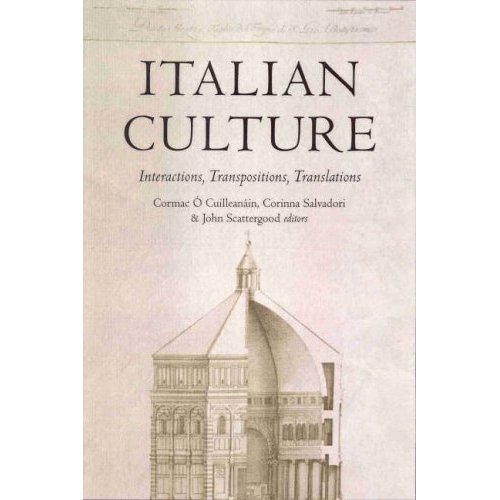
Italian Culture, edd. Ó Cuilleanáin, Salvadori & Scattergood (Four Courts Press, 2006)

Languages appear to be in decline here in the UK. Annual surveys show that large numbers of students have stopped studying foreign languages at schools. Such declines will have a sharp effect on university teaching and in turn how departments rise to the challenge of teaching such students. Whether they will choose to learn a language at university is quite another hurdle.

When the professor of Italian Studies at Trinity College, Dublin (my alma mater) retired, there was a celebratory study day to mark her many years of service to the department. The papers given comprise the articles in this book. The title contains no reference to it being a Festschrift, and Professor Salvadori is in fact one of the volume's editors, so it should be considered a testament to the intellectual vibrancy of the department and to its broad range of interests, as much as it should be considered an homage to its former head of department. A highlight is Peter Armour's contribution on poet-friends in Dante's Florence, a paper he had to deliver sitting down he was so ill. His death, shortly thereafter, was a sad sad loss to Dante studies.

The opening article, written by Corinna Salvadori, is a moving and fascinating account of the history of Italian in the College. Provost John Hely-Hutchinson thought it would be 'highly useful to have Professors of modern languages established in the College', and before long two professorships, one of Italian and Spanish, and one of French and German, were established (in 1776). It was not met with universal approval. One Senior Fellow described the decision as 'pernicious', and wondered would the next step be a Professorship of Horsemanship. Languages, like horsemanship, were 'polite accomplishments' and 'teachers of modern languages, fencing, and dancing masters, and horse-riders, are not always the most eligible companions for youth' (p. 13). Part II of Salvadori's article then discusses the subject in College from the 1960s onwards. It is the story of dedicated teaching staff faced with neglect and disinterest. It is stunning to read the account of Provost Watts coming in to Salvadori's office to explain calmly that the department would remain open simply because it was the cheapest department in the College to run and thus its closure would make no significant saving. The department was for years run by just Corinna Salvadori and Clotilde Soave Bowe, both of whom taught a breadth and load that would not be considered possible now. External examiners would consistently praise the high quality of the degree and with incredulity learn it had all been done by just two people. In the 1980s the department expanded slowly but steadily offering ever stronger and broader preparations for its students. Medieval studies has certainly been the department's forte with two of its staff, Salvadori and Cormac Ó Cuilleanáin, being accomplished critics of the work of Dante and Boccaccio respectively. And it is Dante who looms so large at the absolute heart of the department, the man who made it all worthwhile.

He is the good man behind the great woman in this story.

I beg indulgence for a moment while I tell one anecdote. I was coming to the end of my first year in Italian and was feeling martyred at the huge amount of work we had to do. I'd taken Italian ab initio and felt I was utterly suffocating under verbs and paradigms and god knows what. An evening of poetry had been arranged in the department and Seamus Heaney was invited. Having extricated myself from some piece of work, I went along. Heaney read his translation of the Ugolino episode, in his Fieldwork (1979). It was stunning and beautiful. Corinna Salvadori got up to read the Italian. You could hear a pin drop. She read it with beauty and music and power and horror, and the hair raised on the back of my neck and my stomach churned, and I realized I was in the presence of something great. That evening I made my mind up to continue with Italian and to make an Eramsus application to go to the University of Bologna for a year. And after that all was changed, changed utterly.

It seems that people are returning to this idea that languages are a 'polite accomplishment'. Nothing is further from the truth, nor a more dangerous fallacy. A language that produces something like the Commedia cannot be accurately described as either polite or an accomplishment.

LinkWithin

Related Posts Plugin for WordPress, Blogger...