Tuesday, 30 January 2007

Enciclopedia dantesca, gen. ed. Umberto Bosco, 6 vols (Treccani, 1970-1976)

In 1944 the idea for a new encyclopedia on Dante was suggested by Umberto Bosco (1900-1987). This was designed to replace the Scartazzini 3-volume Hoepli encyclopedia published between 1896-1905. The new encyclopedia actually only took shape during the 1965 celebrations for the 700th anniversary of the Poeta's birth. In 1970 the first volume appeared from Treccani in Rome, and by 1976 the fifth and final volume of lemmata had appeared. A sixth volume appeared the following year, and contained an appendix of texts and illustrations. Thus was completed a monument of Dante scholarship. Whatever is missing from this encyclopedia is simply not worth knowing. In 1984 a 2nd edition was printed, though the revision appears to be mainly an updated bibliography rather than any alterations to the individual entries. Italian publishers are very good at producing luxury books. Think of Vallecchi, for example. So too Treccani reissued the Enciclopedia dantesca in 1996 in a beautiful deluxe edition. This edition, now out of print, was issued in 2500 copies in full leather and just exquisitely produced. The boards are lined with silk and each volume is individually boxed in leather, silk and suede.

Lately I managed to acquire a copy of the ED. It sits now by my desk and is consulted about five times a day, and that's when I'm not working on Dante. Because Dante's poem is encyclopedic, the encyclopedia is...well...even more encyclopedic. Quid dicam?

For scholars who don't read Italian there is the Dante Encyclopedia, ed. by Richard Lansing (New York: Garland, 2000). I've used it and found it very good, especially for taking account of more recent approaches and bibliography. It does not pretend to replace the ED, and a single volume of 1,000 pages could not possibly do so. But just as the ED was put together by the great Dante scholars of the time, so too does the Dante Encyclopedia comprise entries by the big Dante scholars around at the moment.

Tuesday, 23 January 2007

Marilynn Desmond, Ovid's Art and The Wife of Bath (Cornell UP, 2005)


When Naomi arrived for a court hearing into the alleged assault on her maid, she wore a t-shirt that sums up the premise of Marilynn Desmond's new book on Ovid and the erotics of violence in the Wife of Bath's Prologue. 'Naomi Hit Me...And I Loved It', or in another (more apposite) variation 'Naomi Hit Me...And It Felt Like A Kiss'.

The book opens with a very interesting account of a 1997 conference in New Paltz entitled 'Revolting Behaviour: The Challenges of Women's Sexual Freedom'. In the conference there was an informational panel looking at the issue of sadomasochism and the ideas around consensual and safe S/M. It provoked a huge controversy with the SUNY being denounced for 'promoting lesbianism and sadomasochism'. In an investigation it was found that nothing illegal had happened, no taxpayers' money had been misused, and academics were left feeling the welts of a non-consensual conservative spanking. 'The report of the investigating committee specifically appealed to free speech and academic freedom - two principles that have come under enormous pressure in the few short years since September 2001' (p. 2).


There are six chapters: 1. 'Sexual Difference and the Ethics of Erotic Violence'; 2. Ovid's Ars amatoria and the Wounds of Love'; 3. 'Dominus/Ancilla: Epistolary Rhetoric and Eotic Violence in the Letters of Abelard and Heloise'; 4. 'Tote Enclose: The Roman de la Rose and the Heterophallic Ethic'; 5. 'The Vieille Daunce: The Wife of Bath and the Politics of Experience'; 6. 'The Querelle de la Rose: Erotic Violence and the Ethics of Reading'. Chapters 3 and 6 have already appeared in 1998 and 2003. Desmond is primarily interested in the French responses to Ovid and in particular to the marginal responses that appear in gloss form in manuscripts of the French translations of the Ars amatoria. The book is particularly sensitive to the iconography of women and violence and is generously illustrated. I found very interesting the opening discussion of MS illuminations of the figure of the 'mounted Aristotle', and while the point is not forced, I was quite struck by the similarity between many of these figures and the fifteenth-century illuminations representing the Wife of Bath (cf. BNF MS fr. 95, f. 61v [fig. 4, p. 18] and the Wife in MS Gg. 4. 27, f. 222r).

Desmond is very good at looking at broad visual and textual traditions (I'm thinking of her rather excellent Reading Dido: Gender, Textuality, and the Medieval Aeneid) though this book is much more restricted in scope than Reading Dido and I was left wanting more. I'm paying the book a compliment of course, but I am also left with the peculiar feeling that the book could have been a little more substantial. The focus is, admittedly, on the mainly French traditions around Ovid, but a more developed and ripened discussion would have been welcome on the Latin commentary and glossing traditions on Ovid and how this relates to the vernacular glossing traditions. How distinct are they and why?
How Cornell University Press can think it is OK not to produce a bibliography is beyond me. This is an extremely interesting book and I very much recommend it.

Sunday, 14 January 2007

Don't I know You From Somewhere?

They have just reconstructed Dante's face from a set of 1920s drawings and measurements of his skull. Apparently his features are now softer, though the nose is still a bit aquiline. These drawings and studies are actually quite well known to historians of the iconography of Dante. In 1921 the Italian government, with the city of Ravenna, commissioned a thorough study of the Poet's bones. A Prof. Fabio Frassetto, an anthropologist at the University of Bologna, was commissioned for the job. In 1923 his findings were published and then enlarged in book form in 1933 under the title: Dantis ossa - La forma corporea di Dante. Frassetto felt that the Giotto portrait, reproduced below, was so close to Dante's skeletal remains that it must have been done from life. In Altrocchi's review of the problem, cited below, he suggests that the Palatine portrait, and Giotto's, are the two most authoritative representations we have of the Poeta.

It is interesting that there should be an impulse to reconstruct an author's face, as if it will somehow give us some sort of essence or something more than what we already have: the text.

The face and in particular the recognition of a face occur at some very powerful moments in the Commedia. In Inf. 15 Dante meets his old magister Brunetto Latini. Brunetto recognizes him first and greets him. His face is burned ('lo cotto aspetto') but not even that could keep Dante from recognizing him, 'sì che 'l viso abbrusciato non difese | la conoscenza süa al mio 'ntelletto'. Dante immediate reaction is to move towards Brunetto, and not just that but to reach out and touch his face: 'e chinando la mano a la sua faccia, | rispuosi: «Siete voi qui, ser Brunetto?»'. I always find this such a beautifully tender gesture on Dante's part, to reach out and touch Brunetto's burned and scarred face, a gesture that is entirely unselfconscious and intuitive. And notice the repetition of words for face in the passage, aspetto, viso, and faccia, how important it is to represent his face. Brunetto tells him that much honour awaits Dante. When Dante speaks to him he praises his old teacher and again comes back to the idea of Brunetto's face: 'ché 'n la mente m'è fitta, e or m'accora, | la cara e buona imagine paterna | di voi quando nel mondo ad ora ad ora | m'insegnavate come l'uom s'etterna' (Inf. 15. 82-85). For Dante the ability to recall the face of Brunetto is intimately linked to remembering what Brunetto taught him. It's almost as if Brunetto's face is a memorial locus for Dante, one that he knew so well not even burning could render it unrecognizable. Such was the affectio for Brunetto that he is pained to see him in this state, 'or m'accora'. The rhyme here is ancora/m'accora/ora, as if to reinforce the emotional shock and extent of the pain Dante feels, and exactly this is repeated in the Pier della Vigna episode just two canti previous. Such is Dante's emotional response to the awful broken twigs speaking and begging to be remembered on earth, Dante responds to Virgil's invitation to ask a question by saying: '«Domandal tu ancora | di quel che credi ch'a me satisfaccia; | ch'i' non potrei, tanta pietà m'accora»' (Inf. 13. 82-84). These are the only two reflexive uses of the verb accorar.

The second illustration is Giotto's famous portrait. He looks a little arch in this representation. It has, however, undergone some rather heavy-handed 'restoration' apparently, so maybe the skull and bones have survived better after all.

On the question of early Dante iconography see Rudolf Altrocchi, 'The Present Status of Dante Icoography', Italica 12 (1935), 106-115. Altrocchi is also responsible for an analysis of Domenico di Michelino's portrait of Dante that is found in the Duomo: 'Michelino's Dante', Speculum 6 (1931), 15-59.

Friday, 12 January 2007

Closure

Joy unbounded. Back in May 2005 I posted on a volume of the Mondadori reprint of the Ricciardi Opere minori of Dante. I had been looking for vol. 1/1, the Vita nuova and Rime ed. by Domenico de Robertis and Gianfranco Contini. It had been and has been annoying me for a long time. Well, guess what? I found it. Quite by chance, just a casual browse on an Italian version of Abebooks which is called Maremagnum. I find it a very useful site for s/h Italian books, though I do wish that Italian postal charges were a little lower. They seem to also list some of the booksellers on Abebooks, and indeed on Abebooks you'll find some of the sellers who list with Maremagnum. The site charges a commission, which seems fair enough, and they do tell you what they charge. The bookseller is called Studio Bibliografico Orfeo and it is in via Torleone 20/a, 40125 Bologna (tel. +39 051 6360113). Needless to say after looking for this book for about five years it is very satisfying to find it in Bologna. They also sent me a very elegant catalogue of their stock and it looks very interesting. Not a huge amount of Dante, but a few nice things.

The value of these editions is their commentaries, which are excellent. The texts themselves are, bit by bit, being superseded by more recent editions, such as de Robertis' edition of the Rime (I want it I want it etc), Brambilla-Ageno's text of the Convivio and Gorni's edition of the VN, though in this last case we may be talking more about a question of a reinterpretation of the divisio textus rather than individual lectiones; undoubtedly Barbi's text is still extremely important.

I had heard a rumour that Treccani, who bought the Ricciardi catalogue, were going to publish the Opere minori again, and I have a feeling they're going to bring it out in those editions they sell with the Sunday newspapers. I've already seen one of the Promessi sposi and would guess it's going to be the same for Dante. I have another little find that I'll post about soon, but will wait until it arrives!

Sunday, 7 January 2007

Joanna Newsom, Ys (Drag City DC303, 2006)

Anyone who heard Joanna Newsom's last album, The Milk-Eyed Mender will have sat on tenter-hooks for the new album, and here it is. If you didn't like that album then the chances are you'll not warm to this one, though they are quite different. The critical response has been effusive, and it is deserved. Ys contains only five tracks, the longest of which is nearly seventeen minutes. The sound is familiar, but the voice has begun to settle and the sound has begun to widen. There is much more orchestration, so the sound is often very full. Van Dyke Parks did the arrangements and conducting and is credited on the album as playing the accordion; Jim O'Rourke did the mixing; and Steve Albini recorded harp and vocals. That's quite a heavy duty set of collaboration. The lyrics are bonkers but really beautiful. They have a great sense of poetry and music about them, strange and at the same time right. The first track, Emily, contains the following:

And, Emily, I saw you last night by the river.
I dreamed you were skipping little stones across the surface of the water -
frowning at the angle where they were lost, and slipped under forever,
in a mud-cloud, mica-spangled, like the sky'd been breathing on a mirror.

I think that this is an extraordinary achievement and you simply must hear this album. It really is just that simple.

The name of the album is also quite interesting. There is no explanation in the album jacket about the name. The only interpretative clue might be in the cover art, though even that may be enough to keep even Panofsky going for a while with its symbolic imagery. I think that it must have some medieval overtones, like those Northern European masters. The artist Vierling seems to be fond of a kind of Victorian Gothic revival medievalism (Waterhouse, that kind of thing), so I think something of this nature is going on. The name Ys then could refer to the Breton city of King Gradlon who fell in love with a druid/fairy woman, bearing him a daughter Dahut. The beautiful city of Ker Is (or simply Ys) is protected by dams with a bronze floodgate to which only the king has a key. Dahut steals the key, under varying sets of circumstances in different versions of the legend, and opens the floodgates. Gradlon's protetor saint, Guénolé, urges him to throw his (still pagan) daughter into the waters so that they may subside. He does so eventually, but the city is destroyed and becomes the Bay of Dourarnenez in Brittany. Dahut is transformed into a sprite/siren where she can still be heard singing and enchanting sailors to their watery end.

Whether any of this is supposed to have contemporary New Orleans resonances, as I've read some suggest, I am unsure. Water is certainly a very strong theme in the album, and I suspect that the story of a doomed pagan princess sacrificed to save a doomed city was too crazy for her to pass over.

Margery at the MLA

Please read Geoffrey Chaucer hath a Blog for a wonderful account of Margery Kempe going to the MLA. I have just managed to pick myself up off the ground laughing. Genius.

Thursday, 4 January 2007

Déjà vu, dir. Tony Scott (2006)

Please note: the following contains serious spoilers. It's very difficult to talk about without giving away the conceit of the film, so brace yourself or stop reading. Really. If you don't want to read on, for now I'll just say that I highly recommend the film and enjoyed it a lot.

What would you do if you could change the past? If you could travel back in time and do something about some terrible event? Set against the backdrop of an only just recovering post-Katrina New Orleans, Déjà vu opens with an act of domestic terrorism that leaves the city reeling. A ferry boat full of US Navy officers and their families is blown up with over 500 dead. Federal ATF agent Doug Carlin (Denzel Washington) sets about sifting through the debris and his sharp eyes brings him to the attention of FBI agent Andrew Pryzwarra (Val Kilmer). Carlin, we are told, cut his teeth on the Oklahoma bombing case. Pryzwarra assigns him to an elite team of technical wizards who have found a way to bend time, opening a worm-hole into the past that can be viewed on a set of huge monitors in a laboratory. They can see four days ago, in a continuous stream that can cannot be rewound or fast forwarded. So they sit and wait for clues around the bomb site, and will eventually see the bomber actually perpetrate his crime. Then they just arrest him and they’ve solved the crime. Great. But what if they could actually do something about it? What if they could send some sort of a message back to some point in the past so that Carlin could pick it up? What happens if you change the past? The future becomes obsolete, out-dated. Or was it all meant to happen anyway?

The trouble begins when Carlin gets a call about a woman, Claire Kuchever (Paula Patton), who is found with injuries ostensibly caused by the bomb but a full hour before the bomb actually went off. He investigates and believes that she is somehow crucial to understanding what's going on. And in the post bomb time-line, understanding her behaviour, the message 'U Can Save Her' written with magnetic letters on a noticeboard, all seems impossible but significant. Shortly after, the forensic team tell Carlin his fingerprints are all over the apartment, and put it down to his carelessness on initial investigation. But his fingerprints and blood-soaked swabs are both in the apartment though he'd never been there. Thrilling high-speed chases ensue, with Carlin wearing his time-warp-seeing gizmo on his head and following the bomber back to his hideout. There he watches the past happen before his eyes. When Carlin does manage to send himself back in time he has already experienced the things about to happen in this past future, and he anticipates them. So he changes the future, a future he has already experienced, by averting the explosion and saving Claire. His conversation with the bomber, Carroll Oerstadt (Jim Caviezel), creates a sense for Oerstadt of uncanny foreknowledge, a sense that Carlin brings by mentioning things in Oerstadt's FBI questioning in the future. However, in a blaze of bullets this futuristic Carlin gets killled with Oerstadt, while managing to save Clare. And as Claire sits on the shore awaiting questioning by the authorities, Doug Carlin arrives to investigate the explosion. And the future begins again.

Time-travelling is a complicated business, as either Marty McFly in Back to the Future or Hermione and Harry in Harry Potter and the Prisoner of Azkeban will tell you. The conceit of the film, that the sense of déjà vu is caused by actually having experienced something before, a sense of another parallel experience in a 'many worlds theory'-type existence. But the post-bomb 'present' of the film contains realities that Carlin will change, it already contains the alternative past (his bandages and evidence of his presence in the apartment), though he has not actually returned to the past yet. It is as if many pasts are being lived at once within a complex multi-temporal present. Within this present Claire is both dead and alive. (I wonder is a bit like Shroedinger's Cat? If time-travel is going to happen it will be with quantum physics.)

Needless to say there is a huge amount of wish fulfillment in such a film. It's poignant. The great unspoken act of terrorism in the film is 9/11. Imagine being able to return and change that? What kind of present would we now be living? Can we still live that present? By changing the present do we not also, in a way, change the past? To understand the possibilities that surround us in the present is also to understand the complexity of the past, and visa versa. To slip in and out of the past and present is, perhaps, what is most politically subversive about this film, what challenges everyone about what it is they experience and how it has come about.

Wednesday, 27 December 2006

Simon A. Gilson, Dante and Renaissance Florence (CUP, 2005)


Contained in the Proemio to Cristoforo Landino’s Comento on the Divine Comedy is a chapter that comprises the full text of one of Marsilio Ficino’s Latin letters and in which he presents Dante’s coronation with laurel. The scene is surely one suggested by Dante himself when he prophesies his return to the Baptistry to be crowned as poet laureate: ‘con altro vello | ritornerò poeta, e in sul fonte | del mio battesmo prendero ‘l capello’, Par. 25. 7-9. This coronation is brought about through the agency of the poet, vates Landino himself, and the text reads:
‘recently your [sc. Dante’s] father Apollo, made pitiful from my long weeping and your eternal exile, sent Mercury to enter the devout mind of the divine poet Cristoforo Landino. Having assumed Landino’s appearance, he used his wand to awake your sleeping soul, his wings to take you inside the walls of Florence, and finally he crowned your temples with Apollo’s laurel’, ‘nuper tuus pater Apollo, et longum flectum meum, et diuturnum tuum exilium miseratus, mandavit Mercurio, ut pie Christophori Landini divini vatis menti prorsus illaberetur; Landineosque vultus indutus, alma primum virga dormientem et suscitaret, deinde alarum remigio te sublatum menibus Florentinis inferret; denique Phebea tibi lauro tempora redimeret’ (Comento, Procaccioli ed., I, 268, 6-11; trans. Gilson, p. 191). I cite this passage from Simon Gilson’s new book on the Renaissance rezeption of Dante because it is a rather densely-textured attempt to reintegrate Dante as auctor in Florence’s cultural history. Landino as commentator becomes an auctor, and is divinely inspired just like Dante. The Comento is trading in the authority of Virgil’s Aeneid with Mercury’s remigio alarum (cf. ‘de’ remi facemmo ali al folle volo’, Inf. 26. 125), but he is also doing so through the voice of Marsilio Ficino, another of Florence’s vates. The commentary impulse is nicely revealed here, where the commentator seeks to establish his own auctoritas through the excerpted voices of other auctoritates, ventriloquising, imitating and emulating. And now the commentator himself must be up to the job of praising the great poet and needs inspiration, not just ingegno. The Commentary becomes another work of poesia in a way, written by a Poeta.

The illustration, which also forms the dustjacket to Gilson’s book, shows Dante crowned with laurel outside the city walls of Florence, with the city in the background beside the mountain of Purgatory. (Does that mean that Florence is Hell?) It’s by Domenico di Michelino and is a tempera on panel in the Duomo in Florence, and dates from 1465 (232.5 x 292 cm). Dante holds a book, his Comedía, from which rays of light shine forth. It’s almost a holy book. So Dante stands with one of Florence’s great literary treasures, the Comedy in front of Brunelleschi’s Duomo, one of Florence’s great architectural treasures. The Landino/Ficino quotation above shows how important it is to repatriate Dante (and there’s much discussion in the Renaissance about bringing Dante’s bones back to the city) by having him re-enter the city, a kind of obsessive complex over his forced exile caused by the city itself.

Gilson’s book is in three parts. The first, entitled ‘Competing cults: the legacy of the Trecento and the impact of humanism, 1350-1430’, pp. 21-93, treats mainly of Boccaccio and Petrarch and the dichotomy of Dante reception between these two poets. Boccaccio is the great admirer, copier, compiler of Dante’s work, and his own writings are hugely influenced by Dante. Petrarch is notoriously cool towards Dante and is often characterized as unimpressed with Dante’s so-called ‘humanist’ credentials. The rest of the book, then, is broadly about how this dichotomy of denigrating Dante or glorifying him runs throughout the Renaissance and its reception of the Poeta. The second part, entitled ‘New directions and the rise of the vernacular, 1430-1481 (pp. 97-160), looks at Dante as a civic and linguistic model, and at critical judgments of Dante’s poem. The third part is about Cristoforo Landino’s Comento sopra la Comedia, which dates from 1481. Much material, all of it fascinating, it certainly is required reading for any bibliography on ‘The Afterlife of Dante’. My only criticism is that such is the spread of material there was not more time to work out the implications of the positions humanists were taking in respect of Dante. Often Gilson identifies loci of Dante resonances in humanist texts but does not proceed to ask why those localized occurrances might be interesting or significant. It’s not a serious criticism really because now the material has been put together. But I was often left wanting more. It is extremely well documented with a wonderful bibliography. Cambridge University Press’s usual high stardards of finishing the book have left little to correct for the paperback.

Tuesday, 26 December 2006

Lesley Grant-Adamson, Guilty Knowledge (Faber, 1986)


Trinity Rare Books is a wonderful second-hand and antique bookshop in Carrick-on-Shannon (that's in Co. Letirim, in the northwest of Ireland, for my international readers) and I paid a visit on Saturday to wish Nick and Joanna festive greetings. They have good stock in the shop, especially Irish literature and local material. There are some nice early McGaherns and you often see lovely Kavanaghs and Yeats there. There's even an early Ulysses, though I don't think that's for sale. I picked up a couple of nice things, including Arsenio Frugoni, Incontri nel Medioevo (Bologna: il Mulino, 1979), and a copy of Carlo Levi’s Cristo si è fermato a Eboli, as well as the book I review below. The Frugoni is a collection of previously published articles, some of which are very famous, such as his very interesting work on circumstances surrounding Boniface VIII's jubilee year of 1300 (the year in which Dante sets the Commedia). His daughter Chiara is a famous medieval historian too. Mad Christmas dinners in that house, I should think. I once went in to Trinity Books after they'd bought a load of wonderful Italian stuff and picked up copies of Peter Armour, The Door of Purgatory: A Study of Multiple Symbolism in Dante's Purgatorio (Oxford: OUP, 1983), and his Dante's Griffin and the History of the World, as well as John Took, "L'etterno piacer": Aesthetic Ideas in Dante, John Freccero, Dante: The Poetics of Conversion and Rachel Jacoff (ed), The Cambridge Companion to Dante. Except for the last all hardbacks, and all in great shape. I actually thought I was having a mirage to see all that stuff in one place in what is the least densely populated part of Western Europe. I may have started to hyperventilate or at least make some form of alarming moaning noises. You just never know where or when a book is going to turn up. Of course it's the stuff I didn't buy then that still sticks in my mind, like Patrick Boyde's Dante Phylomythes, to be republished imminently in paperback, or Anthony Cassell's Dante's Fearful Art of Justice, or the folly purchase which would have been three volumes of Edward Moore's Studies in Dante (Oxford: Clarendon Press, 1896). But I'm getting over it, and was very grown-up about the whole thing. I've nearly forgotten about them. Three years later.

Lesley Grant-Adamson's third novel is called Guilty Knowledge and was published in 1986 by Faber. The novel's heroine, Rain Morgan, a gossip columnist with the Daily Post, hatches a plan to get a junkit to the Cote d'Azur for a few days in the depths of winter. She will interview Sabine Jourdain, the mistress of a famous artist, who rumour has it wants to talk. Off she goes with her on-off lover, a cartoonist named Oliver, and before you know it they are up to their necks in it. It seems that Rain and her questions have been the catalyst in a whole series of murderous events that leads even to her own safety being threatened. At the heart of the mystery seems to be the reclusive and brilliant artist Marius Durance and the group of glamourous people around him. There are the high-powered dealers, Benjamin and Merlyn Joseph, and Philippe Maurin, the charming gallery owner. And then the remains of Durance's coterie of beautiful women, Sabine herself, and Barbara Coleman. It seems the minute that Rain starts asking questions, both Sabine and Barbara are being urged not to speak, by the Josephs and by Maurin, but what could they have to say that threatens everyone?

Grant-Adamson's novels often have a female detective, or in this case just a nosey journalist who wants to get to the bottom of a murder (or two), and her strength is in the way she draws women who are both frightened of the situations they find themselves in, and determined to understand those situations. In this story Rain and Oliver are constantly about to catch a flight back to England but Rain wants to talk to one last person to put another piece of the puzzle in place. She is always about to say enough, this story isn't worth what's happening, but at the same time she is constantly making connections that draw her deeper and deeper, until eventually she gets in a little too deep. The book is well structured and interesting, though the title, Guilty Knowledge, does not quite work for the story and is, perhaps, a little banal. It's a pity because it is not written that way. It gets a little complicated at the end as the different threads are being brought together, but the killer and their motives (keeping it gender neutral there for you) have a powerful simplicity, like all the best murder stories. And the whole book has been preparing you for that simplicity.

Saturday, 9 December 2006

Two Exhibitions: A Perspective

Yesterday I went to London to see the Renaissance exhibition at the V&A, and the Velázquez exhibition at the National Gallery. A quick trip to Unsworth's opposite the British Library was worth it in that I picked up a copy of Burrow and Doyle's Thomas Hoccleve: Facsimile of the Autograph Verse Manuscripts, EETS S.S. 19 (Oxford: Oxford University Press for the Early English Text Society, 2002) for the princely sum of £34.99, a very good find. The facsimile reproduces three autograph manuscripts of Thomas Hoccleve, containing all his verse except the Regiment of Princes. The manuscripts are very well known, Huntington Library, San Marino, MS HM 111 & 744, and Durham, University Library, MS Cosin V. III. 9. They were all produced between 1422 and 1426 (when Hoccleve died), and are important not just as witnesses of Hoccleve's verse, but also because they are the earliest examples of an English poet creating a 'Book' of his own verse, a 'Collected Works'. As witnesses to a poet's self-presentation, they are extremely interesting. So after blowing money on that I couldn't afford the catalogues for either exhibition.

The V&A exhibition is entitled At Home in Renaissance Italy, and it runs until Janurary 7th, 2007. It is a collection of objets, of household stuff, both high class and low class, all thematically displayed in sections entitled Sala, Cucina, Camera, and Scrittoio. They display works from the Tuscan region, and the Veneto, so it gives you a chance to compare and contrast. The exhibits range in date from about 1400 to about 1600. The two things I was really looking forward to in this exhibition somewhat disappointed me. I wanted to see what they did with marriage dowry chests, known as cassoni, and how they presented marriage gifts etc. There was curiously little on the subject. They did have some gifts, hankerchiefs, a couple of rings, etc, and they were interesting. But there was only one cassone and it was really quite basic. Having read Cristelle L. Baskins, Cassone Painting, Humanism, and Gender in Early Modern Italy, Cambridge Studies in New Art History and Criticism, (Cambridge: Cambridge University Press, 1998), as well as Christiane Klapisch-Zuber, Women, Famil y, and Ritual in Renaissance Italy, trans. Lydia G. Cochrane, (Chicago; London: University of Chicago Press, 1985), esp. the marvellous chapter 'The Griselda Complex' on the very elaborate and fascinating dynamics of exchange and dowries in Renaissance Florence, I was wanting more from the exhibition. The other disappointment was the section entitled Scrittoio. Now I love this kind of thing. Nothing is more satisfying that getting into someone's study and having a root around. And apart from the marvellous Antonella da Messina St Jerome in His Study and the Labours of the Month by Luca della Robbia, which was originally in the de' Medici study, and a couple of impossibly delicate cameos, it was a little...lacking in a narrative. But it may well have been the nature of the material, lots of bits and bobs, and hard to hang a story around it.

The National Gallery's exhibition is simply entitled Velázquez (and runs until 21 January). Nothing else. Not 'The Early Years', 'The Late Years', 'The Lost Years', just 'Velázquez'. So presumably they are trying to give us a snapshot of the artist's output and his greatness. They have set themselves a tough job with so few works, only 46 in all, and many of the superstar paintings are not represented. What is there is certainly of a high quality, and it was a bit of a thrill to see the two 'Kitchen Scene' paintings, dating from about 1618, one of which has a small window in the background through which we can see the Supper at Emmaus. This painting is in the National Gallery Dublin, and I'm very fond of it. The other, at the Art Institute Chicago, lacks the background scene. There is a progression from the early, more domestic settings done when the artist lived in Seville to the later Court paintings, with huge monumental portraits, and mythographical scenes. To be honest it's the early stuff that really moves me, like 'An Old Woman Cooking Eggs' (1618), or 'The Water-Seller of Seville' (1618-1622). And of all the court paintings the most beautiful, in my opinion, is the 'Portrait of a Young Man' (1625-9, Cat. 21/X5573, Bayerische Staatsgemäldesammlungen, Alte Pinakothek, Munich). There's something so intimate and quiet about it, it's not flashy or for an obviously powerful client. His face is clear and frank, someone who knows a little too much of court-life but thinks he knows when his time will come, either to seize his opportunity or to get out altogether. Light streams down on his face from a full and high source. The rest of the painting has been executed with quick brushstrokes, and much of the canvas has been left unfinished, except for the extraordinary face. There's something ever so slightly pouting about the mouth, perhaps a kind of self-regard one might associate with such a powerful court. But this is off-set against the rather tender shadows around the nose and chin, and the beautifully steady eyes. It was worth going to the exhibition for this portrait alone.

Both exhibitions are well worth seeing, but neither will change your life.

Monday, 20 November 2006

Walled Gardens

I recently heard a discussion about Wi-Fi on the radio and they used the expression 'walled garden'. It is a marketing and e-commerce term used to describe the way a company providing a service, such as Wi-Fi, will only allow you to access and purchase products and services provided by them. It essentially creates a monopoly, which can be for profit, as in the case of company, or for protection, as in the case of schools that have a closed network environment. The term's creator is thought to be John Malone (former owner of Tele-Communications Inc., bought by AT&T), but I can't resist citing the Wikipedia entry on this term, which under History says:

"The first use of the term "walled garden" to describe a protected collection of information may date to Alcuin of York, the English scholar who established Charlemagne's famous library. In 796, he sent some of his pupils back to his old school at York to retrieve a number of rare manuscripts: "I say this that you may agree to send some of our boys to get everything we need from there and bring the flowers of Britain back to France that as well as the walled garden in York there may be off-shoots of paradise bearing fruit in Tours."

Alcuin is probably punning on the etymology of 'Paradise', which is from a Persian word for enclosed garden. The background of such an image is undoubtedly the Canticum canticorum, and the image of the hortus conclusus (for example at Ct 4. 12; translating ּּגַּן נָעוּל). It is interesting to note that the Hebrew word gan (garden) shares the same root as defend (ganan), whereas the Indo-European root of the word, gher, means to grasp or enclose (see Blomley, 'The Borrowed View: Privacy, Property, and the Entanglements of Property', Law and Social Inquiry, 30 [2005], 623). So the 'walled garden' has a complex set of associations between protecting/defending and enclosing or cutting off.

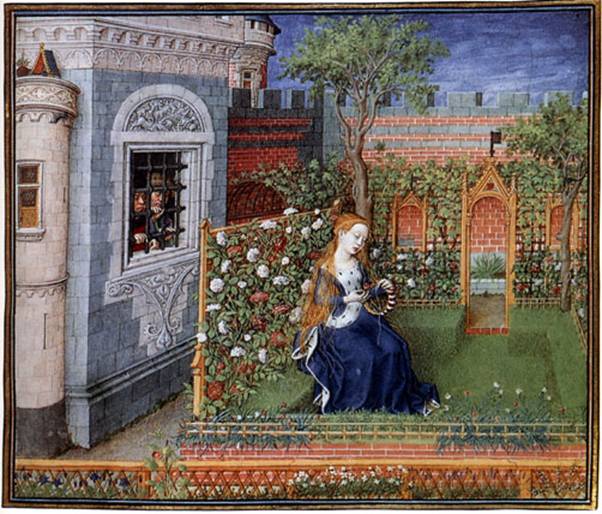
Look, too, at the illustration, which is from Vienna, Österreichischen Nationalbibliothek, MS 2617, f. 53r, a copy of the French translation of Boccaccio's Teseida. This manuscript contains an extraordinary set of illuminations by Barthélemy van Eyck commissioned by King René of Anjou. In the above illumination you see Emilia sitting in her enclosed garden, surrounded by all manner of flowers, as the two Theban prisoners look out at her from their cell. There is even an article that identifies all of the flowers in this garden and tries to tell which month of the year it is: Marie-Thérèse Goussett, 'Le jardin d'Émilie', Revue de la Bibliothèque Nationale, 22 (1986), 7-24. Emily is being protected in her garden, cut off from male company, essentially a kind of prisoner. The two men, looking out from their window, are prisoners too, but have the 'freedom' to look, and both fall in love with her at this moment. Notice how she does not engage with them, she has her back to them and is engrossed in making a garland of flowers. In the Italian text she is a bit of a flirt with the boys and she knows that they are looking at her.

And think then of the 'walled garden' in Chaucer's Parliament of Fowls, and how he is playing with the genre of the sacred paradisal garden full of wonderful birds and flowers, but also containing a structure, in which we find Venus, and those who have been destroyed by love. It's a kind of nightmarish claustrophobic hot-house within the walled garden. And like surfing the net within a 'walled garden' environment, Chaucer is trying to make sense of love with what he is allowed access to within the garden.

Tuesday, 14 November 2006

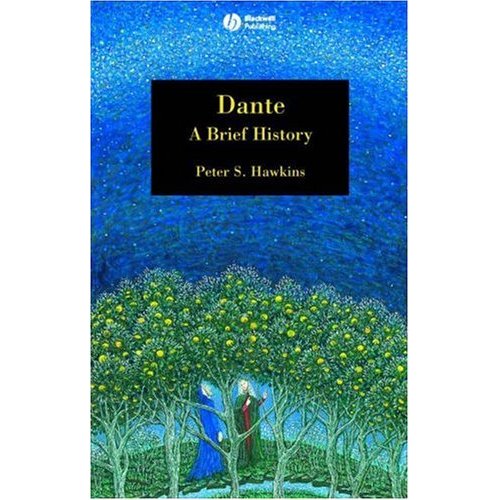
Peter S. Hawkins, Dante: A Brief History, Blackwell Brief Histories of Religion (Oxford: Blackwell, 2006)

Eagerly anticipated, Peter Hawkins' new Dante: A Brief History is a wonderful read. There are five chapters in all, 'Dante's Life and Works', 'Dante's Journey to God', 'Dante's Beatrice', 'Dante's Religion', and finally 'Dante's Afterlife'. Since Hawkins' principal interests in Dante have been from a theological perspective, teaching as he did for some time at the Yale Divinity School, and now directing the Luce Program in Scripture and the Literary Arts at Boston University, the book is very much a meditation as much as it is 'A Brief History'. It is not aimed at a Dante specialist, but rather at a reader interested in some of the 'big ideas' around Dante. So Hawkins returns again and again to the idea of Beatrice, what she means, how she is to be interpreted. Indeed his chapter 'Dante' Beatrice' is a powerful and very challenging reading of this difficult figure. And Hawkins is not content with the standard view of the Commedia, and it is this that is so refreshing about the book. In the prologue he recounts how he returned to his undergraduate copy of the Commedia, to the great crowning scene in Purg 27, only to find his youthful marginal comment: 'Yawn'. His reading was taken up with greater enthusiasm in graduate school and subsequently and Hawkins wonders how the Commedia turned from a Yawn to a Passion. Unembarrassed questioning is the hallmark of the book.

The chapter on 'Dante's Religion' is one of the most succinct and interesting treatments of the subject I've read in a long time. One might think that such a subject would be necessarily full of platitudes and truisms but much that is fresh is brought to his analysis of the 'personal faith story' in the Commedia as well as some wonderful pages on the many smiles of the poem (pp. 122-130, which readers will recognize as a sythesized treatment drawn from his recent PMLA article).

The final chapter is a gorgeous discussion of 'Dante's Afterlife', mainly concentrating on visual workings and reworkings of the poem. Nothing is out of bounds, nor too low-brow for discussion. It's all in the mix, and it's a great mix. We get Robert Mankoff's cartoons for the New Yorker discussed with Edward Frascino's, or the Dante's Inferno Hell Test you can do online, or William Blake beside the wonderful Botticelli's drawings. Especially interesting is the lengthy discussion of Sandow Birk, whose 'Puppet Movie' I hope to see soon, and Birk and Marcus Sanders' three volume 'translation' into California youth-speak. There is also much on Gary Panter's reworking of the story, especially his Jimbo in Purgatory. I really didn't know the work of these post-modern interpreters of Dante and I'm very glad to have done so. The chapter made me rethink some old divisions and boundaries between so-called high and low culture. For example, think of Dante's own re-writings of the Aeneid at the beginning of the Commedia, how it is at once a rewriting and a surpassing.

He made me really think again about the importance of parody, humour, and anachronism in 'reading' and 're-reading' texts. Look at the rather wonderful Geoffrey Chaucer Hath a Blog, for instance and think about how consonant it is with Chaucerian textual strategies, and the extremely interesting dynamic with the 'guest bloggers' Katherine Swynford and Sir John Mandeville. Think about the way that the paratexte is nothing if not a polyphony of voices around the text, an interaction, a reading, a misreading, and think about the way many medieval commentaries and glosses are just like medieval blogs. The blog page sends you to links of other blogs, but also to other more general websites. And the links themselves are clever, like the link to the 'New Me Society'. Quotes, pointing hands, notae, page numbers, all occur in the margins, all direct your attention to somewhere else, all invite you to reread, to rethink.

It's fair to say that Dante: A Brief History got me thinking and rethinking. It's a significant contribution to recent criticism and will be enjoyed widely. Read it.

Friday, 10 November 2006

Archaeology Ireland 20/3 (2006), Special Supplement on The Faddan More Psalter


It is hard to imagine a more important manuscript discovery in my lifetime than that which occurred in July of this year.

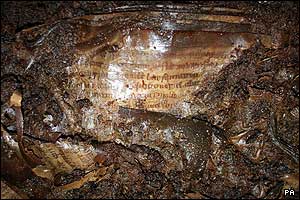
Reports have mainly been restricted to the national and international press, necessarily undetailed and somewhat sensationalist. Archaeology Ireland 20/3 (2006) have now published a special supplement (ISBN 0953442640) entitled The Faddan More Psalter, providing more detail and superb photographs. There are six pieces in the supplement: Patrick F. Wallace, director of the National Museum of Ireland, has a short piece entitled 'A Stroke of Extreme Good Fortune'; Eamonn P. Kelly, Keeper of Irish Antiquities, National Museum of Ireland, has two pieces, the first called 'The Manuscript Discovered', including a fairly detailed description of exactly what is there, and the second 'Other Finds from the Faddan More bog'; Raghnall Ó Floinn, Head of Collections, National Museum of Ireland, has a piece entitled 'Identification', about how he copped that the only fragment of legible text, in ualle lacrimarum, came from Ps. 83. 7, and how that is the Gallican number 83, not the Hebrew 83, but the Hebrew 84, and no it was not about the destruction of Israel, and no it was not a sign of the novisssimi, which seemed to be what some wanted to believe; a learned piece by Bernard Meehan, Keeper of Manuscripts at Trinity College Library, helps to contextualize the importance of this discovery (more anon); and finally, Rolly Read, Head of Conservation, National Museum of Ireland, has a piece on the enormous conservation challenges presented by the codex.

Meehan's piece summarizes what is important about this MS. Its date is early, c.800, making such a discovery truly exceptional. Its original leather cover or wrap has been preserved, and only two other comparable manuscripts have covers, the Cadmug manuscript, and the Book of Armagh. The manuscript was produced on a lavish scale, not much smaller than the Book of Kells or the Macregol Gospels. A peek at the top corner of the first page (which is still too fragile to open yet) reveals a highly decorated page. It seems to be the letters TUS, and the higher parts of the other letters are just visible. It could be BEATUS, which might well be BEATUS UIR, the opening lines of the first Psalm. The image of a bird is visible, as well as other decorative features such as inked lozenges and a yellow and red positive-negative cross design. From the folio estimations made by Kelly it appears to have 52 or perhaps 54 leaves (104-8 pages, that is), and at ten words to a line, and 29-30 to a page, the Faddan More Psalter had plenty of vellum for the complete text of the Psalms as well as a couple of other pages of decoration. Meehan says that he only ever expected that we would widen our codicological knowledge of the period with a leaf or two turning up in the binding of a book somewhere, but never in his wildest dreams could a complete manuscript be discovered. Meehan also poses a number of questions that have you hopping off your chair with excitement: Will a fuller examination of script and decoration confirm or alter the initial supposition about the date of the manuscript? To what extent is the manuscript decorated? Does the manuscript contain any text other than the Psalms? Does a colophon name the scribe, his monastery or the date he was at work? Was there more than one scribe? Was the text glossed? What kind of pigments were used? Is the leather cover contemporary with the manuscript, is it attached, and is it decorated?

It is very fragile, and much of it will probably never be recovered, but what is left might well change the way we think about the ninth-century Irish and their Psalters.

Sunday, 5 November 2006

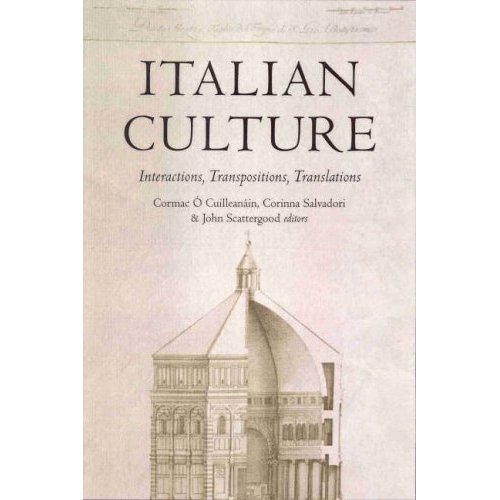
Italian Culture, edd. Ó Cuilleanáin, Salvadori & Scattergood (Four Courts Press, 2006)

Languages appear to be in decline here in the UK. Annual surveys show that large numbers of students have stopped studying foreign languages at schools. Such declines will have a sharp effect on university teaching and in turn how departments rise to the challenge of teaching such students. Whether they will choose to learn a language at university is quite another hurdle.

When the professor of Italian Studies at Trinity College, Dublin (my alma mater) retired, there was a celebratory study day to mark her many years of service to the department. The papers given comprise the articles in this book. The title contains no reference to it being a Festschrift, and Professor Salvadori is in fact one of the volume's editors, so it should be considered a testament to the intellectual vibrancy of the department and to its broad range of interests, as much as it should be considered an homage to its former head of department. A highlight is Peter Armour's contribution on poet-friends in Dante's Florence, a paper he had to deliver sitting down he was so ill. His death, shortly thereafter, was a sad sad loss to Dante studies.

The opening article, written by Corinna Salvadori, is a moving and fascinating account of the history of Italian in the College. Provost John Hely-Hutchinson thought it would be 'highly useful to have Professors of modern languages established in the College', and before long two professorships, one of Italian and Spanish, and one of French and German, were established (in 1776). It was not met with universal approval. One Senior Fellow described the decision as 'pernicious', and wondered would the next step be a Professorship of Horsemanship. Languages, like horsemanship, were 'polite accomplishments' and 'teachers of modern languages, fencing, and dancing masters, and horse-riders, are not always the most eligible companions for youth' (p. 13). Part II of Salvadori's article then discusses the subject in College from the 1960s onwards. It is the story of dedicated teaching staff faced with neglect and disinterest. It is stunning to read the account of Provost Watts coming in to Salvadori's office to explain calmly that the department would remain open simply because it was the cheapest department in the College to run and thus its closure would make no significant saving. The department was for years run by just Corinna Salvadori and Clotilde Soave Bowe, both of whom taught a breadth and load that would not be considered possible now. External examiners would consistently praise the high quality of the degree and with incredulity learn it had all been done by just two people. In the 1980s the department expanded slowly but steadily offering ever stronger and broader preparations for its students. Medieval studies has certainly been the department's forte with two of its staff, Salvadori and Cormac Ó Cuilleanáin, being accomplished critics of the work of Dante and Boccaccio respectively. And it is Dante who looms so large at the absolute heart of the department, the man who made it all worthwhile.

He is the good man behind the great woman in this story.

I beg indulgence for a moment while I tell one anecdote. I was coming to the end of my first year in Italian and was feeling martyred at the huge amount of work we had to do. I'd taken Italian ab initio and felt I was utterly suffocating under verbs and paradigms and god knows what. An evening of poetry had been arranged in the department and Seamus Heaney was invited. Having extricated myself from some piece of work, I went along. Heaney read his translation of the Ugolino episode, in his Fieldwork (1979). It was stunning and beautiful. Corinna Salvadori got up to read the Italian. You could hear a pin drop. She read it with beauty and music and power and horror, and the hair raised on the back of my neck and my stomach churned, and I realized I was in the presence of something great. That evening I made my mind up to continue with Italian and to make an Eramsus application to go to the University of Bologna for a year. And after that all was changed, changed utterly.

It seems that people are returning to this idea that languages are a 'polite accomplishment'. Nothing is further from the truth, nor a more dangerous fallacy. A language that produces something like the Commedia cannot be accurately described as either polite or an accomplishment.

Saturday, 21 October 2006

Everyday, dir. Annie Ryan, written by Michael West


Everyday, directed by Annie Ryan and written by Michael West in collaboration with the company, is Corn Exchange's latest production. It runs in the Samuel Becket Theatre (Dublin) until 28th October. Anyone who saw their award-winning Dublin by Lamplight last year will certainly not have missed this production because they will have known to expect something special. Everyday is no exception. It is nothing short of a tour-de-force of theatre, with performances that stand out for their accomplishment and power. It follows the day in the life of a host of characters all trying their best to keep the frayed threads of their lives together. Despite the large number of characters, and the complex plots, you are immediately engrossed and completely involved. You care about each character, and find yourself laughing out loud uncontrollably one minute while the next being on the verge tears. The characters' lives interweave with great subtilty, à la Kieslowski (Trois Couleurs), almost touching each other, but with no one character having any overall sense of the big picture. And there is great playfulness too, with lots of meta-theatrical moments. One 'intertextual' moment stands out: Mark O'Halloran and Tom Murphy sit drinking cans of beer talking about their lives, how they got their girlfriends pregnant, and what they'll do next. It is a real Adam and Paul moment, full of artful resonance, clever and funny. It's a play about a changing Ireland, with Nadia, a Ukrainian immigrant working as a childminder and a waitress, dealing with the selfishness that Irish economic success has bred so virulently. Another wonderful moment, Aiden, the failed musician who cannot come to call himself an English-language teacher, introduces himself to Nadia and in a breakthrough moment, describes himself as a teacher. Her response is beautifully drawn by Louise Lewis, who you can just see reacts with a sense of respect for his profession, coming from another culture that still prizes the old-fashioned jobs. It is just one of the many very delicate moments in the play and is indicative overall of its great sensitivity and power. Go and see it.

Friday, 13 October 2006

Mark Atherton, Teach Yourself Old English (Hodder & Stoughton, 2006)

They say if you speak three languages you're trilingual, two languages, bilingual, and one language, English. Languages appear to be a problem in schools in England. With fewer and fewer students taking a modern language, and with the structure of 'English' teaching changing so rapidly, these issues directly impact upon the preparation of students when they arrive at university. The problem is that at school everything is neatly divided up into subjects. Someone thinks they'll do English, not having much of an interest in modern languages, say, and sit in front of medieval texts for the first time. They are shocked to discover that what they are looking at is not just 'English', but texts that are deeply influenced by Latin, and/or French, all mixed in with Anglo-Saxon. Literature in the middle ages was not monolingual and approaching it that way will not work. So when students sit down with Mitchell and Robinson's A Guide to Old English, it is increasingly the case that they don't know what they're looking at. The kind of students they had in mind when writing this book were so vastly differently-prepared than students today. Not more or less prepared, just different. Undoubtedly there is less systematic teaching of grammar; I heard a graduate student the other day ask what an inflected language was. Somebody who wants to know what an inflected language is should not start with Mitchell and Robinson. They need to start somewhere else and only then move on to M/R (still the textbook used for the Oxford syllabus). The perfect starting point is Mark Atherton's new Teach Yourself Old English. It is aimed at someone who has not studied OE before, but who would like to get to read texts as soon as possible. So it does not start with lists of paradigms or inflections. It starts you reading straight way, shows you how firmly rooted the words you use every day are in the Old English language, and gets you enjoying it from the start. It's a serious book but not at all stuffy. The Teach Yourself series is excellent by the way, and the Teach Yourself Sanskrit is the one used here in Oxford, so let the snobs be silent. The book comes with a CD in which you can hear all of the texts being recited and repeated and hugely helps the way you learn your verbs and vocabulary.

It's an enormously useful textbook and I recommend it wholeheartedly.

Saturday, 7 October 2006

Antonio Vivaldi, Griselda RV718; Ensemble Matheus, Jean-Christophe Spinosi, 2006

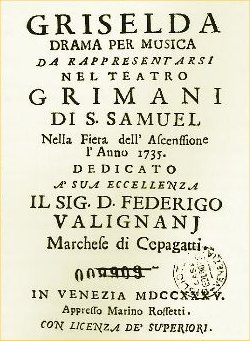
In 1735 at the Teatro S. Samuele in Venice the opera Griselda, written by Antonio Vivaldi, was first performed. This year saw the release of the Ensemble Matheus' recording of this little-known work, under the direction of Jean-Christophe Spinosi (Naïve: OP30419). Their efforts were rewarded with the prestigious Diapason d'Or and the reviews have all been glowing.

The story of Griselda has its first major outing in fourteenth-century Italy where it appears as the final story in Boccaccio's great story-collection Decameron. It became a real bestseller, however, when Francesco Petrarca translated the tale into Latin and included it into his collection of Letters of Old Ages (Res seniles), and indeed it split off from the Seniles and was copied separately and disseminated extremely widely. Chaucer encounters the story and incorporates it into his Canterbury Tales as the tale told by the Clerk of Oxenford. And the story has had a very prestigious lineage of adaptation in French from the fourteenth century onwards.

Vivaldi's Griselda, whose libretto was written by Apostolo Zeno and revised by none other than Carlo Goldoni, presents considerable differences in plotting. The most striking is exactly why Gualtiero tests his patient wife: to convince his people of her worthiness. The very opening of the opera has the people reject Griselda, while Gualtiero wants to marry her. In order to convince them of her virtues he proceeds to test her. While the plots turns a little...baroque at times, it is fascinating to think of Chaucer and his represenation of the people who follow the mercurial will of their leader, accepting the new bride-to-be with alacrious amnesia. The Clerk calls them unsad and evere untrewe, exactly the opposite of Griselda, who is sad (long ago pointed out by Brewer). This is a key theme in the tale, key virtues in medieval literature. For Vivaldi, on the other hand, Griselda's repudiation by the people is a device to introduce another suitor (Ottone) who declares his undying love for her, while the young daughter (Costanza), spirited away long before, and now recalled to 'play' bride-to-be, has her own heartbroken lover (Roberto).

You need a map to follow the rest of this so I shan't go into it here, but the music is fantastic, the recording super, the research wonderful.

Thursday, 5 October 2006

Averroes In Our Time

Listen to Melvyn Bragg's In Our Time on BBC Radio 4 this week discussing Averroes with Amira Benninson, Peter Adamson, and Sir Anthony Kenny.

Dante places Averroes last in a long list of pagan philosophers who are in Inferno because they could not enjoy the Christian revelation. But they are in Limbo, a strange sort of stasis without pain, a middle existence of hope without hope: 'sanza speme vivemo in disio' (Inf. 4. 42). Averroes' name appears with Aristotle's as bookends to a long catalogue of philosphers. Aristotle is the 'maestro di color che sanno', and Averroes is he 'che 'l gran comento feo', that is, he who produced the celebrated Aristotelian commentary. The influence of Averroes' thought in Duecento-Trecento Italian poetry is much debated, especially how and in exactly what way it influenced the dolce stil nuovo and in particular Guido Cavalcanti. Cavalcanti is the great unspoken character in the Commedia, once Dante's primo amico, the only trace of him appears in Inf. 10 where his father asks movingly: 'mio figlio ov'è? e perché non è teco?' (l. 60). Dante's reply has been explained in various ways, and remains ambiguous and strange: 'Da me stesso non vegno: | colui ch'attende là, per qui mi mena | forse cui Guido vostro ebbe a disdegno' (61-3).

Sunday, 24 September 2006

The Queen (2006), dir. Stephen Frears

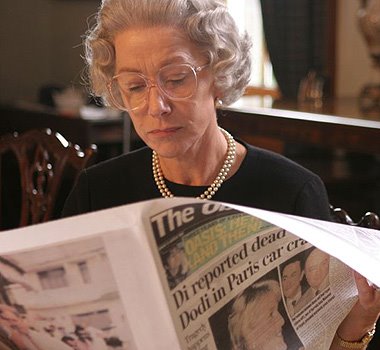
Originally intended for TV, Stephen Frears' account of the Queen (Helen Mirren) during the week between Diana's death and funeral at first glance does not really seem the stuff of a serious film. Opening with pictures of Tony Blair's landslide victory brushing aside eighteen years of Tory government the Queen is shown receiving him and inviting him to become her tenth PM. Comic moments abound and the temptation to caricature must have been unbearable, especially for the portrayels of the Duke of Edinburgh and the Queen Mother.

'That week' is seen here as a kind of fault line between a public who maintains a stiff upper lip ('It's what other countries admire us for!') and a public who responds to media manipulation and grooming. Tony Blair (Michael Sheen, looking disconcertingly like a young Rik Mayall) is then the PM with his finger on the pulse of the public, the man who was able to reflect the grief of the nation and quiver his chin in front of the cameras ('the people's princess', the phrase worked up by a wonderfully unpleasant Alastair Campbell ). It is fascinating to watch the film now and to feel so tired of exactly those attributes he's being praised for in the press during 'that week'. Now it's all part of the spin, then it was empathy.

The Queen wants to do her mourning in private on her Balmoral estate, 'with the boys'; the public want her crying on the balcony of Buckingham Palace, and Tony keeps ringing her to tell her that opinion polls are turning against her. It might not seem likely, but the film manages to carefully draw out the viewer's sympathy and the Queen is shown as a woman who took an oath of public duty, not to be a media darling or to occupy a temporary position but to dedicate her whole life to her people.

The climax of the film is beautiful. A large fourteen-point stag is spotted on the Balmoral estate and Phillip wants to take the boys out stalking to take their minds off things. This is a scene that has probably been repeated in royal families for a thousand years and more. The hunt is traditionally a passtime of royalty, and the stag has a fine aristocratic and noble heritage. The Queen goes out to a remote part of the estate and gets stuck in a stream in her Land Rover. While waiting for help she looks around in appreciation at the beautiful scenery and is overcome with the grief and upheavel of the previous days. The beautiful stag appears and comes very close to her and acknowledges her, almost bowing. She gestures back, and when she hears the hunt approaching, shoos the stag away to safety.

Just before she leaves for London Phillip tells her that the stag had been shot by a paying guest on a neighbouring estate, a merchant banker from London. She goes to visit the carcass on the estate and pays her respects. It is not that she finds it easier to show emotion over a dead stag than a dead daughter-in-law (though I'm sure many would read it that way), but rather the stag is the end of a whole way of life. Now the estates must take paying guests to keep their heads above water, and the stags are hunted by bankers rather than royals. It is the end of a way of life. And of course Diana is the goddess of hunting, and the stag's death is too the death of the former princess. Earl Spencer talked about Diana the hunter becoming the hunted, and this surely forms a subtext for the royals hunting the stag but being eventually killed by a member of the 'public', someone after the stag for a thrill and a story back with the city folk over dinner.

Helen Mirren is amazing, and the film is careful and artful.

Saturday, 23 September 2006

Gyrotourbillon


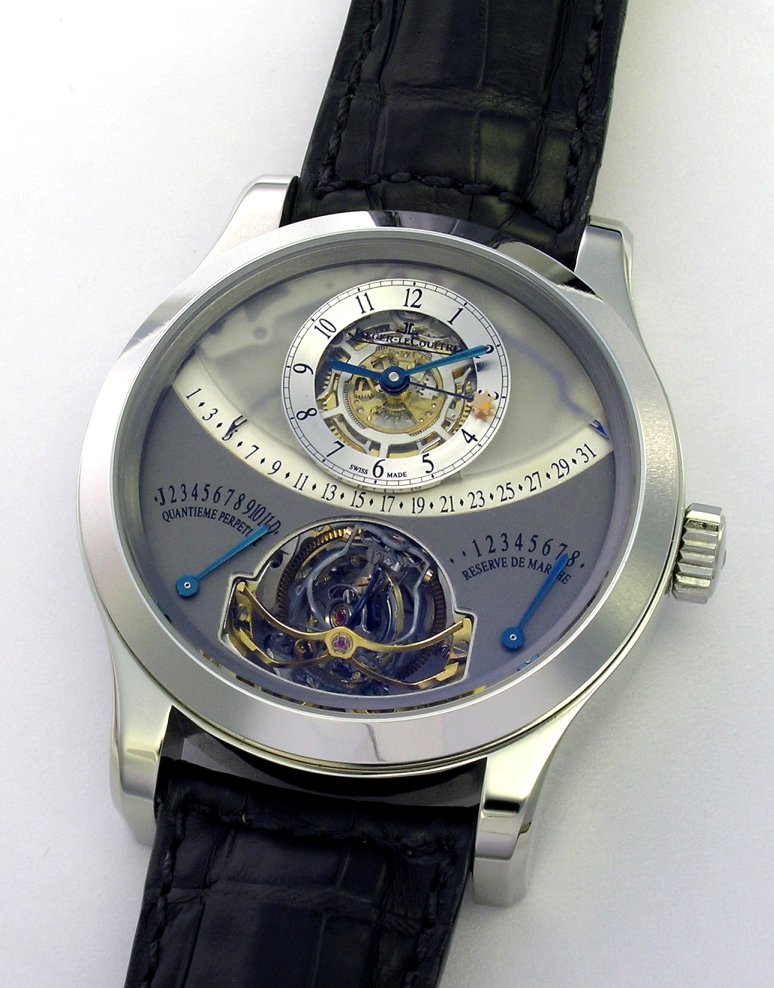
This is a prototype for Swiss watchmaker Jaeger Le-Coultre's new 'Gyrotourbillon', a very exquisite, very advanced design of watch which will be released in super-limited editions over the next few years. It has been developed by Eric Coudray and designer Magali Métrailler. This movie gives a sense of its almost impossible balance and complexity, and beauty. You feel almost like a medieval king watching something exotic and incredible: come orologio che ne chiami | ne l'ora che la sposa di Dio surge | a mattinar lo sposo perché l'ami (Par. X. 139-141). The clock Dante is talking about here is an early chime clock calling the monks to their prayers for the first of the canonical hours. Time belongs to God here. And Paradiso is a good place to have a clock, with its balance and measure and order.

Enjoy the Gyrotourbillon and think of Heaven.

LinkWithin

Related Posts Plugin for WordPress, Blogger...