Sunday, 24 September 2006

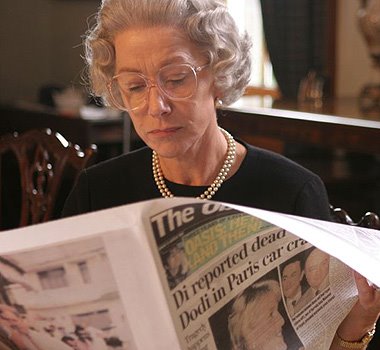
The Queen (2006), dir. Stephen Frears

Originally intended for TV, Stephen Frears' account of the Queen (Helen Mirren) during the week between Diana's death and funeral at first glance does not really seem the stuff of a serious film. Opening with pictures of Tony Blair's landslide victory brushing aside eighteen years of Tory government the Queen is shown receiving him and inviting him to become her tenth PM. Comic moments abound and the temptation to caricature must have been unbearable, especially for the portrayels of the Duke of Edinburgh and the Queen Mother.

'That week' is seen here as a kind of fault line between a public who maintains a stiff upper lip ('It's what other countries admire us for!') and a public who responds to media manipulation and grooming. Tony Blair (Michael Sheen, looking disconcertingly like a young Rik Mayall) is then the PM with his finger on the pulse of the public, the man who was able to reflect the grief of the nation and quiver his chin in front of the cameras ('the people's princess', the phrase worked up by a wonderfully unpleasant Alastair Campbell ). It is fascinating to watch the film now and to feel so tired of exactly those attributes he's being praised for in the press during 'that week'. Now it's all part of the spin, then it was empathy.

The Queen wants to do her mourning in private on her Balmoral estate, 'with the boys'; the public want her crying on the balcony of Buckingham Palace, and Tony keeps ringing her to tell her that opinion polls are turning against her. It might not seem likely, but the film manages to carefully draw out the viewer's sympathy and the Queen is shown as a woman who took an oath of public duty, not to be a media darling or to occupy a temporary position but to dedicate her whole life to her people.

The climax of the film is beautiful. A large fourteen-point stag is spotted on the Balmoral estate and Phillip wants to take the boys out stalking to take their minds off things. This is a scene that has probably been repeated in royal families for a thousand years and more. The hunt is traditionally a passtime of royalty, and the stag has a fine aristocratic and noble heritage. The Queen goes out to a remote part of the estate and gets stuck in a stream in her Land Rover. While waiting for help she looks around in appreciation at the beautiful scenery and is overcome with the grief and upheavel of the previous days. The beautiful stag appears and comes very close to her and acknowledges her, almost bowing. She gestures back, and when she hears the hunt approaching, shoos the stag away to safety.

Just before she leaves for London Phillip tells her that the stag had been shot by a paying guest on a neighbouring estate, a merchant banker from London. She goes to visit the carcass on the estate and pays her respects. It is not that she finds it easier to show emotion over a dead stag than a dead daughter-in-law (though I'm sure many would read it that way), but rather the stag is the end of a whole way of life. Now the estates must take paying guests to keep their heads above water, and the stags are hunted by bankers rather than royals. It is the end of a way of life. And of course Diana is the goddess of hunting, and the stag's death is too the death of the former princess. Earl Spencer talked about Diana the hunter becoming the hunted, and this surely forms a subtext for the royals hunting the stag but being eventually killed by a member of the 'public', someone after the stag for a thrill and a story back with the city folk over dinner.

Helen Mirren is amazing, and the film is careful and artful.

Saturday, 23 September 2006

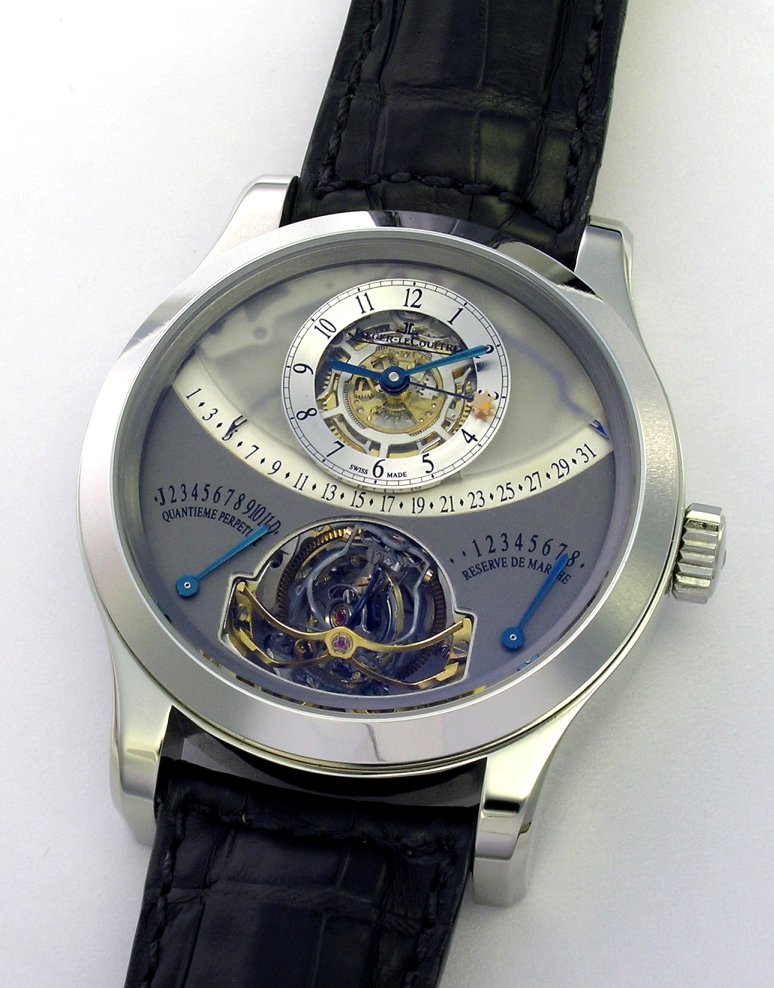
Gyrotourbillon


This is a prototype for Swiss watchmaker Jaeger Le-Coultre's new 'Gyrotourbillon', a very exquisite, very advanced design of watch which will be released in super-limited editions over the next few years. It has been developed by Eric Coudray and designer Magali Métrailler. This movie gives a sense of its almost impossible balance and complexity, and beauty. You feel almost like a medieval king watching something exotic and incredible: come orologio che ne chiami | ne l'ora che la sposa di Dio surge | a mattinar lo sposo perché l'ami (Par. X. 139-141). The clock Dante is talking about here is an early chime clock calling the monks to their prayers for the first of the canonical hours. Time belongs to God here. And Paradiso is a good place to have a clock, with its balance and measure and order.

Enjoy the Gyrotourbillon and think of Heaven.

Illuminating the Renaissance

Before I went away for the summer I took a trip out to Bennett & Kerr where I wanted to pick up a copy of the Manuscript Tanner 346: A Facsimile, intro. Pamela Robinson. What I actually got was her own copy (or one of them at least), with her corrections in the margins. Very nice. While out there I met Richard Gameson, whom I had not met before. But when you are in B & K, out in the middle of the Oxfordshire countryside, in a medieval bookshop on a farm, you cannot really ignore another browser like you would in shop in the big city. It would be like trying to pretend you weren't passing someone on the Himalayas, or in the Arctic Circle. So it was a great pleasure to talk books with him, who knows a great deals about books.

But B & K had just acquired a large part of the library of Janet Backhouse, former Keeper of Manuscripts in the British Library, who died in Nov. 2004 at the too early age of 66. There were boxes and several shelves full of books from her library. It was quite sad to find yourself picking through her books, seeing her notes and cards in books. No matter how big your library gets, nor how learned you become, it will still end up in a secondhand bookshop, picked through by students and scholars trying to build up their own libraries with that book they've been searching for for years. And these in turn...

What I did pick up was a copy of catalogue of the Illuminating the Renaissance exhibition held at the Royal Academy in London Nov 29, 2003 - Feb. 22, 2004. This was an extraordinary exhibition and I remember it vividly. The catalogue had sold out. Backhouse has kept her invite to the opening ceremony of the exhibition, some newspaper reviews, and some of her Sotheby catalogue entries from the 70s for manuscripts featured in the catalogue. There is such a sense of care and attention to detail in these cut outs and inserts, and I found it quite moving.

And you get a sense of inheriting something, of needing to continue in the care and the attention to detail, not just for the sake of the subject, but for the sake of those who have gone before you and who have given so much. It's so easy to get carried away by the polemical and egocentric way many scholars open their work by explaining that every single scholar who has gone before has been so thick not to see this centrally important aspect but not to worry you're reading the real thing now (and can some wealthy American university please hire me and triple my salary, by the way). But just as you'll turn to dust, and your library will be dispersed, so too will your scholarship need to find a sympathetic reader who wishes to nurture rather than to destroy.

While in New York I passed a group of children all getting on a bus going to their summer camp, with the harrassed-looking teacher trying to make sure her charges were all accounted for. I read their t-shirts and thought it could be applied in lots situations and professions: Work Hard and Be Nice.

Friday, 22 September 2006

Back!


What a long time it has been! I've been away for the past five weeks, in Ireland, then in Italy, and now back. Have much to say, but am going to try to spread it out over a couple of posts so that it doesn't all feel breathless.
First, I read two books over the holidays. Alexander McCall Smith's Morality for Beautiful Girls (Abacus, 2003), part of his No. 1 Ladies Detective Agency, was not quite the read I had been expecting. They are not quite 'detective' stories, though some detecting does go on. Set in Botswana, the series has Mma Ramotswe as the heroine, a feisty and intelligent woman who runs a small detective agency. The blurbs and reviews are often very flattering about these books, and I've seen them being read on beaches, buses, etc. But I was disappointed. Perhaps the best way of describing the book is that it is charming, but maybe not in a good way.
The second book I read was Hugo Hamilton, The Speckled People (Fourth Estate, 2003). It is a beautiful read. The book is told in a child's voice, speaking his truths and things as they seem to him, with sometimes devastating simplicity and power. It is such a difficult voice to work with but Hamilton controls it utterly so that you hear him and more importantly you start to listen to him. A memoir in the traditional sense it is not. Nor can it really be considered 'The Early Years' volume. It is about the language crisis played out in his house between an Irish father who would only allow Irish to be spoken in the house, and a German mother, who communicated with them in German. English is the unspoken and unspeakable. It creates an atmosphere where you feel everything so keenly, words become hugely important. It was an utter pleasure to read and I think it can be legitimately considered a modern masterpiece of Irish writing. Read it.
I have also been making my way through Carol Ann Duffy's Rapture (Picador, 2005). I think it is interesting and at times very delicate and beautiful. I'll review it again I think.

Wednesday, 16 August 2006

νῦν μοι χάνοι εὐρεῖα χθών


M.L. West, in his Textual Criticism and Editorial Technique, applicable to Greek and Latin Texts (Stuttgart: Teubner, 1973), tells the story of Eduard Fraenkel's traumatic experience as a young student with Friedrich Leo:
"I had by then read the greater part of Aristophanes, and I began to rave about it to Leo, and to wax eloquent on the magic of his poetry, the beauty of the choral odes, and so on and so forth. Leo let me have my say, perhaps ten minutes in all, without showing any sign of disapproval or impatience. When I was finished, he asked: 'In which edition do you read Aristophanes?' I thought: has he not been listening? What has this question got to do with what I have been telling him? After a moment's ruffled hesitation I answered: 'The Teubner'. Leo: 'Oh, you read Aristophanes without a critical apparatus.' He said it quite calmly, without any sharpness, without a whiff of sarcasm, just sincerely taken aback that it was possible for a tolerably intelligent young man to do such a thing. I looked at the lawn nearby and had a single, overwelming sensation: νῦν μοι χάνοι εὐρεῖα χθών. Later it seemed to me that in that moment I had understood the meaning of real scholarship." Fraenkel is right of course, true scholarship is about getting the detail right, from which the large picture may be drawn. His epiphany about the nature of real scholarship I think also has something to do with modesty, about realizing how little you know. And there is something important in the gentleness of Leo, in his patience and humane treatment of his young and brilliant student; literae humaniores indeed.

Last week I invested in Petrocchi's Commedia secondo l'antica vulgata. It was published in four volumes between 1966-7 with Mondadori in Milan, and has now been republished with Le Lettere in 1994 as "Seconda ristampa riveduta". This might best be translated as a "corrected reprint edition". Pp. v-vii in Vol. 1 (Introduzione) explains what has been changed:
Purg. IV 132 per ch'io ➛ perch'io
XV 18 salendo su ➛ salendo sù
XXI 9 giù surto ➛ già surto
XXVIII 91 lo sommo Ben ➛ lo sommo ben
Par. XI 62 et coram patre e coram patre
XII 59 viva vertute ➛ viva vertute,
with a couple of these changes having appeared in the 1975 "Piccola Biblioteca Einaudi" text produced by Petrocchi. All modern editions and commentaries on the Commedia reproduce the Petrocchi edition, (the editions of Lanza and Sanguineti have not yet made an impact), but I was getting more and more impatient checking variants in the library. Some things you just need to have right beside you, all the time. The variants really are how the text was read as well as copied, so the criticus apparatus is as valuable to those interested in reception history as it is to textual critics.

Sunday, 6 August 2006

Elisabeth Schwarzkopf


The great soprano Elisabeth Schwarzkopf died in Austria on Aug. 3rd. Alan Yentob, the creative director at the BBC said that her early recording of Strauss's Four Last Songs was for him a 'heart-stopper'. I could not agree more. The nuances and depths of her performance are utterly astonishing.

When she was a guest on Sue Lawley's Desert Island Disks she chose eight of her own recordings. That's class. She was also Stormin' Norman's aunt!!

Saturday, 5 August 2006

Campin in the Cloisters


On my last couple of days in New York Betsy (who also stayed on for a bit) and I decided to visit The Cloisters, the medieval collection of the Metropolitan Museum of Modern Art. Though it is a trek up to 190th St., it was well worth it and had me rueing that uninspiring trip to the Met on Saturday evening. It was frankly pointless to drag everyone across Central Pk with little time after the final session to listen to a guide discuss works with a banality that might be interesting to 'tourists' but to a group of professional medievalists was just not on. Why didn't we go to the Cloisters instead? Why didn't we scrap the Plenary session on Friday morning on Exhibiting Art, and have those three professionals talk about three objects in the Cloisters and the problems confronting curators today? After you get over the fact that the whole place is fake, you realize that The Cloisters is beautiful. It's been constructed in a park and made look like a medieval monastery with a beautiful view out over the Hudson. What you find inside is wonderful. It's very evocative. Particularly noteworthy are the extraordinary Unicorn Tapestries, the Robert Campin Annunciation, detail of which above, and the exquisite Hours of Jeanne d'Evreaux. Do not miss the Cloisters on a visit to NY.

A visit to Twelfth Street Books (11 E 12th St., between 5th Ave./Univ.) proved interesting. It's a wonderful bookshop, full of quality secondhand books across a wide range of subjects. I picked up a copy of Toja's edition of Arnaut Daniel's Canzoni (Sansoni, 1961), and Bruno Nardi's Saggi e note di critica dantesca (Riccardo Ricciardi, 1966). Those were the 'finds'; other acquisitions: Teodolinda Barolini, The Undivine Comedy, Eugene Vance, From Topic to Tale, Donald Howard, The Idea of the Canterbury Tales, and JD Burnley's Guide to Chaucer's Language, all for considerably cheaper that the s/h stall in the conference. Never mind.

During some time eating & drinking in the Coliseum (312 W 58th St, opp. TimeWarner Center) one of the screens had CNN playing continuously. You realize how really deeply in trouble this country is when you watch the news for five minutes. CNN were running a very lengthy report, based on events in the Lebanon, entitled: "Is this the end of the world?" I swear. They had all sorts of nuts, Jews, Catholics, fundamentalist Christians (don't know what religion they are...), Republicans, the usual. This was a serious report. They were seriously asking whether we were witnessing the novissimi. Not on a lifestyle channel, or a religous freaky nut channel, or a pseudo-history channel. CNN. The national news. Ok, I know that decision makers and people who think don't watch CNN, but I'm afraid people who vote do. Oh boy. A real shiver-down-the-spine moment that was.

Tuesday, 1 August 2006

NCS @ NYC


This post might also be considered a missive, for I write from the city of New York, sitting in exhaustion after five days of the 15th International Congress of the New Chaucer Society. It was a long conference, and perhaps too long. I'm staying in Empirestateview's apartment, and you really can see the Empire State Building from the apartment! The heat right now is oppressive, but I'm excited to be here.

I'm still digesting the conference and the papers, but hightlights included Caroline Barron talking about her discovery that Thomas Usk worked as a scribe for the Goldsmith's Guild, and Marion Turner's brilliantly suggestive piece on the Mercer's Petition and the House of Fame. There was also an extremely interesting paper by Catherine Eagleton on astrolabe texts and instrument texts in the 14th and 15th centuries. She is a formidable authority on the subject. Sessions also dealt with the subject of Adam Pynkhurst, does he matter? etc. They were very interesting sessions, except for some of the crazy textual people who seem to think that they have a direct line to the truth and are as ruthless as Microsoft about proprietorial opinions. A most undignified scene was witnessed in response to rather stimulating paper by Steve Partridge, whose very important edition of the glosses in the Canterbury Tales manuscripts is anxiously awaited by many, but alas I have completely forgotten her name nor the nature of her cavil. Come dice Virgilio a Dante: guarda e passa.

One of the great mysteries at the conference this year, like a veiled Greta Garbo or Jackie Onassis glimpsed darting into some exclusive residence for a moment, was the identity of Chaucer hath a blog. David Wallace, in a presidential address I shall leave to more authoritative people to comment upon, took a potshot at the blog, but the whole auditorium chuckled together, clearly showing everyone is reading him. It's a very clever blog. I recommend it.

The little book display was very disappointing. I don't know why it isn't a bit bigger, and the little second hand section was way overpriced. I dithered about buying the Bodley 638 facsimile and should have just bought the bloody thing, but I went back just a bit later and it was gone. Doh! Did pick up a copy of SAC 23 though. I also visited the Strand Bookshop, which reputedly has 18 miles of books. You kind of believe it when you walk in. It overwhelms you. I picked up a copy of Kretzmann, Kenny & Pinborg's Cambridge History of Later Medieval Philosophy for 15 dollars. I think that was very good value.

It was great to see the gang again, like Myra, Mary and Betsy (from way back when in NCS in Glasgow, imagine), and I also caught up with Claudia from Florence, who is here researching. (now she is a textual scholar!). It was a most happy coincidence to see her. And I had dinner with Jeremy, an old friend whom I do not see often enough.

New York is a beautiful city. I was expecting energy, a 24/7 kind of place, but I wasn't expecting to be so aesthetically pleased with the place...if that makes any sense. The architecture is of such high quality. I love the place, and I shall definitely be back.

Tuesday, 11 July 2006

When I count to three, you'll have a PhD


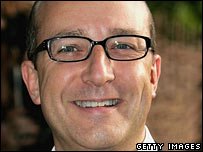
This is Mr Paul McKenna. You may know him from such classic books as Easy Weight Loss and Quit Smoking Now. He is currently engaged in a libel action with the Daily Mirror over claims that he is a fraud. In a series of articles by Mr Victor Lewis-Smith, it was claimed that Mr McKenna bought a PhD from the venerable Lasalle University in the US of A (it's in Louisiana, in case you're passing, or flying over it). You might think that it's a cut and dried affair. Either he has a PhD or he doesn't. Lasalle University's founder actually made up the accreditation body for the awarding of its degrees. Em. Yes. You heard correctly. He set up the Council for post-secondary Christian Education (and nobody thought that sounded dodgy...), and had his university award degrees accredited by it. Mr McKenna claims that he was simply one of the many 'unsuspecting' students duped by this Mr Kirk. Except that it means his PhD has not been accredited. But Mr McKenna claims that the essense of his defamation has been that he bought his degree. As Mr Lewis-Smith wrote: "I discovered that anybody could be fully doctored by Lasalle within months (no previous qualifications needed), just so long as they could answer the following question correctly: 'Do you have $2,615, sir?'
In his evidence today, Mr McKenna insisted that he submitted a thesis of 50,000 words, and had spent over 500 hours of work on it. He has earned this degree.

Now that got me thinking. Let's say that he worked 6 hours per day, a rather low estimate I admit for one to be engaged in the type of research adequate to the level of the degree of PhD. Let's call it the benefit of the doubt. Let's say that he did not work weekends. In fact, let's say that he worked a four-day-week on his research, another low estimate for one to work on one's research I admit. But let's call it the benefit of the doubt.

That means that he finished his PhD in 20 weeks. This is clearly a man who values his timely rather highly.

Saturday, 8 July 2006

Simone dei Crocefissi, National Gallery London


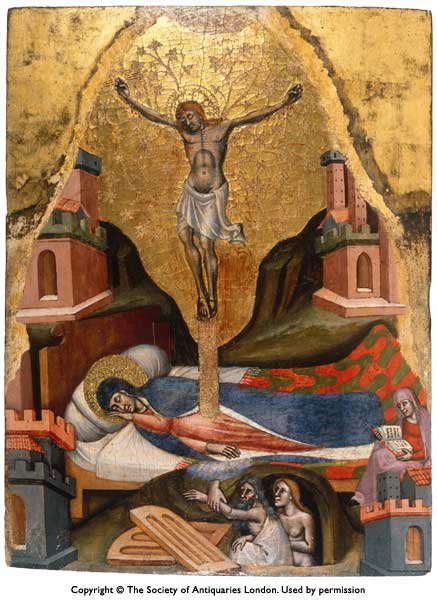
Just back from a couple of days in London at the British Library, a bit of book shopping, and a trip to the National Gallery. The shopping was good: I picked up Skeat's own copy of Furnivall's edition of Harl. 7334 published for the Chaucer Society in 1885. Very pleased, and for a fiver; a bargain I rather think. I was very pleased to go to see one the National Gallery's newest pieces, on loan from the Soc. of Antiquaries. It is a small panel painting entitled 'Dream of the Virgin' by a Bolognese artist called Simone dei Crocefissi (c.1330-1399). He is famous for four large crucifixes in Bologna (at the Palazzo Comunale, S. Giacomo Maggiore, at the Museo S. Stefano, and at S. Giuseppe) which gave him his nickname. He worked mainly in Bologna and became one of the city's most prolific artists during the period.

This painting, dating c.1370-80, shows Simone's use of striking and unusual devotional imagery. The Virgin is shown asleep, being read to by a female companion seated at the end of the bed. Out of the Virgin's side springs a piece of wood upon which hangs Jesus, although a cross is not actually represented. The usual interpretation is that it represents the lignum vitae, the Tree of Life. The composition might be divided between the upper section and lower section divided by the horizontally-placed Virgin. Thus she is the connection between Christ's death on the cross and Man's redemption. The blood of Christ is often represented in altar-pieces as flowing out of his side (sometimes being collected in cups by angels), but this is nicely mirrored by the Virgin having her own side wound out of which comes the suffering of her son on the cross. Christ's redemption is depicted by a hand that protrudes from the dream space to help Adam and Eve out of Hell. She sleeps with her head resting on one hand and her other arm by her side. The pose is very natural and rather delicately done. She is sleeping on a colourful duvet cover that looks very modern, really. Notice how the whole scene is framed with architectural imagery, towers and roofs that are all very reminiscent of Bologna itself. The piece is not of the very highest quality, and this is only too evident when you turn right around and look at the Wilton Diptych behind you. This beautiful gem never fails to impress me, no matter how many times I see it. But if Simone's work is not of the highest artistic quality it is at least unorthodox in a way the Wilton Diptych certainly is not, and surely betrays an intellectually lively audience striving for devotional expression.

For those who wish to read more I recommend Robert Gibbs, Grove Dictionary of Art, s.v.; ibid, 'Two Families of Painters at Bologna in the Later Fourteenth Century', Burlington Mag. CXXI (1979), 560-68; ibid., 'Bolognese Trecento Painting', Burl. Mag. CXX (1978), 237-8; Victoria Markova, 'The Annunciation from the Collection of Moscow's Pushkin Museum and Certain Aspects of Simone dei Crocefissi's Later Works', Burl. Mag. CXX (1978), 4-6. See also Massimo Ferretti, Rappresentazione dei Magi: il gruppo ligneo di S. Stefano e Simone dei Crocefissi (Bologna: ALFA, 1981)[Exh. Cat.].

Monday, 3 July 2006

Thank You For Smoking, dir. Jason Reitman (2005)


This is a very funny satire ripping the proverbial out of the Smoking debate in the US. The story is told through the eyes of Nick Naylor (Aaron Eckhart), a media spokesperson for Big Tobacco. His job is make sure the public is informed about all those things the anti-smoking campaign cannot prove, and when that does not fail, throw money at the problem. His nemesis is a Senator Finisterre (William H. Macy), who is sponsoring anti-smoking bills in the Senate. The whole movie revolves around the idea of spin, spin by the people for and against smoking. Naylor goes to Hollywood to convince an uber-cool exec (Jeff Magall, played by Rob Lowe) there to make a movie where the stars smoke. The result is a very funny scene where they work out the ridiculous storyline: smoking in space, the final frontier. Meanwhile a journalist, Heather Holloway (Katie Holmes) is writing a piece on Nick and sleeps with him hoping he will talk off the record. He does, and the result is a very funny "exposé". His recovery is even funnier.
This is a very enjoyable, clever, and funny film, poking fun at the complete humbug we are subjected to by big business and politicians and political correctness.

Thursday, 22 June 2006

In Our Time: The Spanish Inquisition


Listen to Melvyn Bragg's In Our Time on The Spanish Inquisition, with John Edwards (Emeritus Fellow in Spanish, The Queen's College, Oxford), Alexander Murray (Emeritus Fellow in History, University College, Oxford) and Michael Alpert (Emeritus Professor in Modern and Contemporary History of Spain, University of Westminister). Very enjoyable.

Wednesday, 21 June 2006

The Paston Letters


BBC Radio 4 Women's Hour Drama has adapted The Paston Letters and is broadcasting it all this week. Norman Davis' edition, first published in the 1970s, has been republished by the Early English Text Society in two volumes. The Paston Letters span 1422-1509 and are a treasure trove of detail about life in a medieval family.

Tuesday, 6 June 2006

Rhabdomancer


In these days of hose-pipe bans this is appropriate. I just want to tell you about this word.

I have been reading Emilio Pasquini, Dante e le figure del vero: la fabbrica della Commedia (Milan: Mondadori, 2001), and he used the word rabdomantico. The word means a diviner, or more specifically a water diviner (or a dowser, as they are also known).

It comes from the Greek ῥαβδομαντεία, f. ῥἁβδος meaning 'rod', and μαντεία meaning 'divination, prophetic power'. Someone who practises this is called a rhabdomancer. P. G. W. Glare (in the Oxford Latin Dictionary) records the word rhabdos ~i, f. A rod-shaped phenomenon allied to a rainbow. ~os..generis eiusdem ad uirgae rigorem perlongum colorata nubecula dicitur, Apul. Mun. 16.

Monday, 29 May 2006

Sylvia Huot, From Song to Book (Cornell UP, 1987)


Sylvia Huot's 1987 From Song to Book: The Poetics of Writing in Old French Lyric and Lyrical Narrative Poetry is a stimulating study of the way that medieval French literature developed, during the late-thirteenth and fourteenth-century, a more acute sense of authorship, evinced, she argues, in the changing form of the vernacular codex. The author has clearly a wide knowledge of medieval French manuscripts, especially of the Roman de la Rose. Indeed the RR, she argues, is the great presence throughout the period, providing a model for how poetry can be constructed and how multiple authorship is inscribed and theorized. The crucial mid-point is a fault line where Guillaume de Lorris takes up the continuation of the allegory, changing its focus, and incorporating new themes while weaving together that which has already been written. The idea of the continuation is also explored, as a readerly and writerly response. Think, for example, of the Response to Richard de Founival's Li Bestiaires d'amours, especially the gendered voicing: the response is in the voice of a woman, though that does not necessarily mean that the author was female.

The most interesting part of the book is the third part, "Lyricism and the Book in the Fourteenth Century", which deals with the rise of the single-author codex, especially in the work of Machaut and Froissart. The former provides an especially vivid instantiation of the new sense of authorship in the period and the sense of the control and interaction between the writer and the reader. The book traces the development of a "writerly poetics of courtly lyric and lyric narrative" (p. 329), and it is extremely competent, stimulating, and will strike so many chords to anyone who reads Chaucer, for example. A great companion volume to this book, which I am reading too, is Kevin Brownlee's Poetic Identity in Guillaume de Machaut (Wisconsin UP, 1984). Brownlee is a brilliant scholar and this book is a tour-de-force. Important things happen in France in the fourteenth-century and the direction of English poetry in the period is completely alive to it.

Wednesday, 24 May 2006

Katherine H. Tachau, "God's Compas and Vana Curiositas", Art Bulletin 80 (1998), 7-33


Somehow it seems unconventional to review an article but some articles are really every bit as stimulating and informative as plenty of books around now, so I've decided to review briefly Katherine H. Tachau's wonderful article entitled "God's Compass and Vana Curiositas: Scientific Study in the Old French Bible Moralisée", Art Bulletin 80 (1998), 7-33.

Her view is that the Bibles moralisées appeared during a time of intense intellectual ferment in Paris at the beginning of the thirteenth century, and that to some (like Peter the Chanter), this appeared as an age of spiritual crisis. Her view is that "as a genre, the Bibles moralisées were created, affected, even motivated, by scholarly clergy who shared the latter Weltanschauung, and that they designed the Bibles moralisées to instruct not other scholars but royalty, especially the French kings" (p. 7). The article proceeds to read several fascinating folia of some thirteenth-century Bibles moralisées and discusses, in particlar, the way that pagan Eastern thought was represented in the form of astrologers, and are constantly seen as challenging and encroaching upon the divine sciences. The mechanism of reading these double images is fascinating, with the unmoralized 'original' representation sitting in a roundel above its moralized version, all sitting beside the text. Learning how to read these images is, in a very real way, learning how to read many medieval texts. She concludes: "Seen in that early thirteenth-century Parisian context, the depiction of the compass-wielding God in the first image of the Old French Bible moralisée would not have conveyed to its educated or royal viewers any approbation of the scientific study of the material world. Rather, the painting voices first of all the biblical exegetes' conviction that only God - not astronomers or philosophers - encompasses the entire created order" (p. 27). There is much else to be said about this learned article, but let your own curiosity dictate some attention to it. You will not regret it.

Tuesday, 16 May 2006

Alice Oswald, Woods etc. (Faber, 2005)


There's some great poetry around these days. I am not going to review Seamus Heaney's District and Circle. He has said that he feels like an over-ploughed field, so my own words would do nothing to help that. There are very learned reviews elsewhere doing better jobs than I could. I read District and Circle on Easter Sunday morning as the sun shone full on my face. It is a beautiful collection and was like listening to a childhood relative use words I had long forgotten.

Alice Oswald's third collection of poetry is entitled Woods etc. and is a stunning work. Her second volume, Dart, made her a well-known figure, with a long single poem following a river. These poems are about what she sees around her in her home in Devon, the elemental images of the earth, the moon, water, stones. Such things. Her ancestor is very definitely Ted Hughes, but they are very different. There is something less physically robust about them and at the same time they are more physically sensitive. I hardly know which poem to reproduce here, each time I read it I want to put a different one down here. This poem is the title poem in the collection, 'Woods etc.':

footfall, which is a means so steady
and in small sections wanders through the mind
unnoticed, because it beats constantly,
sweeping together the loose tacks of sound

I remember walking once into increasing
woods, my hearing like a widening wound.
first your voice and then the rustling ceasing.
the last glow of rain dead in the ground

that my feet kept time with the sun's imaginary
changing position, hoping it would rise
suddenly from scattered parts of my body
into the upturned apses of my eyes.

no clearing in that quiet, no change at all.
in my throat the little mercury line
that regulates my speech began to fall
rapidly the endless length of my spine.

Thursday, 11 May 2006

Manuele Gragnolati, Experiencing the Afterlife (U. of Notre Dame Press, 2005)


Manuele Gragnolati's book Experiencing the Afterlife: Soul and Body in Dante and Medieval Culture is the seventh volume in 'The William and Katherine Devers Series in Dante Studies' published by the University of Notre Dame Press. It is an extremely interesting read and comes highly highly recommended. Based on the author's Ph.D. thesis at Columbia (1999, sup. Barolini), the book looks at concepts of pain and suffering in the thirteenth century and how these were incorporated into the notion of Purgatory by Dante. Exactly how do the damned in Hell, and the souls in Purgatory suffer and how does corporeality (and lack therof) affect this suffering? G. looks at Bonvesin de la Riva's Book of the Three Scriptures and argues that the second Red Scripture provides a conceptual model of experiencing the suffering of the Passion that is analogous to the kind of experiencing of suffering the souls undergo in Purgatory. He also argues that Dante's embryological theories, outlined by Statius in Purg. 25 is a (poetic) sythesis of competing theoretical positions on the formation of the soul, form plurality of forms (Bonaventure, Bacon et al.) to unicity (Albert, Thomas, et al.). He asserts that Dante 'plays with the ambiguity within unicity of form's understanding of the soul, but also that he vacilates between the principles of unicity and plurality, arriving at his own original position on personhood, which allows for the perseverance of identity in the afterlife and at the same time maintains the significance of the body materiality' (p. 87). These are important points and provide important philosophical and theological reasons for why the body's materiality is so interesting in the Comedy. G. argues in addition that, in consonance with much Northern Italian eschological writings, the resurrection of the body was seen as a fundamental part of death, that everything that happens after one dies is merely a process until the soul is reunited with the body on the Day of Judgment. These are powerful considering when reading Dante's experience of the afterlife, for he is experiencing it as no-one else is, both in body and soul.
There is much more to say about this book, such as the re-focussing on those aspects of Dante that are indebted to rich veins of popular medieval culture, largely ignored by the critics who sought to place him in a highly Scholastic and learned tradition. This is a very enjoyable book, it is clear, concise, and argued with assurance.

The book has also got me thinking about Eleonore Stump's lectures here in Schools on Evil and Suffering, on the different kinds of pain, on the evil of suffering (or not), and Thomas Aquinas' definition of love.

Friday, 5 May 2006

Studies in the Age of Bargains!


I try not to gloat but sometimes a little piece of luck comes my way and I find a bargain that is just too joyous to be quiet about. The other day I went into the Mind bookshop on Walton Street and found Vols. 1-22 of Studies in the Age of Chaucer, a find that I really never thought would happen. I got it for a super price too. I don't know how many articles I have photocopied over the years from this journal, or which I have promised to go back to read again in the library, and now I can (not) read them on my very own shelf. I am also a member of the New Chaucer Society and so have the newer numbers of SAC, so do not have many to make up the complete set (23-25, if anyone's offering!). Sheer joy.
I also picked up a copy, in Jericho Books, of Rewriting Chaucer: Culture, Authority, and the Idea of the Authentic Text, 1400-1602, ed. by Thomas A. Prendergast and Barbara Kline (Columbus, OH: Ohio State University Press, 1999), also for a bit of a bargain (£4.50!). There are quite a number of interesting articles in this collection, dealing with the very important issue of what the early scribes did to Chaucer, how that was dealt with by the earliest printers (who sometimes had access to manuscripts that are no longer extant, Caxton for example), and how they interacted. The freedom scribes felt, and the very different concepts of 'authenticity' that circulated in the period, all create hugely complex problems for modern editors and readers of Chaucer's work, problems that are unlikely to be solved any time soon. At least that is until someone finds a holograph copy of the complete works of Chaucer. What's the alternative, then? Read Chaucer from transcriptions of Hg, or El, or in parallel texts like the Chaucer Society publications done by Furnivall? Or on CD-ROM facsimiles with hypertext links to other readings? The Riverside Chaucer in this scenario would become obsolete and students would read from their computers and turn the leaves of digital manuscripts. But editing will still be required, presumably. So what kind? And, if the Variorum Chaucer really is so methodologically flawed as everyone says then will Kane's principles be expanded (exemplified in his Piers Plowman edition) and applied to Chaucer? And who will that be?

Monday, 1 May 2006

Happy Birthday Blog


I am one today! Happy Birthday Me. This blog was started on this day exactly twelve months ago. Aww. Thank you to my faithful and loyal readers, and here's to another year of interesting films, plays, books, and poems.

LinkWithin

Related Posts Plugin for WordPress, Blogger...