Monday, 29 May 2006

Sylvia Huot, From Song to Book (Cornell UP, 1987)


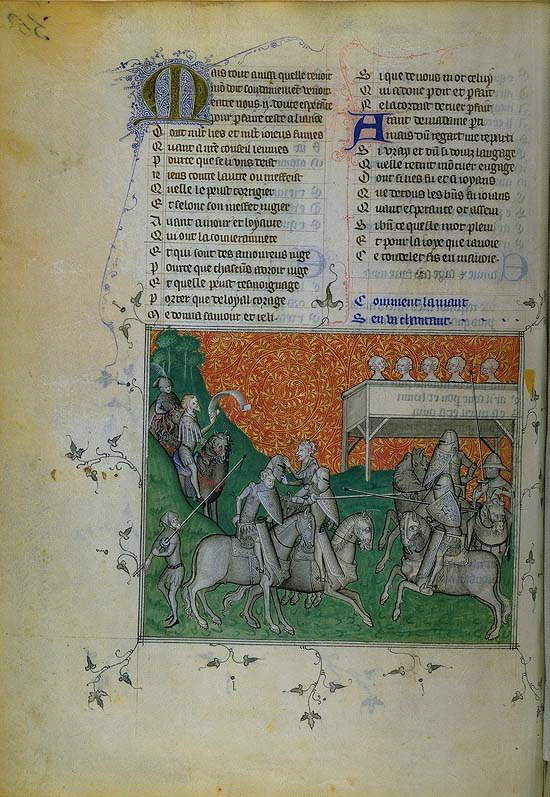
Sylvia Huot's 1987 From Song to Book: The Poetics of Writing in Old French Lyric and Lyrical Narrative Poetry is a stimulating study of the way that medieval French literature developed, during the late-thirteenth and fourteenth-century, a more acute sense of authorship, evinced, she argues, in the changing form of the vernacular codex. The author has clearly a wide knowledge of medieval French manuscripts, especially of the Roman de la Rose. Indeed the RR, she argues, is the great presence throughout the period, providing a model for how poetry can be constructed and how multiple authorship is inscribed and theorized. The crucial mid-point is a fault line where Guillaume de Lorris takes up the continuation of the allegory, changing its focus, and incorporating new themes while weaving together that which has already been written. The idea of the continuation is also explored, as a readerly and writerly response. Think, for example, of the Response to Richard de Founival's Li Bestiaires d'amours, especially the gendered voicing: the response is in the voice of a woman, though that does not necessarily mean that the author was female.

The most interesting part of the book is the third part, "Lyricism and the Book in the Fourteenth Century", which deals with the rise of the single-author codex, especially in the work of Machaut and Froissart. The former provides an especially vivid instantiation of the new sense of authorship in the period and the sense of the control and interaction between the writer and the reader. The book traces the development of a "writerly poetics of courtly lyric and lyric narrative" (p. 329), and it is extremely competent, stimulating, and will strike so many chords to anyone who reads Chaucer, for example. A great companion volume to this book, which I am reading too, is Kevin Brownlee's Poetic Identity in Guillaume de Machaut (Wisconsin UP, 1984). Brownlee is a brilliant scholar and this book is a tour-de-force. Important things happen in France in the fourteenth-century and the direction of English poetry in the period is completely alive to it.

Wednesday, 24 May 2006

Katherine H. Tachau, "God's Compas and Vana Curiositas", Art Bulletin 80 (1998), 7-33


Somehow it seems unconventional to review an article but some articles are really every bit as stimulating and informative as plenty of books around now, so I've decided to review briefly Katherine H. Tachau's wonderful article entitled "God's Compass and Vana Curiositas: Scientific Study in the Old French Bible Moralisée", Art Bulletin 80 (1998), 7-33.

Her view is that the Bibles moralisées appeared during a time of intense intellectual ferment in Paris at the beginning of the thirteenth century, and that to some (like Peter the Chanter), this appeared as an age of spiritual crisis. Her view is that "as a genre, the Bibles moralisées were created, affected, even motivated, by scholarly clergy who shared the latter Weltanschauung, and that they designed the Bibles moralisées to instruct not other scholars but royalty, especially the French kings" (p. 7). The article proceeds to read several fascinating folia of some thirteenth-century Bibles moralisées and discusses, in particlar, the way that pagan Eastern thought was represented in the form of astrologers, and are constantly seen as challenging and encroaching upon the divine sciences. The mechanism of reading these double images is fascinating, with the unmoralized 'original' representation sitting in a roundel above its moralized version, all sitting beside the text. Learning how to read these images is, in a very real way, learning how to read many medieval texts. She concludes: "Seen in that early thirteenth-century Parisian context, the depiction of the compass-wielding God in the first image of the Old French Bible moralisée would not have conveyed to its educated or royal viewers any approbation of the scientific study of the material world. Rather, the painting voices first of all the biblical exegetes' conviction that only God - not astronomers or philosophers - encompasses the entire created order" (p. 27). There is much else to be said about this learned article, but let your own curiosity dictate some attention to it. You will not regret it.

Tuesday, 16 May 2006

Alice Oswald, Woods etc. (Faber, 2005)


There's some great poetry around these days. I am not going to review Seamus Heaney's District and Circle. He has said that he feels like an over-ploughed field, so my own words would do nothing to help that. There are very learned reviews elsewhere doing better jobs than I could. I read District and Circle on Easter Sunday morning as the sun shone full on my face. It is a beautiful collection and was like listening to a childhood relative use words I had long forgotten.

Alice Oswald's third collection of poetry is entitled Woods etc. and is a stunning work. Her second volume, Dart, made her a well-known figure, with a long single poem following a river. These poems are about what she sees around her in her home in Devon, the elemental images of the earth, the moon, water, stones. Such things. Her ancestor is very definitely Ted Hughes, but they are very different. There is something less physically robust about them and at the same time they are more physically sensitive. I hardly know which poem to reproduce here, each time I read it I want to put a different one down here. This poem is the title poem in the collection, 'Woods etc.':

footfall, which is a means so steady
and in small sections wanders through the mind
unnoticed, because it beats constantly,
sweeping together the loose tacks of sound

I remember walking once into increasing
woods, my hearing like a widening wound.
first your voice and then the rustling ceasing.
the last glow of rain dead in the ground

that my feet kept time with the sun's imaginary
changing position, hoping it would rise
suddenly from scattered parts of my body
into the upturned apses of my eyes.

no clearing in that quiet, no change at all.
in my throat the little mercury line
that regulates my speech began to fall
rapidly the endless length of my spine.

Thursday, 11 May 2006

Manuele Gragnolati, Experiencing the Afterlife (U. of Notre Dame Press, 2005)


Manuele Gragnolati's book Experiencing the Afterlife: Soul and Body in Dante and Medieval Culture is the seventh volume in 'The William and Katherine Devers Series in Dante Studies' published by the University of Notre Dame Press. It is an extremely interesting read and comes highly highly recommended. Based on the author's Ph.D. thesis at Columbia (1999, sup. Barolini), the book looks at concepts of pain and suffering in the thirteenth century and how these were incorporated into the notion of Purgatory by Dante. Exactly how do the damned in Hell, and the souls in Purgatory suffer and how does corporeality (and lack therof) affect this suffering? G. looks at Bonvesin de la Riva's Book of the Three Scriptures and argues that the second Red Scripture provides a conceptual model of experiencing the suffering of the Passion that is analogous to the kind of experiencing of suffering the souls undergo in Purgatory. He also argues that Dante's embryological theories, outlined by Statius in Purg. 25 is a (poetic) sythesis of competing theoretical positions on the formation of the soul, form plurality of forms (Bonaventure, Bacon et al.) to unicity (Albert, Thomas, et al.). He asserts that Dante 'plays with the ambiguity within unicity of form's understanding of the soul, but also that he vacilates between the principles of unicity and plurality, arriving at his own original position on personhood, which allows for the perseverance of identity in the afterlife and at the same time maintains the significance of the body materiality' (p. 87). These are important points and provide important philosophical and theological reasons for why the body's materiality is so interesting in the Comedy. G. argues in addition that, in consonance with much Northern Italian eschological writings, the resurrection of the body was seen as a fundamental part of death, that everything that happens after one dies is merely a process until the soul is reunited with the body on the Day of Judgment. These are powerful considering when reading Dante's experience of the afterlife, for he is experiencing it as no-one else is, both in body and soul.
There is much more to say about this book, such as the re-focussing on those aspects of Dante that are indebted to rich veins of popular medieval culture, largely ignored by the critics who sought to place him in a highly Scholastic and learned tradition. This is a very enjoyable book, it is clear, concise, and argued with assurance.

The book has also got me thinking about Eleonore Stump's lectures here in Schools on Evil and Suffering, on the different kinds of pain, on the evil of suffering (or not), and Thomas Aquinas' definition of love.

Friday, 5 May 2006

Studies in the Age of Bargains!


I try not to gloat but sometimes a little piece of luck comes my way and I find a bargain that is just too joyous to be quiet about. The other day I went into the Mind bookshop on Walton Street and found Vols. 1-22 of Studies in the Age of Chaucer, a find that I really never thought would happen. I got it for a super price too. I don't know how many articles I have photocopied over the years from this journal, or which I have promised to go back to read again in the library, and now I can (not) read them on my very own shelf. I am also a member of the New Chaucer Society and so have the newer numbers of SAC, so do not have many to make up the complete set (23-25, if anyone's offering!). Sheer joy.
I also picked up a copy, in Jericho Books, of Rewriting Chaucer: Culture, Authority, and the Idea of the Authentic Text, 1400-1602, ed. by Thomas A. Prendergast and Barbara Kline (Columbus, OH: Ohio State University Press, 1999), also for a bit of a bargain (£4.50!). There are quite a number of interesting articles in this collection, dealing with the very important issue of what the early scribes did to Chaucer, how that was dealt with by the earliest printers (who sometimes had access to manuscripts that are no longer extant, Caxton for example), and how they interacted. The freedom scribes felt, and the very different concepts of 'authenticity' that circulated in the period, all create hugely complex problems for modern editors and readers of Chaucer's work, problems that are unlikely to be solved any time soon. At least that is until someone finds a holograph copy of the complete works of Chaucer. What's the alternative, then? Read Chaucer from transcriptions of Hg, or El, or in parallel texts like the Chaucer Society publications done by Furnivall? Or on CD-ROM facsimiles with hypertext links to other readings? The Riverside Chaucer in this scenario would become obsolete and students would read from their computers and turn the leaves of digital manuscripts. But editing will still be required, presumably. So what kind? And, if the Variorum Chaucer really is so methodologically flawed as everyone says then will Kane's principles be expanded (exemplified in his Piers Plowman edition) and applied to Chaucer? And who will that be?

Monday, 1 May 2006

Happy Birthday Blog


I am one today! Happy Birthday Me. This blog was started on this day exactly twelve months ago. Aww. Thank you to my faithful and loyal readers, and here's to another year of interesting films, plays, books, and poems.

Monday, 24 April 2006

"I woke up and sighed: the world was Marian"


Uta Ranke-Heinemann is a German theologian who is most famous for being the first woman to gain a chair in theology at the University of Essen, and the first to lose it after denying the virgin birth and was excommunicated in 1987. She is most famous in the English-speaking world for her wonderful book Eunuchs for the Kingdom of Heaven.
In an interview last year she talked about her admiration for Ratzinger's intelligence and compared it unfavourably with JPII. "The enormous difference between John Paul II and Ratzinger is intelligence. Ratzinger is more, much more, intelligent. Quite frankly, John Paul II was tedious without end. I couldn’t stand it any more. He was obsessed with Mary. “Mary, Mary, Mary,” he repeated over and over and over. I mean, I feel much for Mary myself, because she lost her son. But John Paul II said Mary was glad to see her son on the cross and that she would have put him there herself because it meant our salvation. I tell you, Ratzinger would not say such a stupid, horrible thing! No, he has much more taste than that. Ratzinger has much more of what the French call esprit de finesse. And John Paul II had none! ... At Munich, Ratzinger did his doctorate with professor Söhngen, and I did mine with professor Schmaus. This was in 1954—at the time of Pius XII’s dogma about Mary being received into heaven. Söhngen quoted Jerome who, around 400, said: “I woke up and sighed: the world was Arian.” (Arius was the great heretic who denied the divinity of Jesus.) And similarly, Söhngen said about Pius XII’s dogma, “I woke up and sighed: the world was Marian.” So, none of us, including Ratzinger, Söhngen’s main doctoral student, were excessive Marians." On the future of the Church she says: "I don’t see any future for a church in which all shepherds are men, and all women are sheep. How could that be a universal church? It’s a mutilated construct!...The church will continue as it always has. Ratzinger will not change 2,000 years of male domination. But perhaps he might make one tiny change for the better. He might permit the use of condoms in AIDS-ravaged Africa. Those women in Africa who are told by their priests that they will go to hell if they use condoms—well, those women are told they're the martyrs of this millennium!"

Sunday, 23 April 2006

Inside Man (2006), dir. Spike Lee


Clive Owen plays Dalton Russell, who explains to us in the opening shot that he has planned the perfect bank robbery. The film then proceeds to show the heist in progress, and the efforts of Det. Keith Frazier (Denzel Washington) to get the hostages being held in the bank out alive and getting the case wrapped up. When the four robbers seal off the bank and begin the robbery they make everyone take off their clothing and get into dark jumpsuits, white masks, and blindfolds; they are dressed just like the robbers. From here on it is very difficult to tell the good guys from the bad guys, and that is a key theme in the film. Russell isn't an evil criminal mastermind, he's got a point to make, and it isn't about holding hostages or hurting them, or about robbing millions of dollars from the bank. There is a funny scene where a little black kid is playing with a Sony PSP and explains to Dalton the object of the game (kill people, put grenades in their mouths, sell crack to them, rape people, the usual thing an 8-year-old should be playing, in sum). Dalton shakes his head and says he'll have to talk to his father about this game. He's disgusted with the violence. Along comes the super powerdressed Madeline White (Jodie Foster, rather gingerly sporting an Hermès Birkin bag), who has been hired by the bank's owner, Arthur Case (Christopher Plummer) to make sure something in a safe deposit box never sees the light of day. It becomes clear that what's in the box interests Dalton too, and he's not willing to part with it just yet. In a bank full of money, the most important thing is an envelope documenting the origin of Case's money, Nazi loot. Can they manage to escape? And do we care?

I think that's my main gripe with the film. We don't care enough about the heist because the motivation is never properly developed. It is undoubtedly worthy, but many questions remain unanswered, and the main one is 'Why does Dalton do it?'. Lee is making us work for it in the film, but in a way we do need certain assurances that are not forthcoming. The film left me oddly dissatisfied. The film is well made, assuredly directed, and the acting is all very solid. There are plenty of nice parallel scenes set up in the film: Frazier can't afford a diamond ring for his girlfriend, the only real piece of evidence left at the scene is a Cartier diamond ring. And with a Spike Lee film you expect some angry political angle. It is there but you have to dig a little for it. It is a very post-9/11 film in this sense. One of the bank clerks who is released is being told to kneel (the cops think he's booby trapped) and when he takes his mask off one of the police officers says 'Oh shit he's a fuckin Arab', meaning 'of course he's wired up to explode'. The man is a Sikh. But the friend of the Nazis Arthur Case is paralleled rather nicely with the shady Birkin-toting Madeline, who blackmails Case to go referee on a purchase deal of property on Fifth Avenue by the nephew of Osama Bin Ladin. The implication is clear: Al-Qaeda are the Nazis of today, and the people we describe as war criminals are the same people who today make money in bed with those who wish to destroy Western civilization; they are perfectly respectable, they are pillars of society, who do lots of worthy and laudable things for people in need. But in fifty years, when the atrocities have been raked over, they will be called war criminals too; and others will have stepped in to take their place. Case says, I saw a chance to make money and I took it; Madeline is just the same. There are many who should be uncomfortable with these sentiments.

Saturday, 22 April 2006

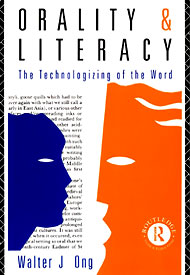
Walter J Ong, Orality and Literacy (Routledge, 1982)


Ong's Orality and Literacy is a classic of its kind. A kind of response to Marshall McLuhan ('The medium is the message' and all that) and an extended discussion of what Orality and Literacy actually means. The book also refers briefly to Derrida et al., but clearly isn't going to go into it. Ong is mainly interested in what he calls primary orality, meaning communities who have no contact with the written word whatsoever. Such communities must surely be hard to find now, and indeed in much of his discussion anything after oral Plato is not quite in this category of orality. Even the so-called primitive society (the kind of stuff Lévi-Strauss ran around looking for), I wonder if they really fit in. Is there really any such thing as primary orality?

His discussion of the changes in literacy and orality in the move between manuscript and print is interesting, though I do wonder a bit about his presentation of manuscript production, and the whole notion that manuscripts were so difficult to read printing really had to be invented. Well, they might look difficult to read by comparison to print, but when there's nothing else, then they are not difficult to read. They just are. Ok, there are cases where scribes copying abbreviations can make mistakes, but that does not mean they found them difficult, it means they are human and make mistakes. Books are often spotted with typos, which doesn't mean that books are hard to read. The restricted access to books in a manuscript culture is a complex phenomenon, and manuscripts cannot be 'blamed' for the fact that they don't look like printed books.

Tuesday, 11 April 2006

A.C. Spearing, Textual Subjectivity (OUP, 2005)


Anyone familiar with Spearing's recent work will, in a way, have seen this book being born. His article on the Man of Law's Tale (NLH 32 [2001], 715-46) in particular will show a fault line of the polemics of the book. Why do we need all these narrators in Chaucer's work? Spearing says that it's a notion that was developed with Kittredge and has stuck fast since; if we have a problem with a tale, we generally attribute it to the narrator. If, on the other hand, we like something in the tale then we attribute it to Chaucer. The proliferation of narrators is unnecessary according to Spearing. In an opening chapter, entitled 'Subjectivity and Textuality' he outlines how he has come to this view, mainly with recourse to Derrida. He uses Derrida's suspicion of Western phonocentrism and priviledging of the spoken word over the written word which has led to our multiplying narrators in the Tales: thus, we trust a narrator more because he is speaking, rather than allowing ourselves to trust the textuality of the poem.
There is an awful lot more I could say about this book. It is a good book, and I recommend it. I do, however, have some problems with it. For all his talk about textuality, his attention in the analysis of the Man of Law's Tale to its curious textual format in both the Hengwrt and Ellesmere manuscripts is too scant. The Tale is glossed in Hg and El, drawing material from Innocent III's De miseria condicionis humane, Ptolemy's Almagest, and Bernard Silvestris' Megacosmos. Robert Enzer Lewis has already demonstrated that these glosses are drawn from Chaucer's manuscript of the De miseria (see PMLA 81 [1966], 485-92 & SP 64 [1967], 1-16). OK. Now go somewhere with that. What's all this talk about textuality and then no talk about the manuscripts? He makes the point that Chaucer's texts are hugely self-conscious, and in a very physical way. This is true. He cites Cooper (Oxford Guide to Chaucer [2nd ed; 1996], p. 126) on the abundance of glosses supporting his claim that the Tale was seriously intended. Ok. Now what? On pp. 12-13 he cites Jeffrey Kittay ("Utterance Unmoored: The Changing Interpretation of the Act of Writing in the European Middle Ages", Language in Society, 17 [1988], 209-30) who highlights the changes in the format of manuscript pages, in particular word division, and biblical glossing where reference is made to numbered passages rather than cited passages (indicating readers flicked back and forth to texts); this is all to talk about a developing textual awareness and increasing sense of textuality. "The implications of this fact for the elements of commentary and self-glossing in medieval poetry are obviously important (see Rouse and Rouse 1982)". And that's it. What? The Statim invenire article is very important, but it's one and only one starting point of a huge point that shouldn't be left hanging like that. Reynolds, Stillinger, Minnis' new stuff (Magister amoris for example), everything Ralph Hanna has written [not cited BTW], and a whole shed load more are just screaming out after this full stop for attention. It is like he has made an excellent point but then has done nothing with it, and indeed the flatness of the subsequent reading of the MLT is a good case in point.

Final word: very stimulating book with some huge gaping holes.

Friday, 7 April 2006

Death & Resurrection: Aspects and Approaches, Lincoln College Oxford


Roll Up Roll Up! Yes, it's that time of year again. The Second Annual Oxford Graduate Medieval Conference will take place next week, Wednesday and Thursday, April 12th and 13th, 2006 on the theme of Death and Resurrection: Aspects and Approaches. The following papers will be delivered:
Christine Maddern (York): Early Medieval Name-Stones as Manuscript Pages; Richard Burian (Glasgow): Wyrd as Death?; Sarah Baccianti (Lausanne): Dead Man Talking, or When Dead Bodies Talk and Move in Grænlendinga saga and Eriks saga rauða; Beth Tovey (Somerville): Sexuality and Dying Bodies in Anglo-Saxon Literature; Alexander Ibarz (Sheffield): Ausiàs March (1400-1459): From Plague to Civil War; Darragh Greene (TCD): 'Let by your sorwful lyf, | For in your sorwe ther lyth no red': From Disorganization and Despair towards Reorganization in the Book of the Duchess; Anna Welch (Melbourne Coll. of Divinity): 'Sister Death': The Influence of St Francis' Attitude Towards Death and Resurrection on the Crucifixion Scene of the Codex Sancti Paschalis; Will Rossiter (Liverpool): Roma/Amor: Petrarchan Necromancy and Necrophilia; Marco Nievergelt (Lincoln): Allegorical Discernment and the Death of the Body: Deguileville's Pèlerinage de la vie humaine; Cecilia Hatt (St Hilda's): Goodbye Vienna: Learning to Die and Measure for Measure; Michael Funk Deckard (Leuven): Fear of Death and the Sublime in John Milton and Edmund Burke.
Professors Vincent Gillespie (LMH) and Eric Stanley (Pembroke) will open and close the conference, and chairs include Paul Strohm (Columbia), Mary Carruthers (Balliol/NYU), and Richard Rowley (Linacre).
And all this just before Easter!

Thursday, 6 April 2006

R. Howard Bloch, Etymologies and Athropologies (U. Chicago Press, 1983)


R. Howard Bloch's Etymologies and Genealogies is an exploration of medieval French literature on the crest of the wave of mainly French theoretical work in the two decades from the Sixties onwards. Derrida, Saussure, Lévi-Strauss, Barthes, de Certeau, are all names that loom large. Bloch takes a central theme and preoccupation in the French Middle Ages, that of lineage, and extends it to an examination of grammar and literature, to ideas of kinship, romance and lyric. And much more.

The book is very interesting and quite a challenging read, and is a good example of a heavy hitting theorist writing about the Middle Ages. I'm not sure whether he's made me rethink anything, but I did take the book seriously as I read it. So that's something. The prose is a little impenetrable at times and might have done with a little clarifying here and there. Anyway, most books of this kind are rubbish (frankly), but I don't think this one is.

Thursday, 30 March 2006

John McGahern


John McGahern passed away in the Mater Hospital in Dublin today.


manibus date lilia plenis

Read this

Wednesday, 22 March 2006

Arthur Miller, Resurrection Blues dir. Altman (The Old Vic, London)


Arthur Miller's penultimate play, Resurrection Blues, is having its European premiere at the Old Vic in London. The stars have been assembled (James Fox, Neve Campbell, Matthew Modine...) and Robert Altman directs. It's a recipe not only for a hit but also for some great theatre. And yet one is left with a curious feeling of having fallen victim to a huge hoax. This play is so awful that I cannot believe that a) Miller (whom I love) wrote it, b) Altman (whom I love) directed it, or c) that any of the actors have ever stood on stage before. The whole thing really is that bad. It's clear that Miller is angry (Corporate America blah blah blah) but the anger has been diffused throughout all the characters so that it becomes a malaise; the humour is so misguided that there are moments in the play when one would think a panto was being performed.
The military dictator/leader of an unnamed South American country has sold the rights to broadcast the execution (a crucifixion) of a revolutionary by an American media corporation. The broadcast's director has scruples about what's being done and try to persuade the dictator not to go through with it. Meanwhile, the dictator's brother has returned from study exile (he was a pharmaceutical mogul) to plead for this revolutionary's case. The people of this country begin to believe this revolutionary is God. So the play is about how people are oppressed, how they believe, how Corporate America doesn't understand such things and only understands money, how people need faith, and lots more.
In a way that's exactly the problem. There are far too many strands in the play for it to gel together. The cast is so lacklustre (I cannot remember one single line from the play) and the direction so flawed that I shall wait some time before I go back to the Old Vic. The whole thing is such a pity.

Saturday, 18 March 2006

Olivia Holmes, Assembling the Lyric Self (U Minnesota Press, 2000)


Olivia Holmes makes a powerful argument that some early French and Italian manuscripts display highly wrought self-conscious impulses to arrange and gather verse into authorial cycles, an impulse we more often associate with much later traditions, such as Dante's Vita Nova and more famously Petrarch's Rerum vulgarium fragmenta. In this she is largely successful, and makes for a very enjoyable read (I particularly enjoyed the chapter on Nicolò de' Rossi).

My criticism should not really detract from what has been achieved in the book. The novelty of Holmes' approach is that the texts under discussion do not come from critical editions but from manuscripts, which has the effect of creating a peculiar alterityabout some familiar texts. This is much to be praised. She discusses some rather well-known manuscripts, such as Modena, Biblioteca Estense e Universitaria α. R. 4. 4., and Chigiano L. VIII. 305, to name but two. The reason for a paucity of descriptive accounts of the manuscript's construction and planning is that these MSS have been described elsewhere, and indeed exist in facsimile (such as Chig. L. V. 176, Boccaccio's autograph no less). However, I feel that since she relies so heavily on the particularity of these examples, the best way to reinforce her observations is by making her reader very very aware of its physical format. We need to know things like collation, ink, parchment, scripts: has the manuscript been put together over a period of time or does it look like it was produced in one coherent block? What evidence is there of ownership? How many scribes worked on it? Do they look professional? How formal is the manuscript? What does its format suggest about the book's use? In sum, it is not enough just to cite from manuscripts, but you've got to give a voice to the physical manuscript itself to really appreciate all that manuscripts have to offer.

Tuesday, 14 March 2006

Sunday, 12 March 2006

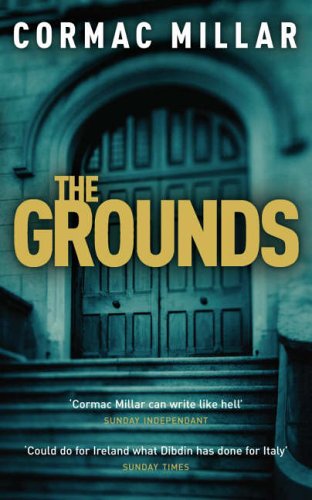
Cormac Millar, The Grounds (Penguin, 2006)


First of all, I feel it is only fair to say that I know Cormac Millar. He teaches Italian, as Cormac Ó Cuilleanáin, at Trinity College Dublin, where, for his sins, he taught me. He is a man of uncommon erudition, of intellectual humanism, and wicked generous wit. I say this because these are attributes that glitter and coruscate throughout The Grounds, his second novel. Millar has certainly raised his game from the first - very enjoyable - novel, An Irish Solution (Penguin, 2005), and the prose has levelled off at a cruising altitude that is both satisfying and challenging. The book just sparkles, it really does; this short review can not do justice to this complex and exciting work.

Séamus Joyce returns to his alma mater, King's College Dublin, to report back to an American university consortium on its suitability for investment. The academics, for a host of different reasons, all look on Joyce with suspicion and alarm. Things get sticky when the college president is found murdered and it looks like he himself is being framed for the delitto. What does it have to do with the painful and seemingly pointless changes being proposed for the venerable institution? And what has happened to a senior historian, whose research assistant's body was found washed up? Can all these deaths be related? But how? We meet a host of academic types who all expend vast energy sniping at each other in a wildy enjoyable manner. There is a property developer who has virtually bought the campus and is busily building apartments everywhere, and there is Séamus's ex-girlfriend, now a junior academic at King's, who is behaving oddly and doesn't have a permanent job! All is not as it appears, even at second glance, at King's College.

Cormac Millar's mother was the distinguished Irish writer Eilís Dillon, and the mise-en-scène of The Grounds is drawn from her 1956 novel Death in the Quadrangle (Faber). As such we are dealing with no ordinary crime novel, but rather a complex, intertextual and extratextual, literary work. This dimension only adds to the internal literary complexity of the book. And of course while the author assures us in a note at the end of the novel that this is not a roman à clef, one cannot resist wondering just how resonant it is with current business plans to keep Trinity College floating with its head just above water. Humanism does not fit well into business plans, it doesn't have a heading of its own, it cannot be poked and prodded, and it cannot be patented. It just won't do.

Sit back and enjoy this funny and clever novel from a powerful new voice in Irish crime fiction. You won't regret it.

Saturday, 11 March 2006

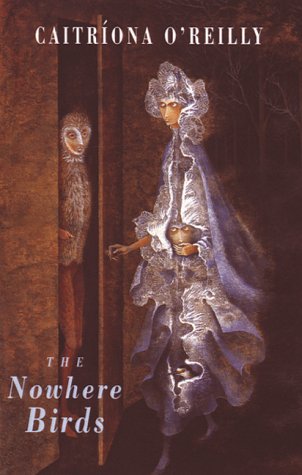
Caitríona O'Reilly, The Nowhere Birds (Bloodaxe, 2001)


The Nowhere Birds is O'Reilly's début collection of poetry and is very impressive. Since I have a small pint glass of daffodils on my desk right now, I'm going to reproduce her poem from this collection called 'Daffodils', which I think will give you a sense of these sensual, and unsettling, poems:


They bring this hint of something startled in them -
the dreadful earliness of their petals
against dead earth, the extremity of their faces
suggesting a violent start -
dumb skulls opening, overnight, to vehemence.
Their lives are quicker than vision,
their voices evade us. And as
water tightens its surface in vases
and sharpens its glass, slicing their sticks
in half, these funnels clatter on their bent necks,
like bells for the already dead.

Tuesday, 7 March 2006

Stupidity


Good films don't get watched. I suppose it is just that simple. But apparently the Oscars are to be considered a flop this year, with one of the lowest ratings in 20 years. Sigh. The films, pundits say, were too highbrow, and nobody had seen them.

Too highbrow. Sigh. Why is everybody so stupid? Or rather, why are most people so stupid? I am disgusted and nauseated by this.

Sunday, 5 March 2006

Astell on Job, reviewed by Lerer


It is a commonplace that academics are embittered jealous failed creative types who eventually succumb to drink or some other such self-destructive behaviour, and who rarely have anything positive to say about fellow academics. Reading reviews can often give one a glimpse of these tendencies, side swipes here and there, footnotes that are less composed to convey information but are meant as a glove used to smack one on the face.
But it was with joy that I read Seth Lerer's review of Ann Astell's book Job, Boethius, and Epic Truth (Cornell UP, 1994) published in Speculum 70 (1995), 869-871. The review opens: 'This is a book of literary criticism; but it is, as well, a testament of faith.' He goes on to look at Astell's treatment of the medieval reception of Boethius' Consolation of Philosophy, pointing out the very stimulating aspects of the study; pointing out too, its deficiencies, where it elides certain problems of textual transmission. He ends the review with an extraordinary, generous, and magnanimous recommendation that could only be produced by a mind capable of breadth, embrace, and art:
'In spite of these criticism, or perhaps because of them, this is a book that I have come to admire with each rereading. It is a rarity in academic criticism: a study of great learning and great belief, whose arguments are voiced without the slightest tinge of pedantry or condescension. It illustrates a way of reading literature as a spiritual humanist; and if its deep faith in a higher truth seems out of step with current institutional uncertainty, then at the very least it should refresh the reader with the courage of its critical convictions.'

Thursday, 2 March 2006

World Book Day 2006


Today is World Book Day. Go out and buy someone your favourite book.

It makes a difference.

Wednesday, 1 March 2006

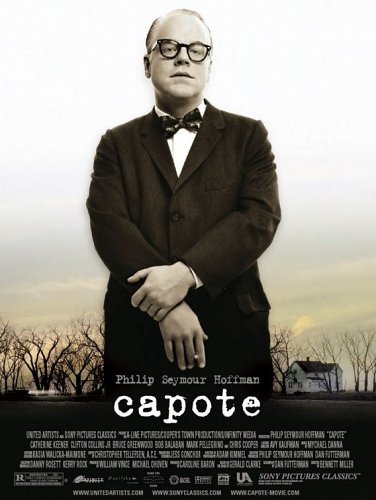
Capote, dir. Bennett Miller (2005)


Capote is the story of the circumstances of Truman Capote's writing of In Cold Blood. Capote reads a short column in the New York Timesof the mysterious killing of a family in Kansas and becomes fascinated. He goes with his friend and research assistant, Harper Lee, to the town of Halcomb and and is profoundly moved by the experience. He follows the trial and befriends the killers, especially one, Perry Smith. The book Capote wants to write is a new kind of book, a fictional work based on true events, the non-fiction novel.

The killers' resistance of the death penalty and Truman Capote's desire to finish the book are represented in the film as opposing each other, and the tension that arises from that is very interesting. He wants to help them, finding them a lawyer for appeals etc, but he wants to write the end of his book. This end that he desires must result in their execution, and when it does happen it shocks him deeply. His self-obsession is clear at the beginning of the film, but the book grows into a destructive obsession that almost transcends his own enormous ego. He confronts questions of honesty and truth, and how the process of creating must incorporate these. It's a challenging film, in many ways.

While the direction is not always as artistically assured as it could be, Phillip Seymour Hoffman gives nothing short of a masterclass in acting in this film. He is just extraordinary. You are utterly convinced and moved by his remarkable performance and for it alone this film is a must see.

Sunday, 26 February 2006

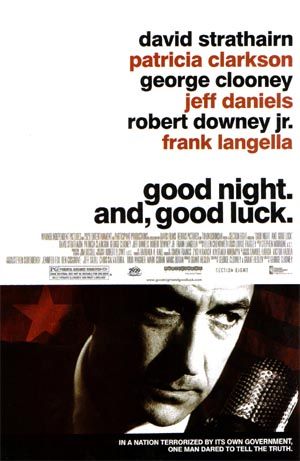
Good Night, and Good Luck, dir. George Clooney (2005)


Good Night, and Good Luck is the story of the confrontation between CBS News anchor man Edward R. Morrow (David Strathairn) and Sen. Joseph McCarthy. These witch hunts are well known; those familiar with Arthur Miller's work will know how this period affected him and his work: The Crucible, for example.
The film does not show anyone being dragged off and thrown in jail. Instead, it depicts a group of journalists at CBS trying to come to terms Sen. McCarthy's one man crusade against Communism seen in every corner of independent thought throughout the United States. In the face of the seemingly monolithic power of government Edward R. Morrow decides to broadcast a series of in-depth examinations of the kind of mock-trials McCarthy was engaged in and questions their legitimacy and legality. I wouldn't describe is as a hatchet job on the junior member from Wisconsin, but some will.
It's a powerful and timely film. It's wonderfully acted - Strathairn is tense and righteous throughout in equal measure, and the direction is sure and satisfying. Robert Downey Jr. seems to be staying on the straight and narrow and showing that he can act. Clooney is curiously set back in the film, he doesn't overpower the screen with his presence and allows the others their space.
If, as one critic put it, one feels preached to, it is because this is a film with a message. So get it. The Left will love it, the Right will hate it. The usual idiotic debates will rage, trying to strangle appreciation and independence, art and beauty. Perhaps there is no hope for us. I left the cinema sad and worried. I enjoyed it immensly, but couldn't help feeling plus ça change plus c'est la meme chose. The danger is most certainly within. Not without.

Saturday, 25 February 2006

OED for All!


This is a bit of an anorak thing to get excited about I know but it's from today's Guardian:

"Oxford University Press has signed a breathrough deal with public libraries across England. Library users will get free access to online resources including the Oxford Dictionary of National Biography, the Oxford English Dictionary, Grove Music and Grove Art. The agreement was brokered with the Museums, Libraries and Archives Council, which hailed the benefits for all sides. Indeed, anyone will be able to get full, free access to the databases at home using their library card number."

I love the OED.

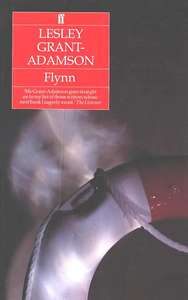
Lesley Grant-Adamson, Flynn (Faber, 1991)


Lesley Grant-Adamson is a well-known British crime writer and Flynn is her seventh novel; she has clocked up fifteen so far - the latest being Undertow. In Flynn she introduces a new character, a detective called Laura Flynn. The book runs two stories in parallel, an initially innocuous case of corporate ownership and the case of her father who walked out when she was four. It is actually very good, quite subtle. She doesn't go for any flashy effects, and most of what happens is very believable, at first seems even banal, until you realize you are actually biting your nails. The writing is very solid and Flynn is a nice character, well balanced between competence and chaos, a detective who gets rather modest jobs that just pay the bills. When yet another seemingly modest job comes along you feel that she's enjoying the increasing danger but at the same time that she's not at all sure that she can keep things in control. All of this is set against the backdrop of the Irish in London, with more than a tinge of the failure so many of them encountered. There's much that is poignant and intelligent in this book. I enjoyed it a lot and will read more.

Sunday, 19 February 2006

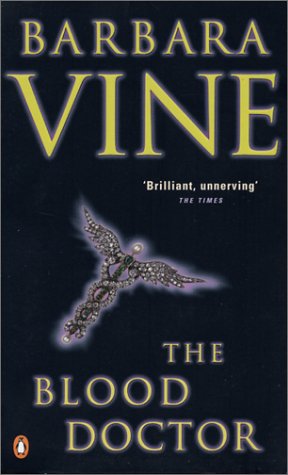
Barbara Vine, The Blood Doctor (Penguin, 2003)


This is quite simply an awful book. It needed a scalpel-wielding editor to be ruthless, for a start. It is a good 200 pages too long. And the excessive length is indicative of the lazy meandering writing. It's not that the idea isn't a good one. It isn't bad. Though it isn't great. No. It's the bad writing. Why is crime fiction often written so badly, especially when plots take lots of thinking and sometimes even a bit of cleverness?
And why bother writing novels of the same genre under a pseudonym? Barbara Vine is the pseudonym of Ruth Rendell, but Ruth Rendell is a crime writer, and Barbara Vine is a...crime writer. I can understand, say, if someone is a poet and a novelist: those two don't seem to mix that comfortably (think of David Harsent, for example). But why write crime novels under two names?

Tuesday, 14 February 2006

Bennett & Kerr II


The latest catalogue (no. 133) from Bennett & Kerr Books, which I have posted about before, has lots of little gems to get your excited. I nearly lost my head when I saw Christopher Baswell's Virgil in Medieval England (Cambridge: CUP, 1995) and rang straight away hoping it wasn't gone. It wasn't. I'm happy. But of course the crisis was really all of the other books I wanted. A couple of examples: facsimiles of MSS Tanner 346 and Bodley 638, two important Chaucer manuscripts, for a very good £50 each, and the Hengwrt facsimile for £85. Two other little gems: Patrick Boyde's latest two fine studies, Human Vices and Human Worth in Dante's Comedy (CUP 2000), and Perception and Passion in Dante's Comedy (CUP, 1993), both for a very competitive £20 each. Panofsky's Early Netherlandish Painting, 2 vols (Icon, 1971, orig. 1953), only £30. These are the things that my shelf feels bare without but which I cannot afford right now (maybe I could do a fast for a while...). These are great works that should have good homes, or else donated to me!

Sunday, 12 February 2006

A Short Film About Killing (1988), dir. Krysztof Kieslowski


A Short Film About Killing originally formed the fifth episode of Kieslowski's celebrated Dekalog, a set of one-hour films broadcast on Polish television exploring the ten commandments in a modern context. Two of these have been developed into full-length features, A Short Film About Love and this one about killing. It's a powerful and affecting film that is hard to describe in detached terms.
It is the story of a young man Jacek (Miroslaw Baka) who brutally murders a taxi-driver (Jan Tesarz), who is put on trial, found guilty, and executed by hanging. The Exodus text tell us not to kill, rather than not to murder, and the implication throughout the film is that killing is perpetrated by the individual criminal and by the State. Both deaths are depicted in gruesome detail: the taxi-driver takes forever to die and is attacked in three different ways by Jacek. It must be the longest murder scene I've ever seen in a film. Likewise, the court process is not dealt with, just the death sentence, and eventually his hanging. Jacek's idealistic young lawyer defending his first case comes to realize that he can be an eloquent and persuasive critic of the death penalty but the judge will still not be turned, the instrument of the State will be deaf to these pleas. This is all against the backdrop of gloomy housing estates in Warsaw in a cold winter. There is no preaching in the film: Kieslowski simply shows us both killings graphically and their barbarity speaks for themselves. The why? we have during the film changes its focus from the taxi-driver's murder to the murderer's murder in a subtle and unsettling way.
Even though this is a highly finished film it is a far cry from the sheen of Three Colours, a film that is far more 'mainstream' in a certain way, or perhaps even The Double Life of Véronique. That's what makes it so powerful, its roughness. Kieslowski is one of the great directors in European cinema, and A Short Film About Killing amply demonstrates why. Watch it.

Friday, 10 February 2006

World Press Photo Award Winners


Check out the World Press Photo Award Winners from the BBC News website; haunting and beautiful.

Thursday, 9 February 2006

In Our Time: Geoffrey Chaucer


Listen to the latest programme of In Our Time on BBC Radio 4 about Geoffrey Chaucer. The three experts are Caroline Larryngton, Ardis Butterfield, and the great Helen Cooper. Well worth listening to! Poor Melvyn just wouldn't leave the whole 'what kind of English is it?' question. You just want to give him a little slap on the wrist and tell him to listen!
You can also download this as a podcast from the Apple iTunes Music Store.

Monday, 6 February 2006

Salesman in Beijing


Listen listen listen to Arthur Miller read from his account of a production of Death of a Salesman on BBC Radio 4's Afternoon Reading. It is just wonderful to hear him describe these actors taking part in a production that would have been unthinkable during the worst years of the Cultural Revolution. It's the stuff of theatre, of lives. Especially the description of the two actors who spent years playing cards because there was nothing else to do who play cards as Charlie and Willie. Very moving.

Sunday, 5 February 2006

Caché, dir. Michael Haneke (2005)


On Friday evening I went to see Michael Haneke's new film Caché. It's a fine film, so subtle and insidious. The film opens with a long sequence of a camera shot of the front of a house with people coming and going, cars passing, life happening, and it all looks rather innocent until we see a rewind button being pressed. We realize that we are watching what the two protagonists are watching, an anonymous tape of their house left on their doorstep. More tapes are sent, but who is sending them and why? They lead Laurent (played by Auteuil) back to a long lost childhood friend and the events that forced the boy into a new life that follow him tragically. The macro event is the massacre of over 200 Algerians during a protest in Paris in 1967 when they were driven into the Seine. The boy's parents were among the dead. So many scenes of the film are make you question points of view, who is watching, are we watching a tape, is this the 'objective' camera, who am I? It creates some very odd moments of identification with the characters and is remarkably unsettling.

The film is about responsibility, individual and collective. The whole subject of France's very difficult history with Algeria is probed in a very intense way by Haneke as we see Laurent deal with what it meant for him as a six-year-old boy. It's not a history lesson, it's far more powerful. Very little actually happens in the film. That is, very little except for one very VERY shocking encounter between Laurent and his childhood friend. An encounter that makes us completely refocus our appreciation of the effect of these events on the boy's life. Juliette Binoche brilliantly traces out a character that slowly doubts and disintigrates in front of this faceless amorphous threat. There is no soundtrack, which really adds to the relentless quality of the film. It is merciless on the viewer, there is nothing easy about it at all. And the final intriguing scene leaves you screaming questions at the screen, literally. And then you stop yourself short when you realize that treating it as a whodunnit is the easiest question to ask about the film. It's very powerful, very clever. Mark Lawson described it as the first great masterpiece of the 21st century: I disagree only in that I don't think it's the first (for that see previous film post). But it's an extraordinary film.

Wednesday, 1 February 2006

Ellesmere


The library in TCD (the alma mater) has a copy of the New Ellesmere Facsimile. I went to see it on Friday. I swear it's almost like turning the pages of a manuscript. You almost smell the manuscript it's so good. It is soooo beautiful. I've never seen anything like it. A collection of essays was published with it, ed. by Stevens & Woodward, an invaluable reference work on the manuscript. It's bound in white calf leather and oak boards, much like a fifteenth-century manuscript would have been put together. The thing that most shocked me is how really luxurious the manuscript is. I know I've read that many times before but until I sat down beside a really good facsimile I hadn't realized just how luxurious. There is so much empty space, a real sign of money in a patron's manuscript. And the borders are gorgeous (see Kathleen Scott's article in the collection above re. dating, which now looks a bit earlier than we thought). And of course we now know the name of the scribe, Adam Pynkhurst (see Lynne Mooney's article in this month's Speculum). One thing is for sure, whoever commissioned this manuscript was serious about his Chaucer and put a lot of effort into making one big and flashy Canterbury Tales, as did the scribe(s). Where did that impetus derive from? Chaucer's death?

Sunday, 22 January 2006

Todtnauberg


Listen to John Banville's play Todtnauberg on BBC Radio 4, aired on Friday Jan 20th.

The title of the play refers to Martin Heidegger's Black Forest retreat, a retreat it is said in which he wrote most of Being and Time. After a poetry reading in Freiberg, Martin Heidegger invited Paul Celan to his cabin; Celan accepted the invitation and they spent an afternoon together on July 25, 1966. Celan wrote a poem entitled "Todtnauberg" after this meeting. Otherwise, we have no record of what they spoke about. Celan wrote in Heidegger's visitors' book: "Into the cabin logbook, with a view toward the Brunnerstern, with hope of a coming word in the heart."
It must have been an extraordinary meeting of two extraordinary minds - I cannot imagine how Celan, a labour-camp survivor, and Heidegger, a card-carrying Nazi, managed to make sense of each other. Perhaps they didn't.

Wednesday, 18 January 2006

Dorothy Molloy, Hare Soup


In the Blackwell's half-price sale you can pick up all sorts of odds and ends. One particularly serendipitous purchase was Dorothy Molloy, Hare Soup, her début collection of poetry (Faber, 2004). I didn't know anything about her but it seems that she died not long after publishing this collection, and was a respected painter. A second collection, drawn from her unpublished papers, is planned for February, entitled Gethsemane Day.

The collection is very good. I wasn't sure about some of her poems at first, but I've come back to them over a couple of days and am increasingly struck by them. The first poem in the collection is called 'Conversation Class'. It is an excellent example of her very startling sense of language, her really clever way of using another language within English, the way that colours mark her striking imagery, and her very complex kind of humour.


I redden to the roots when Jacqueline Dupont zuts
at my French. She cocks her ear and smoothes her coif and
sits me on a poof, settles herself on a chaise-longue.

'Encore une fois,' she zaps, and taps her nails and sips
her Perrier. My tongue is jammed, my teeth are in a
brace. Her hands fly to her face. 'Mon Dieu,' she cries,

'Mon Dieu, qu'est-ce qu'on peut faire?'

I fiddle with my cuticles. She checks her watch and snaps,
'Ouvrez la bouche!' Her forty clocks tick on, tick on.
Her cuckoos coil behind their yodel-flaps. Her grandfathers,

lined up against the wall, come every fifteen minutes
with a boing. 'Finie la classe!' She pours herself
a glass of Armagnac. 'Vous voulez un petit peu?'

I sluice the liquor back.

My tongue is loosed. My eyes are glazed. I sing
the Marseillaise. I feel a revolution
in the red flare of my skirt.

Sunday, 15 January 2006

Alice Lyons in Co. Leitrim

Check out Alice Lyons' blog detailing her 'Staircase Poetry Project' in the new Arts Centre in Carrick-on-Shannon, Co. Leitrim. It looks really interesting and I'm sorry I'm not going to get a chance to see it unfold. I am originally from Co. Leitrim and went to school in Carrick-on-Shannon. It is in the north-west of Ireland, west of the Shannon, for my readers unfamiliar with the Emerald Isle.

Saturday, 14 January 2006

Chrétien de Troyes


You know, I knew eventually I would find it. I'm not talking about the Grail now. Last year I kept my eye on a copy of the Pléiade edition of Chrétien de Troyes, Œuvres complètes in Blackwell's and I hmmed and hawed for months. It cost too much and I'm not really working so much on Chrétien, blah blah blah. Then they had a sale (as they often do), it went into the bargain bin, and I missed it! I was so sore over that. Well imagine my surprise when a copy appeared upstairs in the second-hand section, for a great price. I snapped it up stright away.
I just love the Pléiade editions, bound in full leather with gold tooling on fine paper and set in a beautiful font full of gorgeous ligatures. Lovely lovely, o so lovely.

Thursday, 12 January 2006

One Missable Labyrinth


Kate Mosse's new book is called Labyrinth (Orion, 2005). It is basically a Grail thriller/romance, and the dustjacket makes all sorts of wild accusations about it being just like Dan Brown's Da Vinci Code. Unfortunately every one of those accusations is entirely justified. The story interweaves between 13th century Carcassonne and a young woman called Alaïs Pellettier and a 21st century volunteer on an archeological dig in, yes, Carcassonne, called....Alice Tanner. Actually, you know what, I don't think I need to say any more. The entire plot should be horribly obvious to you now. It's a mélange of Dan Brown and Indiana Jones. But there are problems with the book. First, it's a mélange of Dan Brown and Indiana Jones. Second, well, it's a mélange of Dan Brown and Indiana Jones. Actually the writing is so lazy and ridiculous, worthy of the very best of Mills and Boons. And then she makes all of these cringeworthy references to the great René Nelli etc on the langue d'oc, all peppered to give authenticity. And all of this goes on for 525 pages. To be honest I needed it after the emotional car crash I was in, described in the last post. With no seatbelt. It helped me to switch off and have some brain dead time.

Some of you may use the IMDb (the Internet Movie Database) for reviews etc of films. There are lots of threads on Brokeback Mountain, some of them full of crap (as you'd expect), but some with some very interesting observations. This one looks at the Classical references in the final, stunning, scene in the film, especially the descensus inferis in Aen VI. I'll eventually get over this...I presume.

Tuesday, 10 January 2006

Brokeback Mountain


This is a great film and I recommend it. I've never gone to see a film a second time in the cinema, but I went back to see this one. I don't want to sound silly but it has had a profound effect on me. I have never grieved after seeing a film in my life, but I did after this one. I was describing it to a friend the day after seeing it and I was beginning to choke up. I had to change the subject. I think of myself as fairly level-headed so this kind of behaviour shocked me.
I remember reading Proulx's short-story back when it was published. It appeared first in the New Yorker and then was published separately as a single volume and I remember a lot of talk about the status of the short-story (or maybe this short-story) that it could be published in booklet form with all the publicity machine behind it that you'd expect from a novel. But Fourth Estate were right. And it sold very well as I remember. I also recommend the beautiful Willie Nelson version of Bob Dylan's song 'He was a Friend of Mine', which is played over the closing credits and is on the soundtrack. Ang Lee has done a fine fine job with the material and has allowed the medium of film to really express the full power of the story. It isn't trying to do anything but be art. And it is indeed art.

Saturday, 10 December 2005

Apples and Oranges


You just cannot compare Apple and basically any other computer vendor! Today I went down to London and popped in to the Apple Store on Regent Street. Gawd. It's gorgeous. Fully of lovely Apple stuff, stuff I really really want. It is so nice to be able to see all of their products in one place. They have a cool Genius bar upstairs, and a theatre for presentations etc. It's such a cool space.

Saturday, 3 December 2005

Bennett & Kerr Books


Today I went on an adventure, all the way out to Steventon in rural Oxfordshire. Hurrah. The reason for this incredible voyage into the heart of darkness is that a rather excellent bookseller is there and invited me out to have a gander around their books. Think Famous Five meets Ambridge meets American Gothic (without the pitchfork). The village itself is just beautiful, full of lovely early architecture, a lot of Tudor timber-framed buildings and parsonages and the like. There's a very unusual causeway (a type of raised footpath) that runs through one part of the village too. The directions to this bookshop included things like 'cross the railway line', 'down the lane', 'walk through the farmyard', which is intended to give you an impression of what it's like to literally stand in the middle of a field looking for the entrance to the farmyard! Picking my way through the chickens I eventually made it to the shop. The obstacle course isn't normally an issue since customers all purchase online. Very cleverly, Andrew asked me out to browse because he knew I'd be a danger once I got started. And I also met Edmund and did my very good impersonation of slightly crazy and obsessed bibliophile.

The stock is absolutely wonderful. It's a mix of remaindered texts and secondhand books, some from the libraries of various saints and scholars. For example their latest printed catalogue lists some books from the library of the late Marjorie Reeves. There were so many I wanted desperately but couldn't allow myself. A highlight that comes to mind (sadly spoken for) is Malcolm Parkes, English Cursive Bookhands 1250-1500, priced at a very competitive £48. I also saw a copy of Hoccleve: Facsimile of the Autograph Verse Manuscripts, for what I think was £50, which is good value. But you'll also find other bargains at lower prices. They've got an excellent stock of material on Chaucer, Langland and Beowulf. They've got lots of general medieval history, as well as a considerable Renaissance stock too. If you're after something, send an email and they'll do their best to sort you out.
I myself picked up a copy of Norton-Smith's Geoffrey Chaucer (London, 1974); Chaucer's Dream Poetry: Sources & Analogues, ed. Windeatt (Cambridge, 1982); and a kind of (serious) folly, Barbara Nolan, Chaucer and the Tradition of the 'Roman Antique' (Cambridge, 1992). Needless to say that none of these books is the book that I actually went out to Steventon to collect! That was Coulson & Roy, Incipitarium Ovidianum: A Finding Guide for Texts Related to the Study of Ovid in the Middle Ages and Renaissance (Turnhout, 2000). I had actually ordered this in Blackwell's and it had arrived and was awaiting collection when I saw Bennett & Kerr's copy for exactly half the new price! This justified blowing a fortune in my warped mind. But I am actually using these books at the moment so they're not being used to steady a wobbly table.

When I win the National Lottery I am calling to Bennett & Kerr Books for some serious shopping, just as I'm on my way down to London to Harvey Nichols for some very very serious shopping. Suits you sir, very nice. I could write a better thesis dressed in Prada. I just know it.

Thursday, 1 December 2005

The Spitting Image of...


In an extremely funny episode of Spitting Image, a television producer presents his latest cool idea for the BBC to Janet Street Porter (former exec there, left). He has a platter such as you might see at a banquet, and after much hyped talk takes the lid off, to the disgust of the panel, who are hilariously wretching and covering their mouths in panic. 'Oh my god, it's a steaming pile of ... '; you get the idea.

My last official meeting with the superV went a little like that (though he certainly doesn't look anything like Janet Street Porter). Of course I could only agree with him. Well, after a cruel birthing process another piece of work has been sent to him and I felt a little like including a platter with a lid. In a fit of hypocondria I went to the doctor today thinking my viral flu was actually a kidney infection. While it's not in my head, it's not in my kidneys either. So I just need to sleep it off and rest.

Needless to say the platter was returned, its contents having been competently poked with a stick, worthy of a medieval physik. I now need to return to that platter and do something with it. Next time he'll just put it in a jar of formaldehyde and keep it on his shelf as an example of a rare and grotesquely disgusting creature, one that looks kind of familiar if you squint at it, but then it's gone; nah, it's just weird.

There's always a career at the BBC....

Wednesday, 30 November 2005

Rewrites


When I'm in the throes of writing and rewriting (more often the latter than the former) I listen to Pau Casals play Bach's 6 Cello Suites. He practised them every day for 13 years before he performed them in public. The range of expression and emotion is astonishing and they remain the centre of his output.

They give me solace when I'm revising and revising and going over the same thing for what seems to be the millionth time.

Monday, 28 November 2005

Wallace (ed), Middle English Literature


Today I picked up a s/h copy of David Wallace's Medieval English Literature, and read Christopher Baswell's contribution called 'Latinitas'. It's a very very good chapter on the complexity of the idea of Latin(s) in medieval England:

"Indeed, the divide between Latin literacy and illiteracy was always unstable and permeable. We should instead speak of a gamut of Latinities in medieval England: from minimal competence for practical needs, and largely mnemonic command of sacred texts; through the supported access provided by Books of Hours and by the schools; and only ending in the reading and writing of sophisticated literature. This was complicated still further by the ease of aural access to Latin at all social levels. A secular aristocrat might have a clerk read to him or her; an urbanite could attend and absorb parts of public Latin rituals; even a peasant would be able to pick up Latin tags from sermons or the liturgy. We are unlikely ever to have a full and nuanced sense of the extent of lay literacy in Latin; but ongoing research always seems to reveal an increased proportion of laymen who read Latin, or used it ably through intermediaries."

Reading Baswell and leafing through my notes I was reminded of Édouard Jeaneau's prickly prickly remarks in 'Berkeley, University of California, Bancroft Library MS. 2 (Notes de Lecture)', Mediaeval Studies 50 (1988), 438-456 (450-1) about Baswell's citing of Jeaneau's attribution of an Aeneid Commentary to Bernard Silvestris - it's like a wonderful Victor Meldrew moment where he says that he doesn't know in what language he must write in order to be understood! Anyway, in Baswell's (extraordinary) Virgil in Medieval England (Cambridge, 1995), p. 355 n83 he humbly and impressively apologises for the misinterpretation. A lesser scholar would not have handled it nearly as well.
Anyway Medieval English Literature is a treasure trove of material that will serve very well anyone dealing with the Middle Ages.

Sunday, 27 November 2005

Beware: Mellel & Grammarian


This is a (sort of) technical post about computery things: if you do not know how to switch on a computer just listen to the elevator music in your head and I'll be right with you.

My mood is frustrated and angry.

For a while now I've been using Grammarian Pro with Mellel. It's supposed to be a nifty spell-checker that gives you interactive pop-ups with suggestions for both spelling and grammar. All sounds great. So I'm tidying something to give to the superV and I decide to do a spell-check. It goes through the entire text, and then makes the changes all together at the end. It asks you "do you want to paste the changes?", to which I said yes. I had already made another couple of small changes and saved before I realized exactly what this thing had done. It strips your formatting first of all, so indentations, italics, all such are gone. Very helpful. Then came the horror the horror. It had stripped and deleted EVERY FOOTNOTE in the text. Now just think how helpful I thought Grammarian was at that very moment.

Tech support got back to me quite quickly, but say they are still testing stuff. Great. Oh and no they can't give me a refund. To me, this piece of software is worthless. I recognize that those of you using other programs to write with might have positive experiences, and that's fine. But for me, this is a chocolate wristwatch. And I sure am sorry I wasted my money on it.

Just know what this thing does before you buy it, and if you use Mellel, do not buy it. It's not compatible enough. Simple as that.

Now just press the elevator button for the roof please....

Thursday, 24 November 2005

Kiss Kiss Bang Bang


Went to see Kiss Kiss Bang Bang this evening and I really loved it. The script is so sharp and tight. There is a wonderful chemistry between Downey Jr and Kilmer and you just laugh out loud so often.

Go to see it. You won't be sorry.

Wednesday, 16 November 2005

Idea #13224


I have an idea. This might be a good idea, or it might be a bad idea. And that's where you come in. I need you to post a response to this so I can see what's the temperature.

What about posting short podcasts of people talking about a poem? These podcasts, in the form of mp3s could be downloaded by the reader from this blog, listened to, and a response posted. It could create an informal forum for talking about medieval literature. The format of the discussion could be you and me talking about the piece, or you and someone else. Say you've worked on Sir Orfeo for an essay, why not sit down with your lecturer/professor for 20 mins and talk about it? It's a way of harnessing the informality of the internet in a combination of spoken and written word to our advantage. So things don't need to be very polished but, since you might be replying to posted comments, ideas need to be worked out logically too.


Post comments with your thoughts, suggestions, etc. Please!

Thursday, 10 November 2005

Greyfriars & Blackfriars


Listen to Melvyn Bragg's In Our Time this week on the rise of the Franciscans and the Dominicans in the 13th century, discussed by three eminently listenable experts: Henrietta Leyser, Alexander Murray, and Anthony Kenny. It's an extremely good introduction to the period and well worth listening to.

Wednesday, 9 November 2005

Chaucer: A Bibliographical Manual

Eleanor Prescott Hammond's famous Chaucer: A Bibliographical Manual, first published by Macmillan in 1908 and reprinted in 1930 has been reprinted again by Higginson Books (NY) in a library binding: Barnes & Noble are selling copies for 25 squids. It is not beautiful but the book is extremely useful, which is remarkable for a book of its age and for a bibliography. Testament to her brilliance I suppose. The greats don't date.

It's one of those books, like Brusendorff's The Chaucer Tradition, that you easily forget are there and when you go back to them you realize how comprehensive and stimulating they are.

My copy of Giorgio Brugnoli, Identikit di Lattanzio Placido: Studi sulla scoliastica staziana, ETS Editrice: Pisa, 1988 (ISBN: 88-7741-409) was defective when it arrived, misbound with blank pages left right and centre. But a quick email (perhaps a little more stern than it should have been) to the publishers resulted in a fresh correctly bound copy being sent straight away. So thank you ETS!

Sunday, 6 November 2005

Downfall

I saw Downfall last night, about the last days of Hitler. It is an excellent film, full of the terror of a crumbling 'empire', Hitler's disbelief of the extent and disconnection with the reality of the failure around him. Most of the action of the film takes place in the bunker and the sense of claustrophobia and impending doom is just inescapable. It doesn't make for easy viewing.

Wednesday, 2 November 2005

Sagittarius A

Apparently they have discovered a black hole at the centre of our galaxy: it has been described as 'super-massive'. What that means is that it is four million times the size of the sun. And we've just discovered this thing!! I mean I've missed the obvious before, far be it from me to comment, but I don't think I've ever missed anything four million times the size of the sun (even if it felt like it).

Lecture in Trinity went very well, and was delighted to see some old friends and teachers there.

Thursday, 27 October 2005

Getting IT Together

A very important part of doing research is being organized, and keeping your references and notes in a format that makes the information easily retrievable and easily editable. One way people do this is a card index. Nothing wrong with this at all. It has worked for generations of scholars quite well and I'm not denying its simplicity and effectiveness.

But there are a couple of software programmes that allow you to easily organize your references, keep each piece of bibliographical information in a place that can then be organized easily, through a template style, into whatever format you want (such as MHRA, or Chicago) at the click of a button. You can also keep all of your notes attached to these records, and then do a simple search within the programme for everywhere you noted an author's name, or a title, or a word. I started out using Endnote, which is not a bad piece of software. It is not a great piece of software either, and there is a learning curve. It's very much geared towards the sciences and making changes to suit your own needs takes nerves of steel and plenty of patience.

Then I found Bookends. I find it excellent. It is easy to use and integrates with my word processor seamlessly. The advantage is that I don't have to worry about compiling a bibliography, because as I write and insert my references in footnotes, each of these references is linked to Bookends. When I want to format them, Bookends will compile the bibliography based on the references I have inserted in each footnote. All pain free. And their support forum is excellent. The main man, Jon, will reply to questions in sometimes lightening speed - I'm serious. I've had replies within five minutes from him on queries, all cleared up effortlessly.
Now all you have to do is throw Word out the window and get yourself something sleek and sexy like Mellel. Writing a thesis in Word is simply not very clever. And if you're clever enough to write a thesis, you should be clever enough to get rid of Word. Buying Bookends and Mellel was the best software purchase I ever made.
Now if only I could remember what my thesis was about....

The Chief-Super

The SuperV had his Inaugural last evening: Lunatics, Lovers, and Poets: Some Compact Imaginations. The reference is to A Midsummer Night's Dream (Act 5 Sc. 1): 'The lunatic, the lover, and the poet | Are of imagination all compact'. It was a fine analysis of medieval literary theory as it can illuminate Chaucer's poetics, in particular the House of Fame, which he describes as the most revolutionary piece of poetry in the English language.

It all made me want to go and work. That's encouraging. For me. The work is coming along, but it needs to come along a little faster. These last couple of weeks have been busy, hence the radio silence.

I'm writing a lecture for the Centre for Medieval and Renaissance Studies at Trinity College Dublin (the alma mater), which I'm giving on Tuesday. The subject will be: 'Chaucer and Italy'. I'm looking forward to it. Very much.

Thursday, 20 October 2005

The People who Blog!

Pete Townshend, the rock star, has his very own blog right here on Blogger: It's called The Boy Who Heard Music and he's blogging a serialized novel!

Wednesday, 19 October 2005

In Remembrance of Things...

The great Mary Carruthers is here as a visiting professor at Balliol College and is doing the Eastman Lectures on historical perspectives on the arts of memory and the arts of thinking. I went to her second lecture yesterday and it was fascinating. There are a series of workshops too, and apparently we get to try it all out and see if we can remember every prime minister and the Psalms, the usual stuff. That's going to be fun.

It's now time to get back to work. If only I could remember what it is my thesis is about...

Thursday, 13 October 2005

85,000 PhDs

I heard on the radio today that Europe produces 85,000 PhDs a year. That seems rather a lot doesn't it? I'm a bit dizzy thinking of it. One doctorate at the moment is dizzying me.

Prizes all round too: Banville won the Booker. I haven't read it, but have heard terrible things about it. Really terrible. And ould Pinter won the Nobel Prize. There's a big 75th birthday celebration season at The Gate in Dublin.

Sunday, 9 October 2005

The Pope and His Theologians

Have a listen to the wonderful Denys Turner talking with Irish radio presenter Andy O'Mahoney on theology, knowing God, the incarnation, and the diminished role of the theologian in the contemporary church. I could listen to him all day.

Saturday, 8 October 2005

Book Crisis

So I went in to my local bookshop yesterday and someone has obviously sold off their medieval library. There are loads of nice things - I immediately picked up A Preface to Chaucer, by D.W. Robertson, Jr. - but one thing that I really want is Manly and Rickert's The Text of the Canterbury Tales, 8 vols (Chicago Univ. Pres, 1940). The problem is that it costs £250, which is a lot of money. I might be able to get something off that, but it would still be a pretty hefty whack of money. I think that I am going to have to leave it, but I know I'm going to regret this.
I really am.

Friday, 7 October 2005

Bull

I would like to recommend The Bull, a new play now on for the Dublin Theatre Festival, by Michael Keegan-Dolan. It is quite simply outstanding. It has changed the way I think about theatre - and dance and music, for that matter. He's an extremely talented Irish choreographer and this is his second show for the Theatre Festival: last year he was responsible for the amazing Giselle. Read this interview with Keegan-Dolan, and click here for more info on the Dublin Theatre Festival.

LinkWithin

Related Posts Plugin for WordPress, Blogger...