Showing posts with label Book Review. Show all posts

Saturday, 8 August 2009

Robert Bartlett, The Hanged Man (Princeton UP, 2004)

Lordy, it's been a while since I last posted. Apologies. I've been trying to finish something before term begins and it is taking much longer than I had hoped. Sigh.

I have very much enjoyed reading Robert Bartlett's book The Hanged Man: A Story of Miracle, Memory, and Colonialism in the Middle Ages (Princeton University Press, 2004). It is aimed at a broad audience, not exclusively academic; the highly engaging writing style will ensure such a wide audience.

The story is relatively simple, if somewhat striking. Around 1290 a notorious brigand called William Cragh was hanged in Swansea. The process of execution did not go smoothly: the gallows broke and while Cragh was considered dead, he was hanged again for good measure. This second hanging assured everyone that he was dead and the man was taken down and brought away. An eye witness (William de Briouze junior) described the dead man:
His whole face was black and in parts bloody or stained with blood. His eyes had come out of their sockets and hung outside the eyelids and the sockets were filled with blood. His mouth, neck, and throat and the parts around them, also his nostrils, were filled with blood, so that it was impossible in the natural course of things for him to breathe air through his nostrils or through his mouth or through his throat ... his tongue hung out of his mouth, the length of a man's finger, and it was completely black and swollen and as thick with the blood sticking to it that it seemed the size of a man's two fists together. (p. 6).

I provide this dramatic and rather gory account because it does not look like a man in that shape would be capable of much, let alone recover. But that is what he did, living for another fifteen years or so. As he was being prepared for burial those present noticed him moving. The Lady Mary de Briouze, stepmother to the eyewitness cited above, wife of the lord, he who condemned Cragh to death, had prayed to Thomas de Cantilupe to protect the man, and it was this event that lead to an investigation in 1307 into Thomas's sanctity. Bartlett sifts through the documentation of this investigation (now in the Vatican Archives) and provides a rigorous analysis and contextualization of what is found there. So there's a fascinating chapter on 'Time and Space', pp. 53-67, in which he discusses how the accounts describe distance and time. Distance, for example, is referred to in the length of crossbow shot, and time in terms of how long it takes to walk between places. There is a tradition that he who is hanged once cannot be hanged again, one that seems to be in the background of Piers Plowman B 18. 380-4, 'It is noght used on erthe to hangen a feloun | Other than ones' (cf. C 20. 421-422). This is not exactly the scenario here, in that it does not appear to be an imperfect hanging, but a case of resurrection. Cragh had prayed to the right saint, since Cantilupe was particularly associated with resurrections. Apparently resurrections were still rather unusual in the late thirteenth century:
'a careful study of 4,756 miracle accounts from eleventh- and twelfth-century France found only sixty cases of resurrection; that is, 1.26 percent. Thomas de Cantilupe's forty is thus a number equivalent to fully two-thirds of the miraculous resurrections over these two centuries in France. It is worth noting, however, that resurrection grew more common over the course of the Middle Ages. While they form only 1.26 percent of miracles recorded in eleventh- and twelfth-century France, they constitute 2.2 percent of miracles examined in thirteenth-century canonization processes and 10.2 percent in fourteenth-century ones' (pp. 51-52).

This is fascinating: why is there such a leap in resurrection miracles in the fourteenth century?

In sum, this is a riveting story, marvellously written. Read it.

I've been picking some interesting things up lately too (here in Dublin). Found a very nice copy of Helen Barr's Socioliterary Practice in Late Medieval England, and also Gianni Vattimo's The Transparent Society, which is marvellous. I then picked up his Beyond Interpretation, which I'd bought several years ago and never read, and am increasingly drawn to his work. Have also managed to pick up some very nice s/h philosophy, mainly Heidegger, but some Caputo, too who is quite fascinating. I also picked up a copy of the lovely Tel quel anthology from 1968 entitled Théorie d'ensemble (Éditions du Seuil).

On my desk now is the score of Scarlatti's Griselda (1721), and that's the next thing I'll post about.

Tuesday, 7 October 2008

On Allegory: Some Medieval Aspects and Approaches (Newcastle, 2008)


Miglior acque is proud to present: On Allegory: Some Medieval Aspects and Approaches, ed. by Mary Carr, K.P. Clarke, and Marco Nievergelt (Newcastle: Cambridge Scholars Publishing, 2008), ISBN 1-84718-400-6. Pp. ix + 269. This volume of original essays took its inspiration from an Oxford graduate conference held in 2005 at Lincoln College.

Here is the Table of Contents:

E. G. Stanley, 'Allegory Through the Ages, As Read Mainly in England and As Seen Anywhere' (pp. 1-27); Meredith Bacola, 'The Persistence of Narrative: An Exploration of Hans Memling's The Seven Joys of the Virgin' (pp. 28-41); Kirsten Stirling, '“The Picture of Christ Crucified”: Luthern Influence on Donne's Religious Imagery' (pp. 42-55); Olga Malinovskaya, 'Personification and abstractio in Boethius’ Consolation of Philosophy' (pp. 56-69); Darragh Greene, 'Sum newe thing: Autobiography, Allegory and Authority in the Kingis Quair' (70-86); Catherine A. M. Clarke, 'The Allegory of Landscape: Land Reclamation and Defence at Glastonbury Abbey' (pp. 87-103); Alice Spencer, 'Erotic Dialogue and the Meaning of Margaryte in Usk’s The Testament of Love' (pp. 104-132); Jane Griffiths, 'Truth and Prophecy in Stephen Hawes’ Conforte of Lovers' (pp. 133-155); William Rossiter, 'Translation of Allegory or Allegory of Translation? Petrarch’s Redressing of Boccaccio’s Griselda' (pp. 156-182); K. P. Clarke, 'Reading/Writing Griselda: A Fourteenth-Century Response (Florence, Biblioteca Medicea Laurenziana, MS Plut. 42,1)' (pp. 183-208); Crofton Black, 'Allegory, Cognition, and a Philosophical Controversy: Two Texts by Giovanni Pico della Mirandola' (pp. 209-230); Vincent Gillespie, 'Afterword: On Allegory, Allegoresis and the Erotics of Reading' (pp. 231-256). There is a list of Contributors, pp. 257-259 and an Index, pp. 260-269.

Enjoy!

Wednesday, 17 September 2008

Troilus and Criseyde, ed. Stephen Barney (Norton, 2006)

The publication of this volume is welcome for a number of reasons. It provides the standard critical text, that prepared by Barney for the Riverside Chaucer, in a handy portable format at an affordable price. More importantly, it presents a translation of the major source of the poem, Boccaccio's Filostrato, in a facing-text format. The translation is that of Robert P. apRoberts and Anna Bruni Seldis, published by Garland in 1986 and now impossible to find. It also presents one of the most extraordinary rewritings or continuations of the poem in English (or in this case Older Scots), Robert Henryson's The Testament of Cresseid. And lastly, it reprints a number of articles that have proved influential amongst Chaucerians in the last couple of decades, including those of Bloomfield, Donaldson, Delany, and Taylor, as well as the classic essay by C.S. Lewis, "What Chaucer Really Did to Il Filostrato".

I have been moved to write this review because I have just read a review of this edition by Jenny Adams (University of Massachusetts Amherst) in the rather excellent online journal Heliotropia, the official publication of the American Boccaccio Association. I feel that the Norton Troilus has been rather hard done by and I am more than a little uncomfortable with the review.

The reviewer admits to not having taught with the edition, nor having reason to go to the poem itself for her research. This is considered to provide a "critical distance", which saves her from a "weird attachment to the poem". This weirdness is something Barney presumably suffers from and Barney's assertion that the Troilus is the greatest work in English between Beowulf and The Faerie Qveene is one piece of evidence to suggest such attachment. The Troilus is not, furthermore, considered to be Chaucer's magnum opus. It would be fruitless for me to disagree; it might even be fruitless to cite the evidence that suggests Chaucer's contemporaries and immediate successors considered the poem to be his magnum opus. Fruitless because patent is the evidence of simply reading the poem itself, which ever ceases to amaze me for its extraordinary depths, its sophistication, its beauty and its difficulty.

The strength of the review, to be even handed, is that the facing-text format provides the reviewer with an opportunity to compare the Troilus and its source (apparently for the first time), a comparison considered to be "a powerful antidote to a common undergraduate assumption that medieval authors unthinkingly recycled material". Her comparison results in observing the complexity of Chaucer's treatment of the beginning of Book II, Pandarus awakening to hear the swallow "Proigne", a realization she delightfully calls a "clincher". I quite agree, and I wholeheartedly agree with her when she observes that similar "clinchers" multiply before your eyes when read as a facing-text.

The text is considered "not revolutionary", being a reprint of the Riverside, and in what amounts to damning by faint praise, the whole thing is considered "acceptable". The main criticisms centre on the choice of the essays included at the back of the edition. The main problem appears to be that only two essays treat of the changes made by Chaucer to Boccaccio, that of Lewis and Davis Taylor. Lewis is considered to be "barely teachable", and Taylor is a numerical list rather than actual analysis. Citation in Italian, and words like Frauendienst (Service of the Lady) and ὕβρις (hubris, over-weening pride or supercilliousness) are all deemed beyond students' abilities. The putative lack of good essays out there is finally suggested as an almost inadvertent benefit of this Norton edition, inspiring others to go out and do it.

While I sympathize with untranslated words, I do think that this should provide the lecturer/instructor with an opportunity to talk about these concepts; not understanding something is a moment when students need to consult dictionaries and encyclopediae. I don't think that it is a bad thing at all to have a bit of difficult material for students to work on, it encourages independent work. And there's no doubt that Lewis' essay is difficult, but it is far more difficult to ignore and is surely an important point of reference for all critics who subsequently wrote about Chaucer and Boccaccio. The other articles at the back of the Norton edition are intended to provide material for a much rounder and broader set of views on the Troilus rather than being solely an analysis of the changes to the Filostrato. The student would, in any case, need to consult carefully B.A. Windeatt's Troilus and Criseyde (London, 1984; 1990), whose introduction and notes would provide much of the necessary detail. This is one of the great strengths of the edition in that it can be used so efficiently with Windeatt's text (an admittedly specialist edition) to great effect. The assumption that medieval authors unthinkingly recycled material could easily be dealt with in reading Henryson's poem, also included in the Norton edition and not mentioned at all by the reviewer. This is a pity and a real missed opportunity to make observations on what the editor was saying by putting these texts together and how teaching the Troilus would be enriched and deepened by a reading of the Older Scots poem.

In sum, as a user of this edition for both my research and in my teaching, as a reader who has thought long and hard about both the texts in this edition and the critical essays at the back, I'd like to warmly recommend this volume as nothing short of indispensible.

Wednesday, 9 July 2008

Sebastian Barry, The Secret Scripture (Faber, 2008)


Sebastian Barry's new novel reinforces his position of one of the most beautiful, lyrical writers in Ireland. This needed little reinforcing. His previous novel, A Long Long Way (Faber, 2005) was an incredible delving into an Irish problem never openly described as such. It tells the story of Willie Dunne in the Royal Dublin Fusiliers, his entry into the First World War, and the terrible beauty of 1916 in which he effectively becomes an enemy. This novel deeply affected me, and I shall say only this about it. There is a scene in which Willie thanks his father for writing to him while he was in the trenches. The father is flustered for a moment, with embarrassment almost, and says it was an honour to write to him. An honour. Imagine a father saying that to his son. Well, that is how I felt about reading this book. It was an honour for me.

The Secret Scripture is an impossibly delicate account of Rosemary Clear, Mrs McNulty, during the last days of the Roscommon Regional Mental Hospital. The prose is so delicate that I had to read it slowly in case I damaged it. She is over one hundred years old, though no-one knows exactly. Her psychiatrist, Dr Grene, has been given the task of assessing all the patients and deciding who is fit for release before the remaining patients are transferred to a new facility. The story is told in two interrelated narratives. One is by Rosemary herself, written in her private hours and hidden beneath the floorboards of her room. The other is from Dr Grene's 'Commonplace Book'. So both accounts are personal, biased, based on memory, on that most faulty and tricky faculty we depend on so much for what and who we are. What results is a miracle of past and present and future, private anecdotes and secret memoirs (from Maria Edgeworth's preface to Castle Rackrent). There is so much deep water in this book that it is hard to know where to begin and hard to know if I have even surfaced yet. Barry is interested in the birth pains of the new Ireland, how it incorporates its citizens and who it decides to exclude, to excommunicate [there is, by the way, an extraordinary description of childbirth in the book that will leave you stunned]. The Ireland of The Secret Scripture is struggling to establish itself, where power is concentrated in a few figures, a power that becomes abused and corrupted. Fr Gaunt is such a figure, perhaps one of the key movers of the narrative. It is he who decides to interpret Roseanne's actions in a certain way, an interpretation that leads to her extraordinary purgatorial existence before she is sent to the asylum, and indeed his interpretation of subsequent events is what leads to her incarceration in the asylum. There are many who are implicated and all, in the great struggle for respectibility, are only too happy to invest such power in the priest. The 'facts' of the story are presented from several perspectives, so that it is not possible to settle on what happened, only on what is remembered, on what is important to the individuals involved. Dr Grene has his own story to unravel and to follow, and it leads him to the most unexpected places. The surprise is that it was a journey he never thought he was actually undertaking, getting answers to questions he thought had nothing to do with him. There is great mystery in life, and great truth in mystery.

This is an important book. A very important book. And again, it was an honour to read it.

Monday, 16 June 2008

Stephen Medcalf (ed), The Later Middle Ages (London, 1981)

When I was in Cambridge last week I picked up a couple of rather things, all for under five of these English pounds. The first was David Bevington's 1975 Houghton Mifflin anthology Medieval Drama; the second, wonderfully, was the 1983 third edition of Beryl Smalley's The Study of the Bible in the Middle Ages. These are both marvellous and I'm heartily happy to have them. The third was something I'd been keeping a casual eye out for lately and was surprised and happy to see it: Stephen Medcalf (ed), The Later Middle Ages (London: Methuen, 1981). I am now happy to read it. I saw a good many references to it in the Hoccleve criticism, but this is not a book that gets cited much outside this criticism and I am very puzzled as to why. Then I got curious about him and did a bit of online snooping, only to discover that he died last September. And his obituaries have all been extraordinary: in the Guardian, by Josipovici, his colleague at Sussex; in the Independant, the Telegraph, the Times, and the Church Times. The descriptions of the chaos in which he lived are memorable and I particularly enjoyed his response to the question, could he find any volume in his library, "Within a foot or two". Gabriel Josipovici writes:
He would not have lasted long in the present academic climate, which is the poorer for turning its back on people like Medcalf and Dyson and a whole host of Oxbridge teachers of an earlier generation, who felt that what they were there for was to teach, to impart to their students the values they themselves had learned from their teachers and from the authors they admired.

There is far too much truth in these words, and the things that are being allowed to happen in the academy make me sad, sad for all that is being lost. I am, then, coming to the book with a slightly different dispositio, reading it as a memorial and knowing, in a small way, some of the things that made Medcalf tick. The volume makes sense in a slightly different way now, I think, than it did to its reviewers (Lois Ebin in Spec 58 [1983], 509-511; M.G.A. Vale, English Historical Review 99 [1984], 418-419).

The volume is collaborative, comprising five individually-authored chapters. The first, by Medcalf, is entitled 'On reading books from a half-alien culture', pp. 1-55; the second, by Marjorie Reeves and Stephen Medcalf, 'The ideal, the real and the quest for perfection', pp. 56-107; the third, by Medcalf, 'Inner and outer', pp. 108-171; the fourth, by Nicola Coldstream, 'Art and architecture in the late Middle Ages', pp. 172-224; and finally, the fifth, by David Starkey, 'The age of the household: politics, society and the arts c. 1350-c. 1550', pp. 225-290. An epilogue, by Mecalf, entitled 'From Troilus to Troilus' (pp. 291-305) closes the book. The final two chapters are very interesting, and extremely good introductions to the architectural history of the period, and the chapter on the household is fascinating - my reading nicely segueing with publication of Elliot Kendall's new study, Lordship and Literature: John Gower and the Politics of the Great Household. Medcalf's contributions are extremely good, I think. There is something of a mind wrestling about them, of a tough thinking through big big ideas. It's a broad-brush stroke study, so I can see how critics might want more micro detail. But I think that the zoomed out view is very compelling, and there are many points where it is clear that the water is running very deep. And then there are the startling little details, which I hope will give you a sense of the way that tiny details can get picked up across a wide wide range of reading and be brought together. Medcalf is comparing Hoccleve's Prologue to the Regiment of Princes and Wordsworth's 'Resolution and Independence' and 'The Leechgatherer':
"The poems have the same seven-line stanza, rhyming ababbcc (rhyme royal), except that Wordsworth lengthens the last line each stanza by two syllables. So, although Hoccleve's poem was not printed till after Wordsworth's death, the coincidences seem great enough to suggest that Wordsworth had seen one of the manuscripts, possibly that in his own college of St John's, Cambridge, attracted perhaps by reading in Warton's History of English Poetry about the portrait of Chaucer, and moved by the theme he puts in his poem of 'Mighty poets in their misery dead'. If so, Hoccleve's poem would have given form to an incident that certainly happened to Wordsworth" (p. 136).

Friday, 13 June 2008

Jed Rubenfeld, The Interpretation of Murder (Headline, 2006)

Jed Rubenfeld's The Interpretation of Murder made a bit of a splash here by getting itself chosen by Richard and Judy as the best read of the year, and last year it was read as the book of the week on BBC Radio4. I took the long road to Cambridge and back yesterday and spent the eight hours on the bus reading this.

The story runs two parallel storylines, one centring on Freud's 1909 visit to the USA, and the other, the murder of a young woman in a bizarre S&M scenario in an expensive block of apartments in a posh part of New York City. When a second girl is attacked and survives, Freud and the circle of psychoanalysts around him become involved to help the girl recover her memory and identify the killer.

There is a good deal of atmospheric description of the social scene in New York City, and the first half of the book sets up the mystery rather well, I think. The problem is that as the novel draws to a close there is considerable difficulty in wrapping things up. I think that what has happened is that one layer of story has been laid upon another, all individually good ideas, but it ends up too layered and tying it all together becomes unwieldy. I see what Rubenfeld was trying to do and it is ambitious. The way that so much turns on the very simple detail of the monogram impression on the dead girl's neck, left there by the murderer, might have worked had it not gone through so many unnecessary twists, and when that details is 'explained' at the end, I'm afraid that it leaves you a little at a loss. Again, the idea that the killer is someone you never expected is certainly a satisfying part of a good crime novel. However, the way that this killer's motives are set within the context of psychoanalysis leaves one a little cold, almost unconvinced.

All the Freud and Jung stuff is quite interesting, the tension and rivalry between them. There's also the very enjoyable hint that Jung might be the murderer, not one you're supposed to take very seriously, but it's a bit of a giggle. And Freud and Jung occupy a position that is slightly off centre in the book. So the analysis, the investigating, the direct contact with the murder and the amnesiac witness, are all done by Dr Younger and Det. Littlemore. I think this might have rendered the presence of Freud greater had it been handled better, but as it is, they remained characters badly in need of more fleshing out.

Having said all of this, I did keep reading, and the weaknesses of the book only become apparent in the final 40 or 50 pages. Bring it on holidays. You'll enjoy it.

Wednesday, 20 February 2008

Dante and the Church & Dante and His Literary Precursors, Four Courts, 2007

My prive scilence over the past few weeks has been due to a hectic HT, but I thought I'd better send a flare up just so that you know I'm alive. Things have been busy here this term, both teaching and getting to interesting lectures. Caroline Bynum Walker gave a lecture at Schools last evening entitled "Visual Matter: Christian Materiality in the Later Middle Ages". Fascinating stuff. Last week Derek Pearsall came to talk about the C-Text of Piers Plowman, a new edition of which will appear with Exeter UP next year. Greatly anticipated.

In other news: I just picked up s/h copies of these two collections of essays, each originally comprising lectures delivered at the Annual Dante Lecture Series at University College Dublin. This lecture series is the main outlet for Dante research in Ireland and its organizers and participants, as well as the UCD Foundation for Italian Studies, are all much to be commended. Both of these collections merit attention. I'm still making my way through them, but I greatly enjoyed George Holmes' 'Dante and the Franciscans' (pp. 25-38) and Alexander Murray's 'Purgatory and the Spatial Imagination' (pp. 61-92), a very fascinating and broad account. I am next going to read Catherine Keen's 'Fathers of Lies: (Mis)readings of Clerical and Civic Duty in Inferno XXIII' (pp. 173-207).

The other volume on Dante's literary precursors has twelve essays. Again, I'm still making my way through it, but have already greatly enjoyed A. Teresa Hankey's 'Dante and Statius' (pp. 37-50, though I'm unconvinced) and Peter Hainsworth's excellent 'Dante and Monte Andrea' (pp. 153-177, and I am convinced). Next will be Claire E. Honess, 'Dante and Political Poetry in the Vernacular' (pp. 117-151).

I guess the appearance to two volumes at once must have to do with the RAE last year. One curiosity (as opposed to a criticism): The Dante and the Church convention for citing the Commedia is Petrocchi's edition, but in Dante and His Literary Precursors, it is to Sanguineti's new edition. I'd love to know if there were any philological reasons for the discrepancy. Also it uses Gorni's Vita nova, and De Robertis' Rime, but in the SISMEL edition of 2005 rather than the 2002 Edizione Nazionale published by Le Lettere, while the Church volume simply refers to the Ricciardi Opere minori for everything except the Commedia. So between the two volumes, we're getting everything, I suppose.

Thursday, 6 December 2007

Francesco Petrarca, De insigni obedientia et fide uxoria, ed. Albanese (1998)

This gorgeous little facsimile of Florence, Bibl. Riccardiana, MS 991, prepared by the excellent Gabriella Albanese was published in 1998 by Edizioni dell'Orso (Alessandria); she is also responsible for writing an introduction. It appears to be out of print now, but I shall certainly keep my eyes open for it as I'd love to own a copy. The manuscript is rather unusual in that it comprises just 22 ff of Petrarch's Latin translation of Dec X. 10, the story of Gualtieri and his patient wife Griselda. Very few single volume 'monographs' of the work exist, being much more frequently compiled with other material into a miscellany. Its format is unusual, 18 cm X 12.5 cm, written in a humanist script that is light and spacious.

"L'elegante mise en page del testo, infatti, vergato in scrittura umanistica, a piena pagina, con uno specchio di scrittura arioso, di gusto classico, il formato decisamente moderno e 'petrarchesco' di «libretto da mano» ne fanno un maneggevole libro di lettura, scritto al contempo con eleganza e chiarezza, che ripete da vicino teoria e prassi della riforma del libro voluta e imposta da Petrarca negli ambienti delle più avanzate avanguardie umanistiche" (p. 39).

Perhaps most interesting is its unfinished iconographic programme, with blank spaces at key scenes. Albanese includes an analysis of these empty scenes and a comparison with other illuminated manuscripts with pictorial representations of these very moments in the text. This is a fascinating study and a fascinating manuscript and both are worth looking at carefully.

Saturday, 1 September 2007

Ian Sansom, The Mobile Library: The Case of the Missing Books (Harper, 2005)


The Mobile Library is the first in a series featuring “one of literature’s most unlikely detectives”, Israel Armstrong, a Jewish vegetarian sensitive type who arrives in a small Northern Irish village to take up a position that just might make his CV look passable. Everything that can go wrong does to wrong in his first twenty-four hours. Not least of his problems is that the books have gone missing, and in order to get out of his contract, he must find them.

Sansom is a very smart writer and there are many laugh-out-loud moments in the book. I like the twist of a Jew trying to navigate all the religious and political sensitivities in the North. I like the way this detective is an outsider. I like some of the characters in the book.

But I’m not sure that it is a sincere book. And sure, perhaps it is not meant to be. (I can just hear the cavils now about sincerity...but not to sound too much like one of Sansom's characters, you'll know it when you see it). It is a book that just screams something like “Postmodernity can be fun kids”, and I have at least three problems with such a statement. There are some genuine moments, certainly, but my overall impression was an unsettling sense of being manipulated by cleverness rather than invited to share in the playfulness.

Tuesday, 14 August 2007

Carlo Ginzburg, Wooden Eyes: Nine Reflections on Distance (Verso, 2002)


In these nine reflections on the idea of distance and historical inquiry, Carlo Ginzburg, the noted historian and intellectual makes his way through a variety of fascinating topics from diverse fields with great ease and coolness. The concept of distance is examined from several perspectives. In in the first essay, entitled 'Making It Strange: The Prehistory of a Literary Device', he opens by discussing Viktor Shklovsky's Theory of Prose and his definition of art as a means of experiencing the process of creativity. The artifact itself is quite unimportant. From here he takes us on a wonderful journey from Proust, Marcus Aurelius, Antonio de Guevara (who?), Montaigne, La Bruyère, Tolstoy and many more as he examines the idea of ostranienie or de-familiarization. This gives some idea of the range that Ginzburg provides in his meditations. This only works when the author has complete control over his argument and over his material, and both happily coincide in this book.

A long chapter on 'Myth: Distance and Deceit' takes us from Plato to the Nazis without time for breath in between; another on 'Representation: The Word, The Idea, The Thing' opens with a fascinating discussion of funerary practices in the late middle ages and the use of effigies of the dead and examines the idea of an oscillation between representation as substitute and as mimetic evocation. One of the most facscinating meditations, Chapter 4, 'Ecce: On the Scriptural Roots of Christian Devoational Imagery' opens with a marvellously stimulating discussion of the role of Old Testament (and prophetic) citations in the Gospels, and wonders if it is useful to use the term testimonia to describe these citation strings. His conclusion is that it is the citations that generate the narrative and not the other way around.

Further chapters are: 'Idols and Likenesses: A Passage in Origen and its Vicissitudes'; 'Style: Inclusion and Exclusion'; 'Distance and Perspective: Two Metaphors'; 'To Kill a Chinese Mandarin: The Moral Implications of Distance'; 'Pope Wojtyla's Slip'.

I look forward to keeping this book closeby and returning to it and ruminating further on the many fascinating things Ginzburg has to say. I recommend it.

Sunday, 15 July 2007

Dorothy L. Sayers, Nine Tailors (Gollancz, 1934)

It is with a little embarrassment that I admit to reading only now the crime fiction of Dorothy Sayers. It was with her work on Dante that I was first acquainted, and only later saw that she was a such an accomplished crime novelist. The novel I started with is a late one in the Lord Peter Wimsey series, and it is a very enjoyable read. The prose is getting a little creaky, and Wimsey himself is a funny character and not entirely one that you can believe or sympathize with. However, the story is marvellous, and its dénouement reminds me a lot of Murder on the Orient Express, only a little better because it's more shocking in many ways. Having spend a very short time ringing bells once in Dublin I was totally absorbed in all the bell stuff, and you've got to be to enjoy the book. The story is also very complicated, which requires immense skill to keep control of, to prevent it from dissolving. I shall certainly read soon Murder Must Advertise and Gaudy Night. And it was with delight and shock with equal measure that I read about her work as a copywriter on the Toucan Guinness adverts. I'll never drink a pint the same way again.

Also just read another of the Jonathan Argyll series by Iain Pears, Giotto's Hand (HarperCollins, 1994). I find these very enjoyable, though they are very light and frothy things. Great for a lazy Sunday when you're not in the mood for the papers and you've had a late night. Next on my list is Dibdin's last, and that will get a review certainly.

Wednesday, 4 July 2007

Joan Didion, The Year of Magical Thinking (Harper 2005)

In this beautiful book Joan Didion relentlessly explores her grief after the death of her husband, the writer John Gregory Dunne. Her eye is unflinching, and at times you feel almost invasive reading it. The publicity has been huge, the praise deservedly lavish. A quick Google search will find all you need.
What I found very interesting about the book was they way that she researched grief. She was very practical about it, wanted to know what people's experiences have been, and read some very interesting material. For example she makes frequent reference to the great Philippe Ariès, Western Attitudes Towards Death From the Middle Ages to the Present Day, trans. Patricia Ranum (Johns Hopkins UP, 1974), and comes back to the medieval idea that the dying knew more about their own death than others. She cites the example of Gawain, in the Chanson de Roland, who responds to an incredulous question about the proximity of his death by saying: 'I tell you that I shall not live two days'. She repeats this like a mantra, reflecting on what Ariès says about this passage: 'Only the dying man can tell how much time he has left'. This leads her to look with what I can only describe as a searing set memories of his last hours, looking for any sign that John knew his end was near.

It's a beautiful book, and it's well worth reading. John Leonard, in his review in the NYRB (Vol. 52, No. 16, 20 Oct. 2005) ends aptly: 'I can't imagine dying without this book'. Didion's book is a modern answer to a medieval Ars moriendi, the survivor's guide.

Saturday, 26 May 2007

Paul Strohm (ed), Middle English (Oxford, 2007)

This volume appears as the first in a series called 'Oxford Twenty-First Century Approaches to Literature'. As its editor explains in the introduction, it is not really designed to be a companion to anything. There are no 'major author' chapters for example. Instead, the chapter titles seeks to 'violate customary categorizations' (p. 2): 'Vision, Image, Text'; 'Symbolic Economies'; Episodes'; 'Feeling'; 'Learning to Live', for example. So it's not Middle English Literature or Middle English Culture or Textualities, or any such. No; we're past that very Twentieth Century approach. The result is a jumble, but very curiously pleasing. And how could a medievalist complain about such miscellaneous varietas? The book is valuable, interesting and full of gems.
There isn't the space to review every essay, though do have a look at the table of contents. The following are random thoughts and impressions. The book is divided into four parts, 'Conditions and Context', 'Vantage Points', 'Textual Kinds and Categories', and 'Writing and the World'.
Part one is very stimulating. The opening chapter, by Carol Symes, looks at the idea of the 'manuscript matrix', the complex interaction of canonical texts and canonical manuscripts. 'Nearly everything that we take for granted about the identification, classification, and evaluation of texts must therefore be subjected to rigorous scrutiny in the twenty-first century, so that we gain a new appreciation of the very different conditions in which all medieval writings came into being, while acknowledging that many of the texts that make up the medieval segment of the modern canon were elevated to that status based on a variety of criteria which does not account for the aesthetic, cultural, or social values of medieval people, nor the media through which these values were conveyed' (p. 21). [I'd have loved a bit more on Dante, especially since she cites Sanguineti's edition of the Commedia, p. 14 n18, unfortunately without comment on how this edition might have relevance to her argument]. Robert M. Stein's article, immediately following, similarly urges for a return to the manuscripts and a consideration of the codicological context of these texts in a multi-lingual environment. This issue is addressed, again, by Christopher Baswell's essay 'Multilingualism on the Page' (pp. 38-50). And later, Alexandra Gillespie in 'Books' urges a dynamic approach, implicating the likes of Foucault, MacKenzie and Adam Pynkhurst: 'If my first point is that there are lots of different ways of thinking about books, my second is that no one way of thinking about a book is secure in itself. A book is something that must be worked on and made sense of. It is discursively formed - and discursive formations, the forms of human knowledge, are partial and unstable' (p. 90). Some welcome essays surely include Bruce Holsinger's contribution entitled 'Liturgy', proceeding along a 'detheologizing' line of analysis [an approach familiar to all who've read Barolini].
And it would be remiss of me to ignore the remarkable essay entitled 'Vernacular Theology' by Vincent Gillespie (pp. 401-420), where he argues succinctly and elegantly [he rarely argues any other way] that 'vernacular theology' might now be better understood working 'with the assumption that each subperiod in medieval England produced multiple, interlocking, and overlapping vernacular theologies, each with complex intertextual and interlingual obligations and affiliations' (p. 406). His pages on Ullerston as a key figure in the Oxford translation debate will leave you hungry for more. It is hoped that this 'twenty-first century approach' will soon get another outing providing Gillespie with more space to explore and elucidate this fascinating figure.

Sunday, 11 March 2007

Justin Steinberg, Accounting for Dante (Notre Dame, 2007)

The latest addition to the William and Katherine Devers Series in Italian Studies at the University of Notre Dame Press is the extremely good Accounting for Dante: Urban Readers and Writers in Late Medieval Italy by Justin Steinberg. I could hardly put this book down and greatly enjoyed it.

Steinberg aims to navigate a path between literary criticism and philology. He asks why Dante, who is so concerned in his work with concepts of circulation and transmission, is not studied in the context of his earliest transmission in the so-called Memoriali bolognesi. To look at the notary records in Bologna, records that contain some of the earliest written witnesses of Dante's work, is not new, and work continues apace. But what is so interesting about what Steinberg does is to ask why particular poems appear beside particular records in the Memoriali. Steinberg combines a reading of the Memoriali with an analysis of the rise of notarial guild in Bologna. With this he also looks at how the way books were put together changed dramatically in the period, especially amongst the merchant class and the account books. So rather than quires being copied and subsequently sewn together, the account books were bound blank and then filled up page by page.

The other strand of this study is to examine some of the very famous vernacular anthologies, in particular Vat. 3793. He looks at the editorial choices exerted in these anthologies and how Dante could have seen a lyric such as Donna ch'avete copied in his lifetime in the Memoriali bolognesi (no. 82) and in Vat. 3793 (f. 99v). He looks at the contexts of this poem and in particular the way that it is followed immediately by the poem Ben aggia l'amoroso et dolce chore. In light of this use and abuse of Donna ch'avete, Steinberg reads Purgatorio 24 as a site of two innovative authorial strategies first attempted in the Vita nuova: 'First, he [sc. Dante] suggests that the ultimate authentic text lies in the author's mind and not in the public reception and various material redaction of his texts. This shift in emphasis from reader to writer foreshadows textually what Petrarch and Boccaccio would later experiment with materially when introducing their autographed author's books, and it places renewed importance on authorial intention. Second, Dante presents his dialogue with other vernacular poets as transcending the contingent, contentious "nodo" of contemporary literary production and politics' (p. 94). He then looks at how an anthology like Vat. 3793 is made up of quires representing particular geographical regions and puts such an extended discussion beside an analysis of the De vulgari eloquentia. The results are fascinating and exhilerating.

Chapter One comprises: Dante's First Editors: The Memoriali bolognesi and the Politics of Vernacular Transcription. Chapter Two: "Appresso che questa canzone fue alquanto divulgata tra le genti": Vaticano 3793 and the donne of "Donne ch'avete intelletto d'amore". Chapter Three: "A terrigenis mediocribus": The De vulgari eloquentia and the Babel of Vaticano 3793. Chapter Four: Merchant Bookkeeping and Lyric Anthologizing: Codicological Aspects of Vaticano 3793. Chapter Five: Bankers in Hell: The Poetry of Monte Andrea in Dante's between Historicism and Historicity'. Epilogue: "Dante": Purgatorio 30. 55 and the Question of the Female Voice.

The book looks at how Dante can be viewed in the codicological context of his contemporaries and how such a horizontal view can provides new perspectives on old and familiar texts. It is written with a light and subtle touch and can cut through swathes of (sometimes difficult) codicological and philological material an eye Ockham might envy. There is nothing so satisfying as a book that helps you see the familiar in an entirely new light. Tolle et lege.

Saturday, 3 March 2007

Dante Commentaries (1977) and Dante Readings (1987)

While at the last of this year's UCD Lectura Dantis (this year on War and Peace in Dante) last Monday, where Claire Honess gave a very interesting paper called 'Ecce nunc tempus acceptabile: Henry VII and Dante's Ideal of Peace', John Barnes gave away some copies of the earlier UCD Italian publications. These are increasingly difficult to get hold of so I was delighted to have them, and it seems only right that I should blog a review of them, just to remind you of what is in them. Each volume has its merits, but highlights would surely include the contributions of Lonergan, Armour and Scott in the first volume.

David Nolan (ed), Dante Commentaries: Eight Studies of the Divine Comedy (Dublin & N.J.: Published for University College, Dublin and the Italian Cultural Institute, Dublin, Irish Academic Press and Rowman & Littlefield, 1977) contains the following eight lecturae: David Nolan, 'Inferno XIX'; G. Singh, 'Inferno XXVI: A Personal Appreciation'; C.S. Lonergan, 'The Context of Inferno XXXIII: Bocca, Ugolino, Fra Alberigo'; W.B. Stanford, 'The "Maggior Fortuna" and the Siren in Purgatorio XIX'; Piero Calì, 'Purgatorio XXVII; Peter Armour, 'Purgatorio XXVIII'; J.H. Whitfield, 'Paradiso VI'; J.A. Scott, 'Paradiso XXX'.

Eric Haywood (ed), Dante Readings, Publications of the Foundation for Italian Studies, University College Dublin, 5 (Dublin: Irish Academic Press, 1987) contains the following six articles: Piero Calì, 'Dogma and Poetry in Dante's Paradiso'; Seamus Heaney, 'Envies and Identifications: Dante and the Modern Poet'; Kenneth Hyde, 'The Social and Political Idea of the Comedy'; Deirdre O'Grady, 'Woman Damned, Penitent and Beatified in the Divine Comedy'; Liberato Santoro, 'Dante's Paradiso (Canto 1) and the Aesthetics of Light'; Clotilde Soave-Bowe, 'Purgatorio 19: Adrian V'.

Thursday, 15 February 2007

Ludovico Ariosto, Orlando furioso, secondo la princeps del 1516 (Florence, 2006)

Of great interest is the recent publication of the 1516 edition of Ariosto's Orlando furioso (Florence: Olschki, 2006), ISBN: 88 222 5576 1, edited by Marco Dorigatti. The text of the poem was first issued in 1516 but was extensively revised by the author and republished in 1532. This text, risciacquata in Arno, is the standard edition used today. The 1516 text is not widely witnessed and is extant in just 12 printed copies. Each is interesting because of Ariosto's tight and careful control of every aspect of the page, right down to typographical details. Dorigatti (a lecturer in the Faculty of Modern Languages at Oxford), after an extensive study of these witnesses, reconstructs this earlier text and makes available for the first time an Orlando that is considerably more Ferrarese than Tuscan. The later text was rendered less local, less provincial, and the Tuscan made it more widely popular (more palatable?). The publication of this new text makes it much easier now to study a masterpiece in the re-making and will surely become required reading for the study of Ariosto's reworking and rewriting of himself into Italian literary history.

At the Taylor Institution is a small exhibition to celebrate the publication of this new edition and it is well worth a visit. It contains some of the interesting early editions in the Taylor Institution Library's collection as well as some modern editions.

Tuesday, 23 January 2007

Marilynn Desmond, Ovid's Art and The Wife of Bath (Cornell UP, 2005)


When Naomi arrived for a court hearing into the alleged assault on her maid, she wore a t-shirt that sums up the premise of Marilynn Desmond's new book on Ovid and the erotics of violence in the Wife of Bath's Prologue. 'Naomi Hit Me...And I Loved It', or in another (more apposite) variation 'Naomi Hit Me...And It Felt Like A Kiss'.

The book opens with a very interesting account of a 1997 conference in New Paltz entitled 'Revolting Behaviour: The Challenges of Women's Sexual Freedom'. In the conference there was an informational panel looking at the issue of sadomasochism and the ideas around consensual and safe S/M. It provoked a huge controversy with the SUNY being denounced for 'promoting lesbianism and sadomasochism'. In an investigation it was found that nothing illegal had happened, no taxpayers' money had been misused, and academics were left feeling the welts of a non-consensual conservative spanking. 'The report of the investigating committee specifically appealed to free speech and academic freedom - two principles that have come under enormous pressure in the few short years since September 2001' (p. 2).


There are six chapters: 1. 'Sexual Difference and the Ethics of Erotic Violence'; 2. Ovid's Ars amatoria and the Wounds of Love'; 3. 'Dominus/Ancilla: Epistolary Rhetoric and Eotic Violence in the Letters of Abelard and Heloise'; 4. 'Tote Enclose: The Roman de la Rose and the Heterophallic Ethic'; 5. 'The Vieille Daunce: The Wife of Bath and the Politics of Experience'; 6. 'The Querelle de la Rose: Erotic Violence and the Ethics of Reading'. Chapters 3 and 6 have already appeared in 1998 and 2003. Desmond is primarily interested in the French responses to Ovid and in particular to the marginal responses that appear in gloss form in manuscripts of the French translations of the Ars amatoria. The book is particularly sensitive to the iconography of women and violence and is generously illustrated. I found very interesting the opening discussion of MS illuminations of the figure of the 'mounted Aristotle', and while the point is not forced, I was quite struck by the similarity between many of these figures and the fifteenth-century illuminations representing the Wife of Bath (cf. BNF MS fr. 95, f. 61v [fig. 4, p. 18] and the Wife in MS Gg. 4. 27, f. 222r).

Desmond is very good at looking at broad visual and textual traditions (I'm thinking of her rather excellent Reading Dido: Gender, Textuality, and the Medieval Aeneid) though this book is much more restricted in scope than Reading Dido and I was left wanting more. I'm paying the book a compliment of course, but I am also left with the peculiar feeling that the book could have been a little more substantial. The focus is, admittedly, on the mainly French traditions around Ovid, but a more developed and ripened discussion would have been welcome on the Latin commentary and glossing traditions on Ovid and how this relates to the vernacular glossing traditions. How distinct are they and why?
How Cornell University Press can think it is OK not to produce a bibliography is beyond me. This is an extremely interesting book and I very much recommend it.

Wednesday, 27 December 2006

Simon A. Gilson, Dante and Renaissance Florence (CUP, 2005)


Contained in the Proemio to Cristoforo Landino’s Comento on the Divine Comedy is a chapter that comprises the full text of one of Marsilio Ficino’s Latin letters and in which he presents Dante’s coronation with laurel. The scene is surely one suggested by Dante himself when he prophesies his return to the Baptistry to be crowned as poet laureate: ‘con altro vello | ritornerò poeta, e in sul fonte | del mio battesmo prendero ‘l capello’, Par. 25. 7-9. This coronation is brought about through the agency of the poet, vates Landino himself, and the text reads:
‘recently your [sc. Dante’s] father Apollo, made pitiful from my long weeping and your eternal exile, sent Mercury to enter the devout mind of the divine poet Cristoforo Landino. Having assumed Landino’s appearance, he used his wand to awake your sleeping soul, his wings to take you inside the walls of Florence, and finally he crowned your temples with Apollo’s laurel’, ‘nuper tuus pater Apollo, et longum flectum meum, et diuturnum tuum exilium miseratus, mandavit Mercurio, ut pie Christophori Landini divini vatis menti prorsus illaberetur; Landineosque vultus indutus, alma primum virga dormientem et suscitaret, deinde alarum remigio te sublatum menibus Florentinis inferret; denique Phebea tibi lauro tempora redimeret’ (Comento, Procaccioli ed., I, 268, 6-11; trans. Gilson, p. 191). I cite this passage from Simon Gilson’s new book on the Renaissance rezeption of Dante because it is a rather densely-textured attempt to reintegrate Dante as auctor in Florence’s cultural history. Landino as commentator becomes an auctor, and is divinely inspired just like Dante. The Comento is trading in the authority of Virgil’s Aeneid with Mercury’s remigio alarum (cf. ‘de’ remi facemmo ali al folle volo’, Inf. 26. 125), but he is also doing so through the voice of Marsilio Ficino, another of Florence’s vates. The commentary impulse is nicely revealed here, where the commentator seeks to establish his own auctoritas through the excerpted voices of other auctoritates, ventriloquising, imitating and emulating. And now the commentator himself must be up to the job of praising the great poet and needs inspiration, not just ingegno. The Commentary becomes another work of poesia in a way, written by a Poeta.

The illustration, which also forms the dustjacket to Gilson’s book, shows Dante crowned with laurel outside the city walls of Florence, with the city in the background beside the mountain of Purgatory. (Does that mean that Florence is Hell?) It’s by Domenico di Michelino and is a tempera on panel in the Duomo in Florence, and dates from 1465 (232.5 x 292 cm). Dante holds a book, his Comedía, from which rays of light shine forth. It’s almost a holy book. So Dante stands with one of Florence’s great literary treasures, the Comedy in front of Brunelleschi’s Duomo, one of Florence’s great architectural treasures. The Landino/Ficino quotation above shows how important it is to repatriate Dante (and there’s much discussion in the Renaissance about bringing Dante’s bones back to the city) by having him re-enter the city, a kind of obsessive complex over his forced exile caused by the city itself.

Gilson’s book is in three parts. The first, entitled ‘Competing cults: the legacy of the Trecento and the impact of humanism, 1350-1430’, pp. 21-93, treats mainly of Boccaccio and Petrarch and the dichotomy of Dante reception between these two poets. Boccaccio is the great admirer, copier, compiler of Dante’s work, and his own writings are hugely influenced by Dante. Petrarch is notoriously cool towards Dante and is often characterized as unimpressed with Dante’s so-called ‘humanist’ credentials. The rest of the book, then, is broadly about how this dichotomy of denigrating Dante or glorifying him runs throughout the Renaissance and its reception of the Poeta. The second part, entitled ‘New directions and the rise of the vernacular, 1430-1481 (pp. 97-160), looks at Dante as a civic and linguistic model, and at critical judgments of Dante’s poem. The third part is about Cristoforo Landino’s Comento sopra la Comedia, which dates from 1481. Much material, all of it fascinating, it certainly is required reading for any bibliography on ‘The Afterlife of Dante’. My only criticism is that such is the spread of material there was not more time to work out the implications of the positions humanists were taking in respect of Dante. Often Gilson identifies loci of Dante resonances in humanist texts but does not proceed to ask why those localized occurrances might be interesting or significant. It’s not a serious criticism really because now the material has been put together. But I was often left wanting more. It is extremely well documented with a wonderful bibliography. Cambridge University Press’s usual high stardards of finishing the book have left little to correct for the paperback.

Tuesday, 26 December 2006

Lesley Grant-Adamson, Guilty Knowledge (Faber, 1986)


Trinity Rare Books is a wonderful second-hand and antique bookshop in Carrick-on-Shannon (that's in Co. Letirim, in the northwest of Ireland, for my international readers) and I paid a visit on Saturday to wish Nick and Joanna festive greetings. They have good stock in the shop, especially Irish literature and local material. There are some nice early McGaherns and you often see lovely Kavanaghs and Yeats there. There's even an early Ulysses, though I don't think that's for sale. I picked up a couple of nice things, including Arsenio Frugoni, Incontri nel Medioevo (Bologna: il Mulino, 1979), and a copy of Carlo Levi’s Cristo si è fermato a Eboli, as well as the book I review below. The Frugoni is a collection of previously published articles, some of which are very famous, such as his very interesting work on circumstances surrounding Boniface VIII's jubilee year of 1300 (the year in which Dante sets the Commedia). His daughter Chiara is a famous medieval historian too. Mad Christmas dinners in that house, I should think. I once went in to Trinity Books after they'd bought a load of wonderful Italian stuff and picked up copies of Peter Armour, The Door of Purgatory: A Study of Multiple Symbolism in Dante's Purgatorio (Oxford: OUP, 1983), and his Dante's Griffin and the History of the World, as well as John Took, "L'etterno piacer": Aesthetic Ideas in Dante, John Freccero, Dante: The Poetics of Conversion and Rachel Jacoff (ed), The Cambridge Companion to Dante. Except for the last all hardbacks, and all in great shape. I actually thought I was having a mirage to see all that stuff in one place in what is the least densely populated part of Western Europe. I may have started to hyperventilate or at least make some form of alarming moaning noises. You just never know where or when a book is going to turn up. Of course it's the stuff I didn't buy then that still sticks in my mind, like Patrick Boyde's Dante Phylomythes, to be republished imminently in paperback, or Anthony Cassell's Dante's Fearful Art of Justice, or the folly purchase which would have been three volumes of Edward Moore's Studies in Dante (Oxford: Clarendon Press, 1896). But I'm getting over it, and was very grown-up about the whole thing. I've nearly forgotten about them. Three years later.

Lesley Grant-Adamson's third novel is called Guilty Knowledge and was published in 1986 by Faber. The novel's heroine, Rain Morgan, a gossip columnist with the Daily Post, hatches a plan to get a junkit to the Cote d'Azur for a few days in the depths of winter. She will interview Sabine Jourdain, the mistress of a famous artist, who rumour has it wants to talk. Off she goes with her on-off lover, a cartoonist named Oliver, and before you know it they are up to their necks in it. It seems that Rain and her questions have been the catalyst in a whole series of murderous events that leads even to her own safety being threatened. At the heart of the mystery seems to be the reclusive and brilliant artist Marius Durance and the group of glamourous people around him. There are the high-powered dealers, Benjamin and Merlyn Joseph, and Philippe Maurin, the charming gallery owner. And then the remains of Durance's coterie of beautiful women, Sabine herself, and Barbara Coleman. It seems the minute that Rain starts asking questions, both Sabine and Barbara are being urged not to speak, by the Josephs and by Maurin, but what could they have to say that threatens everyone?

Grant-Adamson's novels often have a female detective, or in this case just a nosey journalist who wants to get to the bottom of a murder (or two), and her strength is in the way she draws women who are both frightened of the situations they find themselves in, and determined to understand those situations. In this story Rain and Oliver are constantly about to catch a flight back to England but Rain wants to talk to one last person to put another piece of the puzzle in place. She is always about to say enough, this story isn't worth what's happening, but at the same time she is constantly making connections that draw her deeper and deeper, until eventually she gets in a little too deep. The book is well structured and interesting, though the title, Guilty Knowledge, does not quite work for the story and is, perhaps, a little banal. It's a pity because it is not written that way. It gets a little complicated at the end as the different threads are being brought together, but the killer and their motives (keeping it gender neutral there for you) have a powerful simplicity, like all the best murder stories. And the whole book has been preparing you for that simplicity.

Tuesday, 14 November 2006

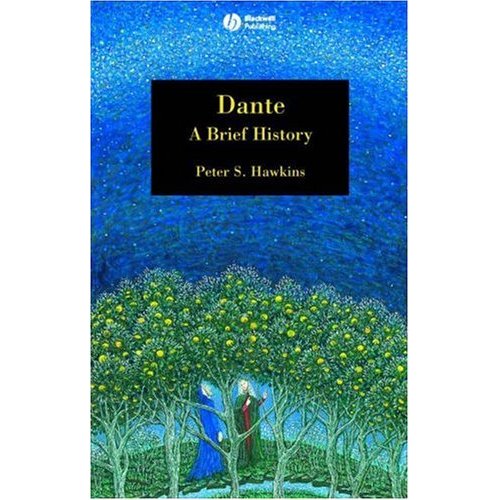
Peter S. Hawkins, Dante: A Brief History, Blackwell Brief Histories of Religion (Oxford: Blackwell, 2006)

Eagerly anticipated, Peter Hawkins' new Dante: A Brief History is a wonderful read. There are five chapters in all, 'Dante's Life and Works', 'Dante's Journey to God', 'Dante's Beatrice', 'Dante's Religion', and finally 'Dante's Afterlife'. Since Hawkins' principal interests in Dante have been from a theological perspective, teaching as he did for some time at the Yale Divinity School, and now directing the Luce Program in Scripture and the Literary Arts at Boston University, the book is very much a meditation as much as it is 'A Brief History'. It is not aimed at a Dante specialist, but rather at a reader interested in some of the 'big ideas' around Dante. So Hawkins returns again and again to the idea of Beatrice, what she means, how she is to be interpreted. Indeed his chapter 'Dante' Beatrice' is a powerful and very challenging reading of this difficult figure. And Hawkins is not content with the standard view of the Commedia, and it is this that is so refreshing about the book. In the prologue he recounts how he returned to his undergraduate copy of the Commedia, to the great crowning scene in Purg 27, only to find his youthful marginal comment: 'Yawn'. His reading was taken up with greater enthusiasm in graduate school and subsequently and Hawkins wonders how the Commedia turned from a Yawn to a Passion. Unembarrassed questioning is the hallmark of the book.

The chapter on 'Dante's Religion' is one of the most succinct and interesting treatments of the subject I've read in a long time. One might think that such a subject would be necessarily full of platitudes and truisms but much that is fresh is brought to his analysis of the 'personal faith story' in the Commedia as well as some wonderful pages on the many smiles of the poem (pp. 122-130, which readers will recognize as a sythesized treatment drawn from his recent PMLA article).

The final chapter is a gorgeous discussion of 'Dante's Afterlife', mainly concentrating on visual workings and reworkings of the poem. Nothing is out of bounds, nor too low-brow for discussion. It's all in the mix, and it's a great mix. We get Robert Mankoff's cartoons for the New Yorker discussed with Edward Frascino's, or the Dante's Inferno Hell Test you can do online, or William Blake beside the wonderful Botticelli's drawings. Especially interesting is the lengthy discussion of Sandow Birk, whose 'Puppet Movie' I hope to see soon, and Birk and Marcus Sanders' three volume 'translation' into California youth-speak. There is also much on Gary Panter's reworking of the story, especially his Jimbo in Purgatory. I really didn't know the work of these post-modern interpreters of Dante and I'm very glad to have done so. The chapter made me rethink some old divisions and boundaries between so-called high and low culture. For example, think of Dante's own re-writings of the Aeneid at the beginning of the Commedia, how it is at once a rewriting and a surpassing.

He made me really think again about the importance of parody, humour, and anachronism in 'reading' and 're-reading' texts. Look at the rather wonderful Geoffrey Chaucer Hath a Blog, for instance and think about how consonant it is with Chaucerian textual strategies, and the extremely interesting dynamic with the 'guest bloggers' Katherine Swynford and Sir John Mandeville. Think about the way that the paratexte is nothing if not a polyphony of voices around the text, an interaction, a reading, a misreading, and think about the way many medieval commentaries and glosses are just like medieval blogs. The blog page sends you to links of other blogs, but also to other more general websites. And the links themselves are clever, like the link to the 'New Me Society'. Quotes, pointing hands, notae, page numbers, all occur in the margins, all direct your attention to somewhere else, all invite you to reread, to rethink.

It's fair to say that Dante: A Brief History got me thinking and rethinking. It's a significant contribution to recent criticism and will be enjoyed widely. Read it.

LinkWithin

Related Posts Plugin for WordPress, Blogger...