Thursday, 22 June 2006

In Our Time: The Spanish Inquisition


Listen to Melvyn Bragg's In Our Time on The Spanish Inquisition, with John Edwards (Emeritus Fellow in Spanish, The Queen's College, Oxford), Alexander Murray (Emeritus Fellow in History, University College, Oxford) and Michael Alpert (Emeritus Professor in Modern and Contemporary History of Spain, University of Westminister). Very enjoyable.

Wednesday, 21 June 2006

The Paston Letters


BBC Radio 4 Women's Hour Drama has adapted The Paston Letters and is broadcasting it all this week. Norman Davis' edition, first published in the 1970s, has been republished by the Early English Text Society in two volumes. The Paston Letters span 1422-1509 and are a treasure trove of detail about life in a medieval family.

Tuesday, 6 June 2006

Rhabdomancer


In these days of hose-pipe bans this is appropriate. I just want to tell you about this word.

I have been reading Emilio Pasquini, Dante e le figure del vero: la fabbrica della Commedia (Milan: Mondadori, 2001), and he used the word rabdomantico. The word means a diviner, or more specifically a water diviner (or a dowser, as they are also known).

It comes from the Greek ῥαβδομαντεία, f. ῥἁβδος meaning 'rod', and μαντεία meaning 'divination, prophetic power'. Someone who practises this is called a rhabdomancer. P. G. W. Glare (in the Oxford Latin Dictionary) records the word rhabdos ~i, f. A rod-shaped phenomenon allied to a rainbow. ~os..generis eiusdem ad uirgae rigorem perlongum colorata nubecula dicitur, Apul. Mun. 16.

Monday, 29 May 2006

Sylvia Huot, From Song to Book (Cornell UP, 1987)


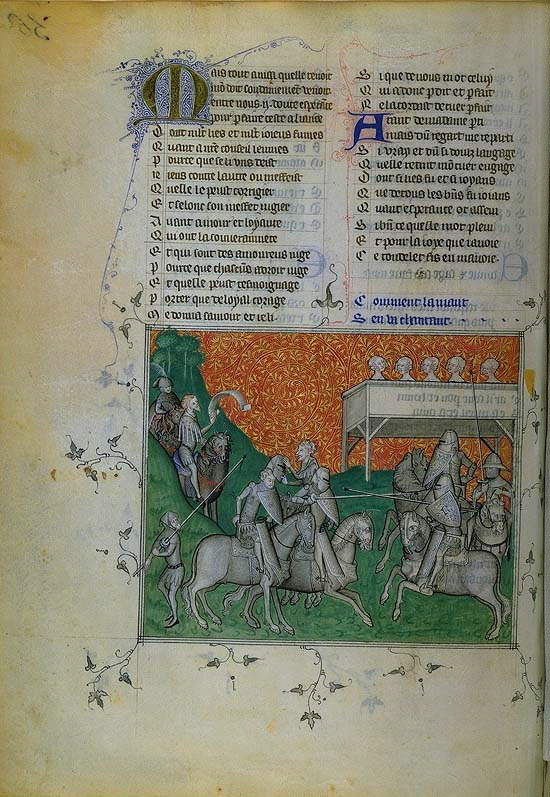
Sylvia Huot's 1987 From Song to Book: The Poetics of Writing in Old French Lyric and Lyrical Narrative Poetry is a stimulating study of the way that medieval French literature developed, during the late-thirteenth and fourteenth-century, a more acute sense of authorship, evinced, she argues, in the changing form of the vernacular codex. The author has clearly a wide knowledge of medieval French manuscripts, especially of the Roman de la Rose. Indeed the RR, she argues, is the great presence throughout the period, providing a model for how poetry can be constructed and how multiple authorship is inscribed and theorized. The crucial mid-point is a fault line where Guillaume de Lorris takes up the continuation of the allegory, changing its focus, and incorporating new themes while weaving together that which has already been written. The idea of the continuation is also explored, as a readerly and writerly response. Think, for example, of the Response to Richard de Founival's Li Bestiaires d'amours, especially the gendered voicing: the response is in the voice of a woman, though that does not necessarily mean that the author was female.

The most interesting part of the book is the third part, "Lyricism and the Book in the Fourteenth Century", which deals with the rise of the single-author codex, especially in the work of Machaut and Froissart. The former provides an especially vivid instantiation of the new sense of authorship in the period and the sense of the control and interaction between the writer and the reader. The book traces the development of a "writerly poetics of courtly lyric and lyric narrative" (p. 329), and it is extremely competent, stimulating, and will strike so many chords to anyone who reads Chaucer, for example. A great companion volume to this book, which I am reading too, is Kevin Brownlee's Poetic Identity in Guillaume de Machaut (Wisconsin UP, 1984). Brownlee is a brilliant scholar and this book is a tour-de-force. Important things happen in France in the fourteenth-century and the direction of English poetry in the period is completely alive to it.

Wednesday, 24 May 2006

Katherine H. Tachau, "God's Compas and Vana Curiositas", Art Bulletin 80 (1998), 7-33


Somehow it seems unconventional to review an article but some articles are really every bit as stimulating and informative as plenty of books around now, so I've decided to review briefly Katherine H. Tachau's wonderful article entitled "God's Compass and Vana Curiositas: Scientific Study in the Old French Bible Moralisée", Art Bulletin 80 (1998), 7-33.

Her view is that the Bibles moralisées appeared during a time of intense intellectual ferment in Paris at the beginning of the thirteenth century, and that to some (like Peter the Chanter), this appeared as an age of spiritual crisis. Her view is that "as a genre, the Bibles moralisées were created, affected, even motivated, by scholarly clergy who shared the latter Weltanschauung, and that they designed the Bibles moralisées to instruct not other scholars but royalty, especially the French kings" (p. 7). The article proceeds to read several fascinating folia of some thirteenth-century Bibles moralisées and discusses, in particlar, the way that pagan Eastern thought was represented in the form of astrologers, and are constantly seen as challenging and encroaching upon the divine sciences. The mechanism of reading these double images is fascinating, with the unmoralized 'original' representation sitting in a roundel above its moralized version, all sitting beside the text. Learning how to read these images is, in a very real way, learning how to read many medieval texts. She concludes: "Seen in that early thirteenth-century Parisian context, the depiction of the compass-wielding God in the first image of the Old French Bible moralisée would not have conveyed to its educated or royal viewers any approbation of the scientific study of the material world. Rather, the painting voices first of all the biblical exegetes' conviction that only God - not astronomers or philosophers - encompasses the entire created order" (p. 27). There is much else to be said about this learned article, but let your own curiosity dictate some attention to it. You will not regret it.

Tuesday, 16 May 2006

Alice Oswald, Woods etc. (Faber, 2005)


There's some great poetry around these days. I am not going to review Seamus Heaney's District and Circle. He has said that he feels like an over-ploughed field, so my own words would do nothing to help that. There are very learned reviews elsewhere doing better jobs than I could. I read District and Circle on Easter Sunday morning as the sun shone full on my face. It is a beautiful collection and was like listening to a childhood relative use words I had long forgotten.

Alice Oswald's third collection of poetry is entitled Woods etc. and is a stunning work. Her second volume, Dart, made her a well-known figure, with a long single poem following a river. These poems are about what she sees around her in her home in Devon, the elemental images of the earth, the moon, water, stones. Such things. Her ancestor is very definitely Ted Hughes, but they are very different. There is something less physically robust about them and at the same time they are more physically sensitive. I hardly know which poem to reproduce here, each time I read it I want to put a different one down here. This poem is the title poem in the collection, 'Woods etc.':

footfall, which is a means so steady
and in small sections wanders through the mind
unnoticed, because it beats constantly,
sweeping together the loose tacks of sound

I remember walking once into increasing
woods, my hearing like a widening wound.
first your voice and then the rustling ceasing.
the last glow of rain dead in the ground

that my feet kept time with the sun's imaginary
changing position, hoping it would rise
suddenly from scattered parts of my body
into the upturned apses of my eyes.

no clearing in that quiet, no change at all.
in my throat the little mercury line
that regulates my speech began to fall
rapidly the endless length of my spine.

Thursday, 11 May 2006

Manuele Gragnolati, Experiencing the Afterlife (U. of Notre Dame Press, 2005)


Manuele Gragnolati's book Experiencing the Afterlife: Soul and Body in Dante and Medieval Culture is the seventh volume in 'The William and Katherine Devers Series in Dante Studies' published by the University of Notre Dame Press. It is an extremely interesting read and comes highly highly recommended. Based on the author's Ph.D. thesis at Columbia (1999, sup. Barolini), the book looks at concepts of pain and suffering in the thirteenth century and how these were incorporated into the notion of Purgatory by Dante. Exactly how do the damned in Hell, and the souls in Purgatory suffer and how does corporeality (and lack therof) affect this suffering? G. looks at Bonvesin de la Riva's Book of the Three Scriptures and argues that the second Red Scripture provides a conceptual model of experiencing the suffering of the Passion that is analogous to the kind of experiencing of suffering the souls undergo in Purgatory. He also argues that Dante's embryological theories, outlined by Statius in Purg. 25 is a (poetic) sythesis of competing theoretical positions on the formation of the soul, form plurality of forms (Bonaventure, Bacon et al.) to unicity (Albert, Thomas, et al.). He asserts that Dante 'plays with the ambiguity within unicity of form's understanding of the soul, but also that he vacilates between the principles of unicity and plurality, arriving at his own original position on personhood, which allows for the perseverance of identity in the afterlife and at the same time maintains the significance of the body materiality' (p. 87). These are important points and provide important philosophical and theological reasons for why the body's materiality is so interesting in the Comedy. G. argues in addition that, in consonance with much Northern Italian eschological writings, the resurrection of the body was seen as a fundamental part of death, that everything that happens after one dies is merely a process until the soul is reunited with the body on the Day of Judgment. These are powerful considering when reading Dante's experience of the afterlife, for he is experiencing it as no-one else is, both in body and soul.
There is much more to say about this book, such as the re-focussing on those aspects of Dante that are indebted to rich veins of popular medieval culture, largely ignored by the critics who sought to place him in a highly Scholastic and learned tradition. This is a very enjoyable book, it is clear, concise, and argued with assurance.

The book has also got me thinking about Eleonore Stump's lectures here in Schools on Evil and Suffering, on the different kinds of pain, on the evil of suffering (or not), and Thomas Aquinas' definition of love.

Friday, 5 May 2006

Studies in the Age of Bargains!


I try not to gloat but sometimes a little piece of luck comes my way and I find a bargain that is just too joyous to be quiet about. The other day I went into the Mind bookshop on Walton Street and found Vols. 1-22 of Studies in the Age of Chaucer, a find that I really never thought would happen. I got it for a super price too. I don't know how many articles I have photocopied over the years from this journal, or which I have promised to go back to read again in the library, and now I can (not) read them on my very own shelf. I am also a member of the New Chaucer Society and so have the newer numbers of SAC, so do not have many to make up the complete set (23-25, if anyone's offering!). Sheer joy.
I also picked up a copy, in Jericho Books, of Rewriting Chaucer: Culture, Authority, and the Idea of the Authentic Text, 1400-1602, ed. by Thomas A. Prendergast and Barbara Kline (Columbus, OH: Ohio State University Press, 1999), also for a bit of a bargain (£4.50!). There are quite a number of interesting articles in this collection, dealing with the very important issue of what the early scribes did to Chaucer, how that was dealt with by the earliest printers (who sometimes had access to manuscripts that are no longer extant, Caxton for example), and how they interacted. The freedom scribes felt, and the very different concepts of 'authenticity' that circulated in the period, all create hugely complex problems for modern editors and readers of Chaucer's work, problems that are unlikely to be solved any time soon. At least that is until someone finds a holograph copy of the complete works of Chaucer. What's the alternative, then? Read Chaucer from transcriptions of Hg, or El, or in parallel texts like the Chaucer Society publications done by Furnivall? Or on CD-ROM facsimiles with hypertext links to other readings? The Riverside Chaucer in this scenario would become obsolete and students would read from their computers and turn the leaves of digital manuscripts. But editing will still be required, presumably. So what kind? And, if the Variorum Chaucer really is so methodologically flawed as everyone says then will Kane's principles be expanded (exemplified in his Piers Plowman edition) and applied to Chaucer? And who will that be?

Monday, 1 May 2006

Happy Birthday Blog


I am one today! Happy Birthday Me. This blog was started on this day exactly twelve months ago. Aww. Thank you to my faithful and loyal readers, and here's to another year of interesting films, plays, books, and poems.

Monday, 24 April 2006

"I woke up and sighed: the world was Marian"


Uta Ranke-Heinemann is a German theologian who is most famous for being the first woman to gain a chair in theology at the University of Essen, and the first to lose it after denying the virgin birth and was excommunicated in 1987. She is most famous in the English-speaking world for her wonderful book Eunuchs for the Kingdom of Heaven.
In an interview last year she talked about her admiration for Ratzinger's intelligence and compared it unfavourably with JPII. "The enormous difference between John Paul II and Ratzinger is intelligence. Ratzinger is more, much more, intelligent. Quite frankly, John Paul II was tedious without end. I couldn’t stand it any more. He was obsessed with Mary. “Mary, Mary, Mary,” he repeated over and over and over. I mean, I feel much for Mary myself, because she lost her son. But John Paul II said Mary was glad to see her son on the cross and that she would have put him there herself because it meant our salvation. I tell you, Ratzinger would not say such a stupid, horrible thing! No, he has much more taste than that. Ratzinger has much more of what the French call esprit de finesse. And John Paul II had none! ... At Munich, Ratzinger did his doctorate with professor Söhngen, and I did mine with professor Schmaus. This was in 1954—at the time of Pius XII’s dogma about Mary being received into heaven. Söhngen quoted Jerome who, around 400, said: “I woke up and sighed: the world was Arian.” (Arius was the great heretic who denied the divinity of Jesus.) And similarly, Söhngen said about Pius XII’s dogma, “I woke up and sighed: the world was Marian.” So, none of us, including Ratzinger, Söhngen’s main doctoral student, were excessive Marians." On the future of the Church she says: "I don’t see any future for a church in which all shepherds are men, and all women are sheep. How could that be a universal church? It’s a mutilated construct!...The church will continue as it always has. Ratzinger will not change 2,000 years of male domination. But perhaps he might make one tiny change for the better. He might permit the use of condoms in AIDS-ravaged Africa. Those women in Africa who are told by their priests that they will go to hell if they use condoms—well, those women are told they're the martyrs of this millennium!"

Sunday, 23 April 2006

Inside Man (2006), dir. Spike Lee


Clive Owen plays Dalton Russell, who explains to us in the opening shot that he has planned the perfect bank robbery. The film then proceeds to show the heist in progress, and the efforts of Det. Keith Frazier (Denzel Washington) to get the hostages being held in the bank out alive and getting the case wrapped up. When the four robbers seal off the bank and begin the robbery they make everyone take off their clothing and get into dark jumpsuits, white masks, and blindfolds; they are dressed just like the robbers. From here on it is very difficult to tell the good guys from the bad guys, and that is a key theme in the film. Russell isn't an evil criminal mastermind, he's got a point to make, and it isn't about holding hostages or hurting them, or about robbing millions of dollars from the bank. There is a funny scene where a little black kid is playing with a Sony PSP and explains to Dalton the object of the game (kill people, put grenades in their mouths, sell crack to them, rape people, the usual thing an 8-year-old should be playing, in sum). Dalton shakes his head and says he'll have to talk to his father about this game. He's disgusted with the violence. Along comes the super powerdressed Madeline White (Jodie Foster, rather gingerly sporting an Hermès Birkin bag), who has been hired by the bank's owner, Arthur Case (Christopher Plummer) to make sure something in a safe deposit box never sees the light of day. It becomes clear that what's in the box interests Dalton too, and he's not willing to part with it just yet. In a bank full of money, the most important thing is an envelope documenting the origin of Case's money, Nazi loot. Can they manage to escape? And do we care?

I think that's my main gripe with the film. We don't care enough about the heist because the motivation is never properly developed. It is undoubtedly worthy, but many questions remain unanswered, and the main one is 'Why does Dalton do it?'. Lee is making us work for it in the film, but in a way we do need certain assurances that are not forthcoming. The film left me oddly dissatisfied. The film is well made, assuredly directed, and the acting is all very solid. There are plenty of nice parallel scenes set up in the film: Frazier can't afford a diamond ring for his girlfriend, the only real piece of evidence left at the scene is a Cartier diamond ring. And with a Spike Lee film you expect some angry political angle. It is there but you have to dig a little for it. It is a very post-9/11 film in this sense. One of the bank clerks who is released is being told to kneel (the cops think he's booby trapped) and when he takes his mask off one of the police officers says 'Oh shit he's a fuckin Arab', meaning 'of course he's wired up to explode'. The man is a Sikh. But the friend of the Nazis Arthur Case is paralleled rather nicely with the shady Birkin-toting Madeline, who blackmails Case to go referee on a purchase deal of property on Fifth Avenue by the nephew of Osama Bin Ladin. The implication is clear: Al-Qaeda are the Nazis of today, and the people we describe as war criminals are the same people who today make money in bed with those who wish to destroy Western civilization; they are perfectly respectable, they are pillars of society, who do lots of worthy and laudable things for people in need. But in fifty years, when the atrocities have been raked over, they will be called war criminals too; and others will have stepped in to take their place. Case says, I saw a chance to make money and I took it; Madeline is just the same. There are many who should be uncomfortable with these sentiments.

Saturday, 22 April 2006

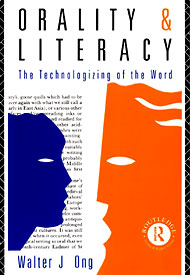
Walter J Ong, Orality and Literacy (Routledge, 1982)


Ong's Orality and Literacy is a classic of its kind. A kind of response to Marshall McLuhan ('The medium is the message' and all that) and an extended discussion of what Orality and Literacy actually means. The book also refers briefly to Derrida et al., but clearly isn't going to go into it. Ong is mainly interested in what he calls primary orality, meaning communities who have no contact with the written word whatsoever. Such communities must surely be hard to find now, and indeed in much of his discussion anything after oral Plato is not quite in this category of orality. Even the so-called primitive society (the kind of stuff Lévi-Strauss ran around looking for), I wonder if they really fit in. Is there really any such thing as primary orality?

His discussion of the changes in literacy and orality in the move between manuscript and print is interesting, though I do wonder a bit about his presentation of manuscript production, and the whole notion that manuscripts were so difficult to read printing really had to be invented. Well, they might look difficult to read by comparison to print, but when there's nothing else, then they are not difficult to read. They just are. Ok, there are cases where scribes copying abbreviations can make mistakes, but that does not mean they found them difficult, it means they are human and make mistakes. Books are often spotted with typos, which doesn't mean that books are hard to read. The restricted access to books in a manuscript culture is a complex phenomenon, and manuscripts cannot be 'blamed' for the fact that they don't look like printed books.

Tuesday, 11 April 2006

A.C. Spearing, Textual Subjectivity (OUP, 2005)


Anyone familiar with Spearing's recent work will, in a way, have seen this book being born. His article on the Man of Law's Tale (NLH 32 [2001], 715-46) in particular will show a fault line of the polemics of the book. Why do we need all these narrators in Chaucer's work? Spearing says that it's a notion that was developed with Kittredge and has stuck fast since; if we have a problem with a tale, we generally attribute it to the narrator. If, on the other hand, we like something in the tale then we attribute it to Chaucer. The proliferation of narrators is unnecessary according to Spearing. In an opening chapter, entitled 'Subjectivity and Textuality' he outlines how he has come to this view, mainly with recourse to Derrida. He uses Derrida's suspicion of Western phonocentrism and priviledging of the spoken word over the written word which has led to our multiplying narrators in the Tales: thus, we trust a narrator more because he is speaking, rather than allowing ourselves to trust the textuality of the poem.
There is an awful lot more I could say about this book. It is a good book, and I recommend it. I do, however, have some problems with it. For all his talk about textuality, his attention in the analysis of the Man of Law's Tale to its curious textual format in both the Hengwrt and Ellesmere manuscripts is too scant. The Tale is glossed in Hg and El, drawing material from Innocent III's De miseria condicionis humane, Ptolemy's Almagest, and Bernard Silvestris' Megacosmos. Robert Enzer Lewis has already demonstrated that these glosses are drawn from Chaucer's manuscript of the De miseria (see PMLA 81 [1966], 485-92 & SP 64 [1967], 1-16). OK. Now go somewhere with that. What's all this talk about textuality and then no talk about the manuscripts? He makes the point that Chaucer's texts are hugely self-conscious, and in a very physical way. This is true. He cites Cooper (Oxford Guide to Chaucer [2nd ed; 1996], p. 126) on the abundance of glosses supporting his claim that the Tale was seriously intended. Ok. Now what? On pp. 12-13 he cites Jeffrey Kittay ("Utterance Unmoored: The Changing Interpretation of the Act of Writing in the European Middle Ages", Language in Society, 17 [1988], 209-30) who highlights the changes in the format of manuscript pages, in particular word division, and biblical glossing where reference is made to numbered passages rather than cited passages (indicating readers flicked back and forth to texts); this is all to talk about a developing textual awareness and increasing sense of textuality. "The implications of this fact for the elements of commentary and self-glossing in medieval poetry are obviously important (see Rouse and Rouse 1982)". And that's it. What? The Statim invenire article is very important, but it's one and only one starting point of a huge point that shouldn't be left hanging like that. Reynolds, Stillinger, Minnis' new stuff (Magister amoris for example), everything Ralph Hanna has written [not cited BTW], and a whole shed load more are just screaming out after this full stop for attention. It is like he has made an excellent point but then has done nothing with it, and indeed the flatness of the subsequent reading of the MLT is a good case in point.

Final word: very stimulating book with some huge gaping holes.

Friday, 7 April 2006

Death & Resurrection: Aspects and Approaches, Lincoln College Oxford


Roll Up Roll Up! Yes, it's that time of year again. The Second Annual Oxford Graduate Medieval Conference will take place next week, Wednesday and Thursday, April 12th and 13th, 2006 on the theme of Death and Resurrection: Aspects and Approaches. The following papers will be delivered:
Christine Maddern (York): Early Medieval Name-Stones as Manuscript Pages; Richard Burian (Glasgow): Wyrd as Death?; Sarah Baccianti (Lausanne): Dead Man Talking, or When Dead Bodies Talk and Move in Grænlendinga saga and Eriks saga rauða; Beth Tovey (Somerville): Sexuality and Dying Bodies in Anglo-Saxon Literature; Alexander Ibarz (Sheffield): Ausiàs March (1400-1459): From Plague to Civil War; Darragh Greene (TCD): 'Let by your sorwful lyf, | For in your sorwe ther lyth no red': From Disorganization and Despair towards Reorganization in the Book of the Duchess; Anna Welch (Melbourne Coll. of Divinity): 'Sister Death': The Influence of St Francis' Attitude Towards Death and Resurrection on the Crucifixion Scene of the Codex Sancti Paschalis; Will Rossiter (Liverpool): Roma/Amor: Petrarchan Necromancy and Necrophilia; Marco Nievergelt (Lincoln): Allegorical Discernment and the Death of the Body: Deguileville's Pèlerinage de la vie humaine; Cecilia Hatt (St Hilda's): Goodbye Vienna: Learning to Die and Measure for Measure; Michael Funk Deckard (Leuven): Fear of Death and the Sublime in John Milton and Edmund Burke.
Professors Vincent Gillespie (LMH) and Eric Stanley (Pembroke) will open and close the conference, and chairs include Paul Strohm (Columbia), Mary Carruthers (Balliol/NYU), and Richard Rowley (Linacre).
And all this just before Easter!

Thursday, 6 April 2006

R. Howard Bloch, Etymologies and Athropologies (U. Chicago Press, 1983)


R. Howard Bloch's Etymologies and Genealogies is an exploration of medieval French literature on the crest of the wave of mainly French theoretical work in the two decades from the Sixties onwards. Derrida, Saussure, Lévi-Strauss, Barthes, de Certeau, are all names that loom large. Bloch takes a central theme and preoccupation in the French Middle Ages, that of lineage, and extends it to an examination of grammar and literature, to ideas of kinship, romance and lyric. And much more.

The book is very interesting and quite a challenging read, and is a good example of a heavy hitting theorist writing about the Middle Ages. I'm not sure whether he's made me rethink anything, but I did take the book seriously as I read it. So that's something. The prose is a little impenetrable at times and might have done with a little clarifying here and there. Anyway, most books of this kind are rubbish (frankly), but I don't think this one is.

Thursday, 30 March 2006

John McGahern


John McGahern passed away in the Mater Hospital in Dublin today.


manibus date lilia plenis

Read this

Wednesday, 22 March 2006

Arthur Miller, Resurrection Blues dir. Altman (The Old Vic, London)


Arthur Miller's penultimate play, Resurrection Blues, is having its European premiere at the Old Vic in London. The stars have been assembled (James Fox, Neve Campbell, Matthew Modine...) and Robert Altman directs. It's a recipe not only for a hit but also for some great theatre. And yet one is left with a curious feeling of having fallen victim to a huge hoax. This play is so awful that I cannot believe that a) Miller (whom I love) wrote it, b) Altman (whom I love) directed it, or c) that any of the actors have ever stood on stage before. The whole thing really is that bad. It's clear that Miller is angry (Corporate America blah blah blah) but the anger has been diffused throughout all the characters so that it becomes a malaise; the humour is so misguided that there are moments in the play when one would think a panto was being performed.
The military dictator/leader of an unnamed South American country has sold the rights to broadcast the execution (a crucifixion) of a revolutionary by an American media corporation. The broadcast's director has scruples about what's being done and try to persuade the dictator not to go through with it. Meanwhile, the dictator's brother has returned from study exile (he was a pharmaceutical mogul) to plead for this revolutionary's case. The people of this country begin to believe this revolutionary is God. So the play is about how people are oppressed, how they believe, how Corporate America doesn't understand such things and only understands money, how people need faith, and lots more.
In a way that's exactly the problem. There are far too many strands in the play for it to gel together. The cast is so lacklustre (I cannot remember one single line from the play) and the direction so flawed that I shall wait some time before I go back to the Old Vic. The whole thing is such a pity.

Saturday, 18 March 2006

Olivia Holmes, Assembling the Lyric Self (U Minnesota Press, 2000)


Olivia Holmes makes a powerful argument that some early French and Italian manuscripts display highly wrought self-conscious impulses to arrange and gather verse into authorial cycles, an impulse we more often associate with much later traditions, such as Dante's Vita Nova and more famously Petrarch's Rerum vulgarium fragmenta. In this she is largely successful, and makes for a very enjoyable read (I particularly enjoyed the chapter on Nicolò de' Rossi).

My criticism should not really detract from what has been achieved in the book. The novelty of Holmes' approach is that the texts under discussion do not come from critical editions but from manuscripts, which has the effect of creating a peculiar alterityabout some familiar texts. This is much to be praised. She discusses some rather well-known manuscripts, such as Modena, Biblioteca Estense e Universitaria α. R. 4. 4., and Chigiano L. VIII. 305, to name but two. The reason for a paucity of descriptive accounts of the manuscript's construction and planning is that these MSS have been described elsewhere, and indeed exist in facsimile (such as Chig. L. V. 176, Boccaccio's autograph no less). However, I feel that since she relies so heavily on the particularity of these examples, the best way to reinforce her observations is by making her reader very very aware of its physical format. We need to know things like collation, ink, parchment, scripts: has the manuscript been put together over a period of time or does it look like it was produced in one coherent block? What evidence is there of ownership? How many scribes worked on it? Do they look professional? How formal is the manuscript? What does its format suggest about the book's use? In sum, it is not enough just to cite from manuscripts, but you've got to give a voice to the physical manuscript itself to really appreciate all that manuscripts have to offer.

Tuesday, 14 March 2006

Sunday, 12 March 2006

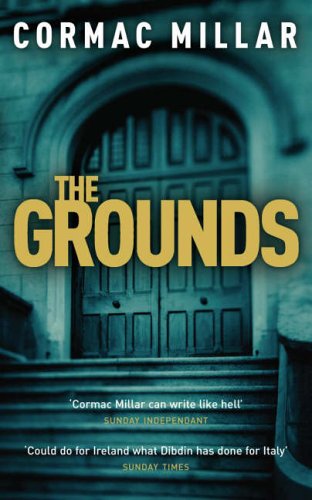
Cormac Millar, The Grounds (Penguin, 2006)


First of all, I feel it is only fair to say that I know Cormac Millar. He teaches Italian, as Cormac Ó Cuilleanáin, at Trinity College Dublin, where, for his sins, he taught me. He is a man of uncommon erudition, of intellectual humanism, and wicked generous wit. I say this because these are attributes that glitter and coruscate throughout The Grounds, his second novel. Millar has certainly raised his game from the first - very enjoyable - novel, An Irish Solution (Penguin, 2005), and the prose has levelled off at a cruising altitude that is both satisfying and challenging. The book just sparkles, it really does; this short review can not do justice to this complex and exciting work.

Séamus Joyce returns to his alma mater, King's College Dublin, to report back to an American university consortium on its suitability for investment. The academics, for a host of different reasons, all look on Joyce with suspicion and alarm. Things get sticky when the college president is found murdered and it looks like he himself is being framed for the delitto. What does it have to do with the painful and seemingly pointless changes being proposed for the venerable institution? And what has happened to a senior historian, whose research assistant's body was found washed up? Can all these deaths be related? But how? We meet a host of academic types who all expend vast energy sniping at each other in a wildy enjoyable manner. There is a property developer who has virtually bought the campus and is busily building apartments everywhere, and there is Séamus's ex-girlfriend, now a junior academic at King's, who is behaving oddly and doesn't have a permanent job! All is not as it appears, even at second glance, at King's College.

Cormac Millar's mother was the distinguished Irish writer Eilís Dillon, and the mise-en-scène of The Grounds is drawn from her 1956 novel Death in the Quadrangle (Faber). As such we are dealing with no ordinary crime novel, but rather a complex, intertextual and extratextual, literary work. This dimension only adds to the internal literary complexity of the book. And of course while the author assures us in a note at the end of the novel that this is not a roman à clef, one cannot resist wondering just how resonant it is with current business plans to keep Trinity College floating with its head just above water. Humanism does not fit well into business plans, it doesn't have a heading of its own, it cannot be poked and prodded, and it cannot be patented. It just won't do.

Sit back and enjoy this funny and clever novel from a powerful new voice in Irish crime fiction. You won't regret it.

LinkWithin

Related Posts Plugin for WordPress, Blogger...